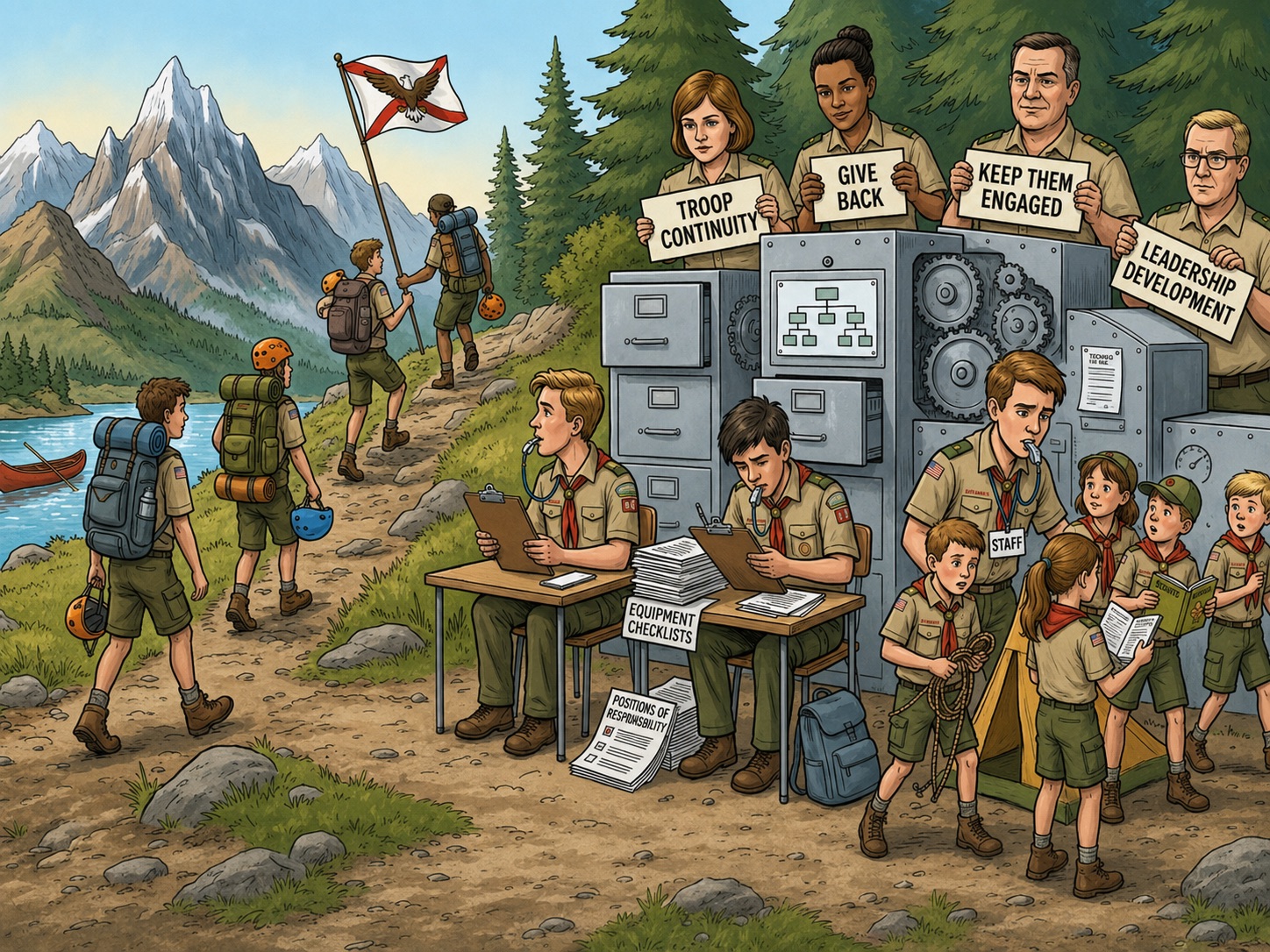
Scouts BSA is a program for ages 10-17.1 That age span is the problem.
The lived experience is a middle-school program that traps high schoolers, then asks them to supervise the middle schoolers. That is a babysitting program decorated with leadership language.
High schoolers are simply unpaid staff for the middle-school program.
Series note: This is the last part of a series on how BSA’s gold loopers stole the patrol method, replacing it with a corporate-bureaucracy simulation.
Part 1: The patrol method is not a youth bureaucracy
Part 2: How the troop bureaucracy acquired a leadership theory
Part 3: How troop positions of responsibility steal patrol ownership
Part 4: Adults must stop hiding behind youth offices
Mixed-age patrols expose the contradiction
The tension appears in BSA’s own troop-structure guidance, where gold loopers speak out of both sides of their mouth regarding mixed-age patrols. That is where a 10-year-old and a 17-year-old are peers in the same patrol.
BSA’s online documentation presents mixed-age patrols favorably, falsely claiming it is the historical model2 and placing them first in a list, without qualification.3 The adult-leader guidebook praises the same model, presenting it as the historical approach that has “several advantages”.4
But then gold loopers’ literature admits the problem: 10-year-olds and 17-year-olds have little in common.5 It offers new-Scout, regular, and older-Scout patrols as a “better approach”.6
More broadly, this is about the program, not just the patrols. The three-tier patrol scheme is still part of a culture that traps high schoolers in the middle-school program to serve as unpaid staff.
Gold loopers have long known that high schoolers need something different. The 1938 Guide Book of Senior Scouting admits this, calling it “one fact that we cannot escape” that a high schooler’s needs differ from those of younger youth.7
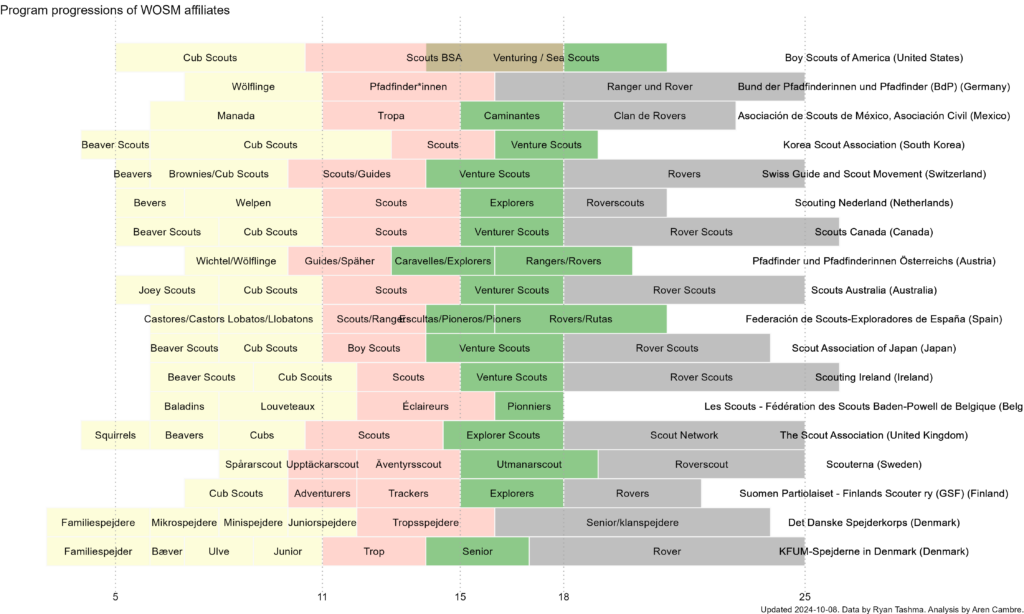
Today, BSA is alone among its international peers, still trapping high schoolers in a middle-school program:
The troop converts high schoolers into staff
Many troops fill troop-level titled roles with high schoolers. Not always, but commonly enough that the pattern matters. High schoolers are routinely called out to operate the bureaucracy that keeps the middle schoolers in line. Even when placed in their own patrol, even without a titled role, high schoolers are still pulled toward troop-level instruction and supervision, especially of the youngest youth.
That is babysitting.
The since-abandoned Leadership Corps admits to this logic. The 1981 Scoutmaster Handbook described it as a troop structure for 14- and 15-year-old troop-level bureaucrats. The theory is that it would also allow them some activities of their own, holding their interest in Scouting while providing “leadership” services for the troop.8
Strip away the vocabulary and the bargain is obvious: high schoolers remain in a middle-school program to provide babysitting services, with occasional chances at age-appropriate programming on the side.
Middle schoolers and high schoolers both lose
Middle schoolers lose first because the staffing model displaces patrol ownership. They get a program mediated through high-school instruction and crowd control, rather than one centered on their own patrols and their own developmental needs.
High schoolers lose leadership development. Gold loopers often pretend that Scouts BSA can remain appropriate for high schoolers by giving them the corporate-bureaucracy simulation to operate. The bargain is blunt: stay in the middle-school program, hold an office, keep middle schoolers moving, and call that leadership.
Running a bureaucracy is not leadership. Fulfilling a check-boxed role, keeping eleven-year-olds in line, delivering concrete instructions to middle schoolers, and maintaining an adult-authored organization chart do not give high schoolers leadership experience. It just makes them bureaucrats.
Leadership is a mutual-influence process: earning trust, motivating skeptical peers, shaping a shared vision, and moving with people who can push back.
That leadership work is messy because peers are not subordinates. Crucial to leadership development is the give-and-take of similar-age peers: skepticism, disagreement, ambition, status, humor, resistance, and buy-in.
In cross-age interactions in a formal-supervision scheme, the age gap alone, plus how early adolescents still tend to be rather concrete and literal, create authority without before a word is even spoken. This displaces the social processes–the influence dynamic–that is table stakes to leadership. This is a supervision system, not leadership training.
Scouts BSA withholds genuine leadership development while praising high schoolers for supervising middle schoolers inside a tidy corporate-bureaucracy simulation.
The defenses fail
The defenses arrive in a familiar cluster. High schoolers should “give back”. Offices supposedly keep them engaged. The troop bureaucracy supposedly needs officeholders. Troops supposedly need high schoolers for continuity and expertise. High-school staffing is supposedly inherent to Scouting.
These claims sound practical until they are taken seriously.
“Giving back” is not a debt
“Giving back” as an institutional expectation seeks involuntary servitude while obscuring it with cheery language.
Help received as a middle schooler is not a labor debt. Scouting service is voluntary and generous, not a bill that comes due when the middle schoolers enter 9th grade.
No age band of Scouts owes anything to any other age band of Scouts.
“Keeping them engaged” is not a program
Gold loopers have long tried to use troop-level youth offices as a retention device.
Their 1938 Senior Scouting guide, even while providing excellent supports for why high schoolers should be in “Senior Scouting” programs, claimed that many high-school-aged Scouts found satisfaction in filling positions of responsibility.9 The 1959 Scoutmaster’s Handbook made the same workaround explicit, saying the Junior Assistant Scoutmaster office may “hold the interest of older boys”.10
Strip the cheery veneer and look at the blunt truth: Instead of moving high schoolers into an age-appropriate program with broader adventure and age-level peer experiences, gold loopers kept them tied to the middle-school program by handing them bureaucratic, titled roles.
“We need officeholders” is circular
The officeholder defense is circular. It says high schoolers must remain in Scouts BSA because the troop’s corporate-bureaucracy simulation must be staffed. This treats a need created by this bureaucracy as proof that high schoolers belong in the middle-school program.
A better answer is to stop clinging to myths, specifically that bureaucratic roles are the program or are essential to Scouting. The best answer is to restore the patrol method, abolishing all troop-level youth-staffed offices. The patrol method is not a troop-level bureaucracy!
“Troop continuity” is troop convenience
The continuity defense is troop convenience dressed up as youth development.
If meetings, campouts, and new-Scout instruction depend on high schoolers managing middle schoolers, that indicts the troop machinery. Adult leaders must handle troop-level continuity without turning high schoolers into staff, and patrols can still own their own activities.
“Expertise transfer” does not require a staffing class
The expertise-transfer defense has a narrow truth. A high schooler may choose to teach a skill or serve as a limited Guide (expanded below). That is voluntary service under adult guidance, not a condition of being in Scouting, not a reason to assign a whole age cohort to manage middle schoolers, not a reason to trap high schoolers in a middle-school program.
Adults have a duty of adult association. It’s what we signed up for, a part of being a direct-contact adult leader. Part of that duty is mentoring all youth directly, not hiding behind youth offices.
High-school staffing is not inherent to Scouting
The claim that high-school staffing is inherent to Scouting is absurd.
Baden-Powell did not want high schoolers trapped inside a middle-school program. After observing older youth leaving the program and noting substantial differences between older and younger youth, Baden-Powell recommended in 1918 that older youth have their own program that meets separately.11
Per the chart near the top of this article, BSA is the last of its international peer organizations to not adopt this 1918 vision. That 90% of BSA’s high schoolers linger in its middle-school program makes BSA an outlier.
A Guide is a compromise, not the cure
A Guide role may have a place as a compromise. I have argued elsewhere for creating Guides as a position of responsibility. The role must be created alongside the end of the babysitting regime, not as a new name for it.
A Guide must be voluntary, limited, adult-supervised, and available across programs: a youth, while active in an age-level program, may choose to serve a program for a younger age band.
That is not assigning a whole class of high schoolers to staff a middle-school program. A Guide is a service opportunity. It cannot be the theory of high-school membership.
To re-emphasize: Voluntary service is a non-negotiable aspect of the Guide role. If none of a community’s high schoolers are interested in being a Guide, then middle schoolers will exclusively receive adult mentorship. That’s fine. High-school staffing of a middle-school program is not essential to Scouting and must never be compelled.
The age-section prescription is simple
I have made the full age-section argument elsewhere: Scouts BSA is a middle-school program, early founders pointed toward differentiated programs, BSA’s international peers use differentiated age sections, and high schoolers belong in an age-level program.
The program-design prescription is summarized in the Move Forward: Save Scouting proposal: Scouts BSA will focus on grades 6-8. Youth in grades 9-12, including 18-year-old seniors12, should be in Venturing or Sea Scouts. Starting with high-school graduation, Venturers and Sea Scouts graduate to Rovers13, a worldwide program that gold loopers killed in the 1950s.
Shiny objects and older-Scout patrols are just pressure valves
Gold loopers’ literature calls the older-Scout patrol a safety valve.14 That safety valve leaves the faulty architecture intact: a ten-year-old and a seventeen-year-old do not need the same program, pace, or adult posture.
Gold loopers also create shiny objects that help sustain the staffing bargain: high adventure, paid camp staffing, and Order of the Arrow. The theory is these occasional escapes help keep high schoolers registered in the middle-school program.
While OA is a shiny object today, I have argued elsewhere that it must be retired.
High adventure and camp staffing are great. But once this occasional escape is completed, the high schooler returns to being infantilized, to babysitting duties in a troop.
The value of high adventure and camp staffing would increase if they were adjuncts to an actual high-school program, or to Rovers for high-school graduates. As substitutes for age-appropriate program design, they are diminished.
Admitting high-school disgust with the bargain
High schoolers are disgusted with the bargain. “Eagling out” is the common phenomenon where high schoolers, tired of babysitting chores and being infantilized in a middle-school program, head to the exit as they complete Eagle. Another common phenomenon is quiet quitting, where a high schooler reduces involvement or disappears while remaining on the roster, resurfacing only in time to knock out Eagle before turning 18. A third common phenomenon are high schoolers who have resigned themselves to their disgust of babysitting chores, showing up but clearly conflicted about why he’s there.
Conversations on this often turn to a “blame the unit-volunteer” ethic, a common, blame-shifting tactic of gold loopers to avoid accountability for their own incompetence.
BSA tacitly admits to this disgust. The following passage responds to that unstated frustration15:
You might think of Venturing and Sea Scouts as somewhat akin to the Scoutmasters’ lounge at summer camp: a place to renew and refresh before diving back into the work of leading a troop.
Here, BSA admits that high schoolers are tired of babysitting chores, frustrated with being infantilized in a middle-school program. That is why high schoolers would need to “renew and refresh”. The troop program no longer works for them! But instead of providing age-level program that meets their needs, the prescription is only a relief valve.
Also, this sentiment minimizes the high-school programs. Unlike Scouts BSA, they use the patrol method, and they support leadership development. Just as bullies target qualities in others they are jealous of, gold loopers representing the middle-school program snipe at the programs all high schoolers should be in.
End the staffing bargain
Today’s Scouts BSA program design induces a problem, then it calls management of that problem “leadership”.
For middle schoolers, good Scouting means patrols with ownership, mentored by adults. For high schoolers, it means an actual high-school program: Venturing or Sea Scouts.
The series ends where it began: the patrol method is not a youth bureaucracy. Restore patrol ownership, restore adult association, and move high schoolers into an age-appropriate program. The troop no longer needs high schoolers to staff a machine that should not exist.
However, if inaction remains the gold-looper playbook, then BSA should at least have the honesty to pay the babysitters.
Footnotes
- Scouts BSA: Frequently Asked Questions, Boy Scouts of America. ↩︎
- In the context of an ages 10-17 program–an 8 year age span–it is disingenuous to claim that mixed-age patrols are the historical approach, especially without qualification. In 1918, Scouting’s founder Robert Baden-Powell, after having gained considerable experience following his 1907 Brownsea Island experiment, recommended older youth be moved to their own program. Since then, all of BSA’s international peer Scouting organizations–UK, Australia, Mexico, Canada, Ireland, and many more–have fulfilled the founder’s vision vision. Generally, all their programs span only 3-4 years. Due to its intransigence on this, BSA is an outlier on the world stage. 3-4 year age spans map to common understandings of adolescent developmental stages. 8-year age spans combine considerably different developmental stages, an entirely different proposition. Cast more accurately, it is absurd to claim that mixed-age patrols in a program that spans 8 years is the historical approach. Rather, it is the approach of an organization beset by inertia and indifferent about the quality, effectiveness, and safety of the programs it designed. ↩︎
- Types of Patrols, Troop Leader Resources, Boy Scouts of America ↩︎
- Troop Leader Guidebook, Volume 1, Boy Scouts of America, 2018, p. 17. ↩︎
- Ibid., pp. 64-65. ↩︎
- Ibid., pp. 17-18. ↩︎
- Guide Book of Senior Scouting, Boy Scouts of America, 1938, p. 6. ↩︎
- Scoutmaster Handbook, Boy Scouts of America, 1981, pp. 63-65. ↩︎
- Boy Scouts of America, Guide Book of Senior Scouting, 1938, pp. 15-17. Note: This claim holds no water. Despite decades of this experiment—retaining high schoolers while trapping them in a middle-school program—no evidence exists that it has meaningfully improved older-youth retention. ↩︎
- Boy Scouts of America, Scoutmaster’s Handbook, Fifth Edition, 1959, p 53. ↩︎
- Provisional Rules for Rover-Scouts, 6th Edition, The Boy Scouts Association (UK), Sept. 1918, p. 5. ↩︎
- Current youth-protection standards must be changed to accommodate societal norms. 18-year-old high-school seniors must be treated the same as other high schoolers. For example, if an 18-year-old 12th grader wishes to buddy with a 16-year-old 11th-grade friend, that must not be prohibited. ↩︎
- Rovers is a young-adult program. Mapped to USA norms, Rovers would begin at high-school graduation. ↩︎
- Troop Leader Guidebook, Volume 1, Boy Scouts of America, 2018, p. 17. ↩︎
- Troop Leader Guidebook, Volume 2, Boy Scouts of America, 2018, p. 124. ↩︎


Leave a Reply