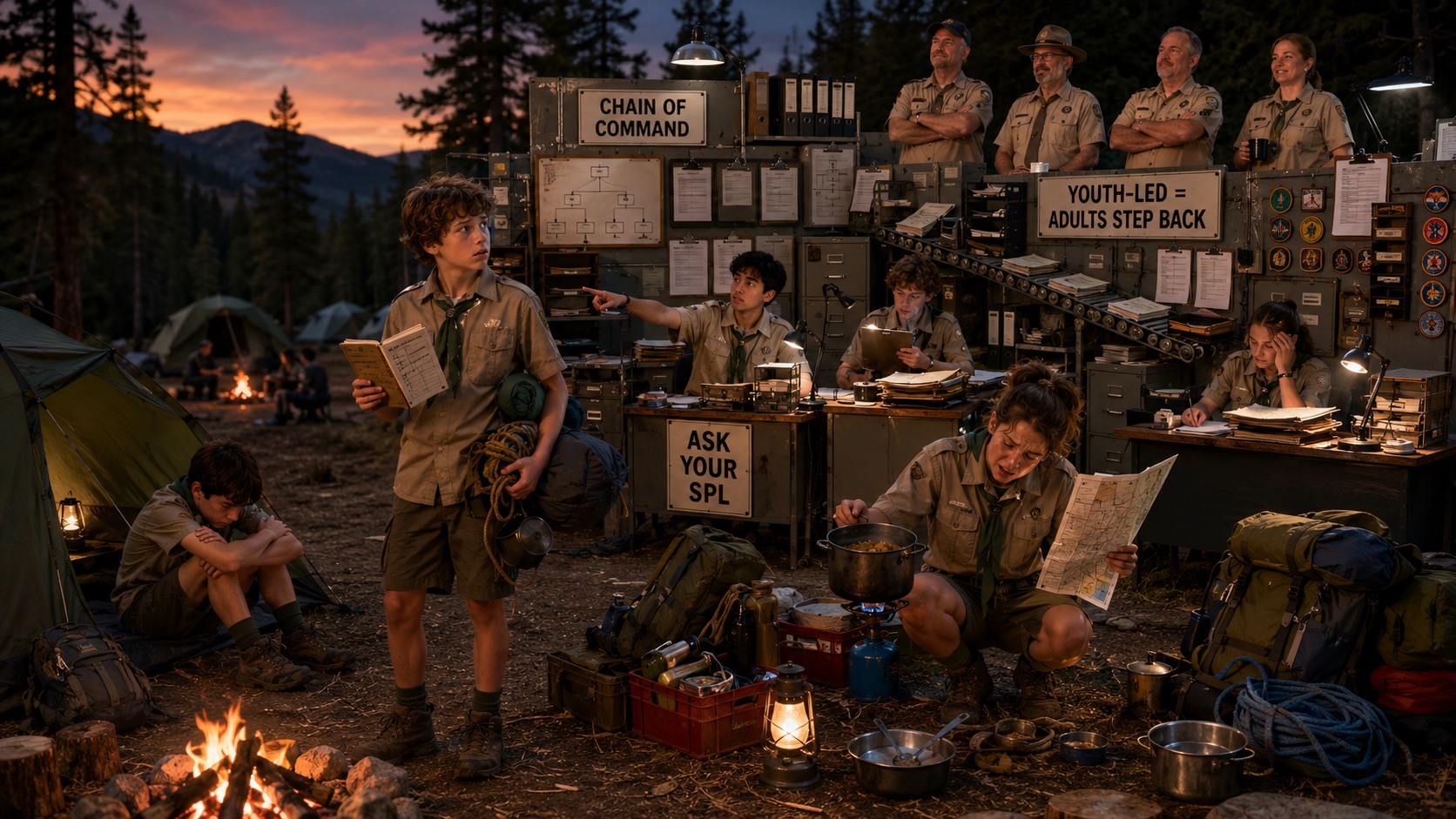
The Scouts BSA corporate-bureaucracy simulation displaced patrol ownership and gave adults a place to hide.
The phrase “Ask your SPL” is one symptom. In the culture of the middle-school program (Scouts BSA), it often means an adult has declined to mentor a child, instead routing the Scout into the youth-staffed, troop-office bureaucracy. Adult abdication gets dressed up as youth-led practice, then openly celebrated:
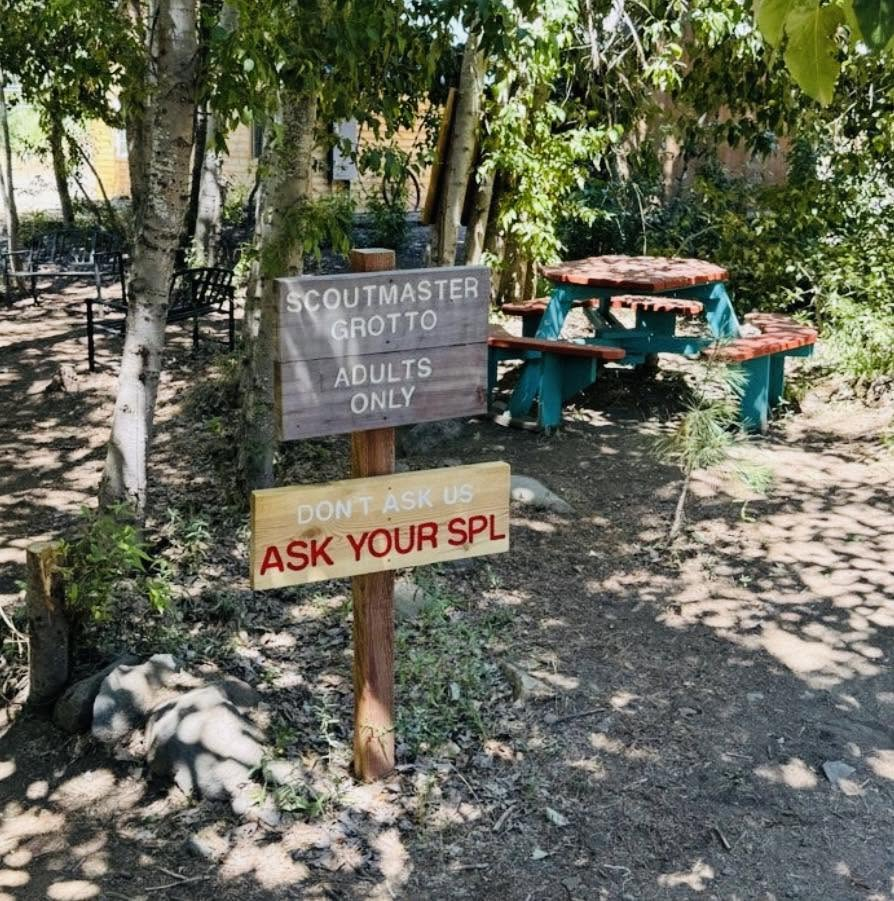
The adult-association method is core to Scouting. Adults cannot fulfill that method by withholding it. They must know Scouts and patrols directly.
Series note: This is part 4 of a five-part series on how BSA’s gold loopers stole the patrol method, replacing it with a corporate-bureaucracy simulation.
Part 1: The patrol method is not a youth bureaucracy
Part 2: How the troop bureaucracy acquired a leadership theory
Part 3: How troop positions of responsibility steal patrol ownership
Part 5: High schoolers are not troop staff
Adult association is not optional
Adult association must comply with BSA’s youth-safeguarding standards.1 Especially important is the “no one-on-one contact” rule, which must always be upheld.
“Association with Adults” is one of the methods of Scouts BSA. Youth learn by watching adult conduct and by having adult leaders who listen, encourage, and “take a sincere interest in them”.2
The current adult-leader guidebook contains adult-association language: adults should listen, encourage, challenge, guide, make themselves available on hikes and campouts, provide quiet support during patrol work, and strengthen mentoring relationships on outings.3
The trouble is the competing instruction. Through the same guidebook, gold loopers normalize a Scoutmaster “reced[ing] into the background” as the Senior Patrol Leader becomes “more effective”.4 In practice, that becomes a culture where adults hide behind troop-level youth offices and call their distance youth leadership.
Adult association is not a decoration added after “youth-led” has supposedly done the real work. It is core to how Scouting develops youth.
The danger used to be stated more plainly. The 1922 Handbook for Scoutmasters warned that when Scoutmasters lose personal touch with the youth, that may lead to military discipline and classroom methods. By 1981, the Scoutmaster Handbook still recognized that Scoutmaster conferences could build adult-Scout relationships, but it placed that relationship-building inside scheduled set-pieces. The old warning was about losing personal touch. The later structure made personal touch easier to isolate from ordinary troop life.5
As the corporate-bureaucracy simulation swallowed the Scouts BSA program, administration became the dominant concern, and adult association became easier to confine to scheduled moments while the daily life of the troop was routed through youth-staffed bureaucratic offices.
Association is relational, and administration is structural. This series opposes the second and pleads for the first.
Baden-Powell prescribed adult presence
Baden-Powell’s language was relational. BSA’s own curation of Baden-Powell quotations includes the idea that the Scoutmaster guides the boy in the spirit of an “older brother” and knows the boys well enough to understand them.6 This phrasing matters because of the posture behind it: adults close enough to know youth and guide them without taking over.
Elsewhere, Baden-Powell described Scouting as “a game for boys … in which elder brothers can give their younger brothers a healthy environment and encourage them to healthy activities such as will help them to develop.”7 By “elder brother”, Baden-Powell was referring to adults, not high-school substitutes.
Baden-Powell was describing adults close enough to know the youth, restrained enough not to commandeer their work, and mature enough to translate adult judgment into the language of youth. That posture leaves no room for adults standing at the back of the room while a high-school bureaucrat relays every meaningful interaction.
“Ask your SPL” is adult absence
In gold loopers’ corporate-bureaucracy simulation, “Ask your SPL” is the polite version of adult abdication.
A Scout confused about a Tenderfoot rank requirement should not be bounced through a teen chain of command. A homesick Scout should not be told to find the right youth manager. A patrol chef should not be unsupported when cooking the pancakes. A Patrol Leader who is overwhelmed should not be treated as if the only adult relationship available is a scheduled meeting with the Scoutmaster after the PLC. Yet that is the culture encouraged by the “Ask your SPL” retort.
The 1981 Scoutmaster Handbook made that posture sound normal. Its model of a good troop has the Scoutmaster away from the meeting while youth in bureaucratic roles run the operations: the Senior Patrol Leader runs the meeting, the Scribe keeps records, the Patrol Leaders’ Council plans, and Patrol Leaders keep order.8
The 1981 adult-leader handbook tells the Scoutmaster to work into the background and put the youth-staffed troop-office machinery into the foreground.9 The current adult-leader guidebook is mixed. It preserves some good adult-association language, but still puts adults inside a structure where youth bureaucrats—the SPL, Assistant SPL, youth offices, and PLC—carry the operating load.10 The result is not youth initiative, and it’s not leadership. It’s just youth operating a machine while adults admire their own absence.
Adults should know patrols directly
Another example of competing instruction in the adult-leader guidebook is how adults are encouraged to focus direct mentorship to the youth-office structure.11 If they do this, ordinary Scouts lose much direct adult association, Patrol Leaders are undermined as patrols lose adult focus, and the bureaucracy gains false moral authority. The previous article explains how unit adults inherited that self-reproducing machine.
Adults need a direct feel for patrol life: what each patrol is attempting, which Scouts are growing, which Scouts are isolated, which Patrol Leaders are earning trust, and which conflicts are ordinary friction rather than real harm.
Adults therefore have to tolerate some disorder. A patrol sorting through disagreement is not automatically a management failure. It may be the exact place where leadership is being learned. The adult task is to keep that space safe, humane, and developmental. That does not happen when the adult replaces association with a corporate-bureaucracy simulation, even though that bureaucracy looks cleaner from across the room.
Adults should mentor Patrol Leaders without converting them into middle managers. They should help a Patrol Leader ask better questions: What does your patrol want? Who is quiet? What are you worried about? What can you try before an adult steps in? What did you learn from the last failure?
Teen staff are not adult association
Cross-age help among youth can have value in narrow circumstances (see next section), that does not substitute for adults knowing and mentoring middle schoolers directly.
In the troop-office chain, high schoolers often become the adults’ front line: supervisors, instructors, and buffers between adults and middle schoolers.12 That turns teen help into a babysitting regime with leadership language painted on it.
The substitution damages both age groups. Middle schoolers lose the adult relationships that are core to Scouting. High schoolers lose the chance to pursue age-level adventure with peers because they are kept in the middle-school program as staff. The adult-association failure starts here: adults have handed off a method of Scouting to youth offices.
Middle schoolers especially need this distinction. Research on adolescent support notes that younger adolescents may report more support from parents and other adults compared to older adolescents.13 BSA has every reason to preserve intentional, non-parental adult association in Scouts BSA, a program whose developmental focus is middle school.
Cross-age mentoring must be adult-guided…
The cross-age mentoring research supports a narrow proposition: older youth can help middle schoolers when adults build and supervise the relationship. A meta-analysis of cross-age mentoring found positive effects, but the stronger programs had moderate or high adult oversight and supervision. That finding supports adult-guided help from older youth, not teen substitution.14
The comparison evidence is cautionary. In a review of Big Brothers Big Sisters school-based mentoring, high-school mentors supported by local BBBS agencies did not significantly improve many school-related measures compared with non-mentored youth. The broader BBBS comparison likewise found some relational advantages for older-peer mentoring, but weaker or absent results on misconduct, classroom effort, and academic competence. Adult mentoring may not win every comparison, but the research does not justify turning middle schoolers over to high schoolers.15
The program-design literature points the same direction. In this research, “peer” does not mean that a 17-year-old is an ordinary program peer of a 10-year-old. It means an older or more-experienced youth in a defined helping role with someone younger or less experienced. That role needs clear objectives, matching, training, monitoring, guidance, and evaluation. The National Mentoring Resource Center likewise treats cross-age mentoring as promising but only preliminarily backed by evidence, and it stresses adult guidance, training, and supervision.16
That structured mentoring model is different from ordinary Scouts BSA culture, where high schoolers are expected to manage middle schoolers as part of the troop machine, all the while pretending to be program peers to the middle schoolers, in an environment where adults are encouraged to keep their distance. The research can support approachable, adult-guided help from older youth. It does not validate BSA’s jumbled program design, where high schoolers are trapped in a program designed around the developmental stage of middle schoolers.
…but adult mentoring is good
The adult-mentoring evidence supplies the positive case for adult association. A meta-analysis associated natural adult mentoring with positive youth outcomes, especially when the relationship itself was high quality.17 A large meta-analysis of intergenerational youth mentoring programs likewise found statistically significant effects across youth outcomes.18 Other research on youth support systems describes supportive youth-adult relationships as sources of care, challenge, support, expanded possibility, and shared power.19
That evidence fits the ordinary advantages of adult maturity. Adults bring judgment, accountability, emotional range, and distance from the peer-status games that shape adolescence. That maturity lets them teach, protect, and interpret without asking high schoolers to impersonate adults.
Adult association fits the evidence. A troop culture built on teen substitution lacks that support.
The repair is active adult association
The repair is simple but not passive: adults in Scouts BSA should be close enough to know Scouts and restrained enough to let patrols own their work.
Adults can ask questions, teach skills, notice risk, and speak directly with Scouts without turning every problem into adult control. That is healthy adult partnership: direct, accountable, and respectful of patrol ownership.
What does that look like in practice? It looks ordinary, and it stays inside Scouting’s safeguards.
On a campout, an adult moves through the patrol sites and stops where a patrol is cooking. The adult asks how the meal is coming, watches a new Scout fumble the stove, and shows the fix directly rather than waiting for the SPL to be summoned. The adult notices a Scout sitting apart from the group and finds a reason to bring them back in. None of that requires a title, a scheduled meeting, or involvement of a troop-level youth bureaucrat.
A Scoutmaster conference unrelated to advancement is another channel, and it works when it is a conversation rather than a checklist, when it results in adult action and support instead of passive listening then forgetting. It may include asking what a Scout is enjoying, what is hard, and who they are becoming.
Sometimes direct association means visibly doing nothing: an adult watches a patrol argue its way through a bad plan, stays close enough to intervene if anyone is at risk, and lets the patrol own the outcome. Presence is not control. The adult who can stand near a struggling patrol without seizing the wheel is practicing adult association in its hardest form.
In each scene the adult is close, accountable, and visible, and in no scene is the patrol’s self-ownership challenged. The safeguards that govern adult-youth contact never required adult distance—only that adult presence be conducted in the open. Distance was never the rule. It became the habit years before safeguarding was even a thing in BSA.
Restoring adult association weakens the Scouts BSA troop-office machinery because that structure depends on adult distance. Once adults resume direct mentorship, troop-level youth-bureaucrat offices lose their borrowed moral authority.
Scouts BSA’s repair
A repaired Scouts BSA program would set aside the gold loopers’ corporate-bureaucracy simulation. It would be rebuilt around patrol ownership. Adults would be present. Youth would own real adventures. No high schooler would be asked to substitute for the adults Scouting promised would be there.
The next article follows the cost of that substitution for high schoolers themselves: deprived of age-level programming, most are trapped inside a middle-school program, then praised for operating the very bureaucracy that traps them there.
Footnotes
- Scouting’s Barriers to Abuse, Scouting America. ↩︎
- Scouts BSA: The Aims and Methods of Scouting, Boy Scouts of America. ↩︎
- Troop Leader Guidebook, Volume 1, Boy Scouts of America, 2018, pp. 15, 70, 127, 130. ↩︎
- Ibid., PDF p. 20. ↩︎
- Handbook for Scoutmasters, Second Edition, Boy Scouts of America, 1922, p. 16;The Official Scoutmaster Handbook, Seventh Edition, Boy Scouts of America, 1981, pp. 147-149. ↩︎
- Pearls of Wisdom – Quotes from Baden-Powell, Boy Scouts of America. ↩︎
- Robert Baden-Powell, Aids to Scoutmastership, 1944, p. 6. The elder-brother framing appears elsewhere in the book as well. ↩︎
- The Official Scoutmaster Handbook, Seventh Edition, Boy Scouts of America, 1981, p. 19. ↩︎
- Ibid., pp. 18-22. ↩︎
- Troop Leader Guidebook, Volume 1, Boy Scouts of America, 2018, pp. 85-88, 127. ↩︎
- Ibid., pp. 11, 69-72, 83-84. ↩︎
- For a BSA-hosted example of the chain-of-command posture, see Kip Krumwiede, “Lessons I Learned as a Scout Leader,” Boy Scouts of America, 2020, especially the section “Respecting the Chain of Command.” ↩︎
- Caroline L. Bokhorst, Sindy R. Sumpter, and P. Michiel Westenberg, “Social Support from Parents, Friends, Classmates, and Teachers in Children and Adolescents Aged 9 to 18 Years: Who Is Perceived as Most Supportive?”, Social Development, 2010. This is cited by and expanded on in Shannon M. Varga, Mark Vincent B. Yu, Haley E. Johnson, Valerie Futch Ehrlich, and Nancy L. Deutsch, “‘It’s going to help me in life‘: Forms, sources, and functions of social support for youth in natural mentoring relationships”, Journal of Community Psychology, 2023. ↩︎
- Samantha Burton, Elizabeth B. Raposa, Cyanea Y. S. Poon, Geert Jan J. M. Stams, and Jean Rhodes, Cross-age peer mentoring for youth: A meta-analysis, American Journal of Community Psychology 70 (2022): 211-227, PDF pp. 1-3, 9, 11. ↩︎
- Burton et al., Cross-age peer mentoring for youth: A meta-analysis, PDF pp. 2, 5. ↩︎
- Michael J. Karcher and Joshua R. M. Berger, One-to-One Cross-Age Peer Mentoring: National Mentoring Resource Center Model Review, National Mentoring Resource Center, September 2017; Linlin Luo and Heidrun Stoeger, Unlocking the transformative power of mentoring for youth development in communities, schools, and talent domains, Journal of Community Psychology 51 (2023): 3067-3082, PDF pp. 2, 7-10. ↩︎
- L. Van Dam, D. Smit, B. Wildschut, S. Branje, J. Rhodes, M. Assink, and G. Stams, Does Natural Mentoring Matter? A Multilevel Meta-analysis on the Association Between Natural Mentoring and Youth Outcomes, American Journal of Community Psychology, 2018. ↩︎
- Elizabeth B. Raposa et al., The Effects of Youth Mentoring Programs: A Meta-analysis of Outcome Studies, Journal of Youth and Adolescence, 2019. ↩︎
- Taylor N. Melton, Maya V. Brehm, and Nancy L. Deutsch, Broadening the perspective on youth’s systems of support: An ecological examination of supportive peer and adult relationships during adolescence, Journal of Community Psychology, 2021. ↩︎
Leave a Reply