The Scouts BSA corporate-bureaucracy simulation did not appear all at once. Gold loopers did this gradually. They built up the troop-office machinery, wired it into advancement, and then gave that machinery a faux leadership-development theory. In 1972, gold loopers used the Improved Scouting Program to validate their gradual creep and give it a curriculum.
The first article explained that the patrol method means self-governing patrols, not youth administration of a troop machine. This article presents the institutional history, how BSA’s gold loopers gradually stole the patrol method from our youth.
Series note: This is part two of a five-part series on how BSA’s gold loopers stole the patrol method, replacing it with a corporate-bureaucracy simulation. (The next articles will be published in a few days.)
Part 1: The patrol method is not a youth bureaucracy
Part 3: How troop positions of responsibility steal patrol ownership
Part 4: Adults must stop hiding behind youth offices
Part 5: High schoolers are not troop staff
The theft was gradual
Unit-level adults did not create the corporate-bureaucracy simulation. They inherited it from from gold loopers.
Gold loopers did not commit a single midnight theft. The records show no single heist. Instead, we see accretion, one handbook at a time.
A troop practicing the patrol method would feel like a collection of patrols, each mentored by adults, with a focus on the patrol agendas. Over the 20th century, gold loopers gradually imposed a troop-level office layer that grew in size and prominence. That shifted the Scouts BSA program’s focus away from patrols and toward a troop-level machine. It also pulled everyday adult association back from most youth, except for those in selected, troop-level offices.
The handbooks show patrols giving way to offices
The Scoutmaster handbooks show the original center of gravity and the building tension. Youth-facing books repeated the same machinery.
The 1914 Handbook for Scout Masters, First Edition, does not yet present a durable troop-office layer as the normal center of Scout operations. Its early troop-organization material is sparse: Patrol Leaders and the Scout Scribe are the only visible youth structure.1
While the Scout Scribe was a troop-level role, it was not a functionary in youth bureaucracy. Rather, the role was practical, to assist the Scoutmaster2:
Troop records giving details of the progress of the boys enrolled are invaluable to the Local and National Organizations. A complete set of records should therefore be kept by every troop. Inasmuch as the Scout Master himself may not be able to give the time required in the preparation of data of this kind, it is important that one of the members of the troop be chosen as Scout Scribe or Troop Secretary.
Description of the Scout Scribe role from the 1914 Handbook for Scout Masters. This youth role provided clerical support to the Scoutmaster. It was not an officer in a youth chain of command.
Even in 1914, though, the first seed of troop-level youth authority is visible. In one ceremony, “[i]n case there is no Assistant
Scout Master”, a senior patrol leader (SPL) handles some ceremonial details.3 Elsewhere, the book says the senior patrol leader usually presides at troop meetings, and a model troop constitution calls the Senior Patrol Leader the Troop Leader or Troop President, with general supervision over the troop and subordinate officers. The patrol-leader-training chapter then pulls the title back toward patrol merit. It describes the SPL as a situational role filled by the “advanced or senior Patrol Leader”, or more precisely “the Leader of the patrol doing the best work”. This is not a permanent, bureaucratic supervisor position. Instead, the SPL “should occasionally be in full charge” when the troop is assembled.4
That is the first tension: a patrol-derived honor and occasional troop function already carrying the seed of later troop-office authority. Had this been the limit of the progression, then we could comfortably say that the patrol method was still in use. But that seed later germinates.
The 1922 Handbook for Scoutmasters, Second Edition, illustrates the patrol method5:
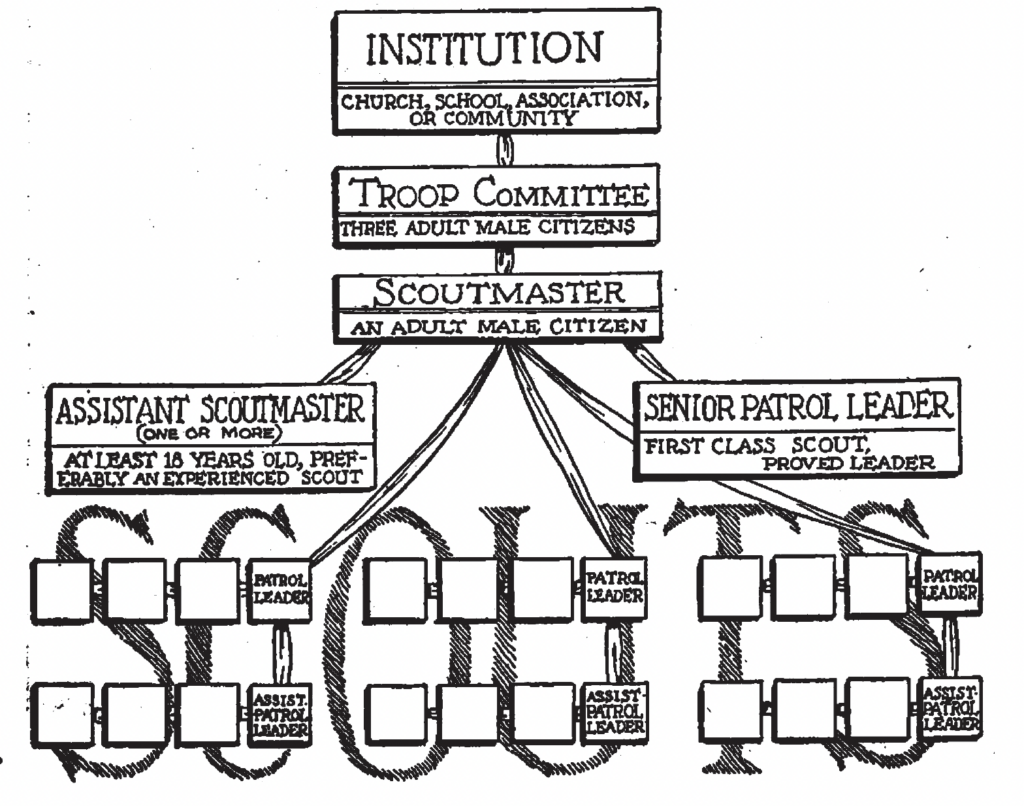
In the chart, the Patrol Leader answers to no other youth and is mentored directly by the Scoutmaster. But the text grows the 1914 tension by assigning a more expansive role to the senior patrol leader6:
Senior Patrol Leader: Preside at meetings. Lead games. Carry out plans of the Scoutmaster. Supervise and direct work of Patrol Leaders and Scouts.
Role description from the 1922 Handbook for Scoutmasters.
This is still not a supervisor of an expansive youth bureaucracy, and use of lower case in other sections suggests it’s still an informal role. But the word “supervise” matters. By 1922, the troop-supervisory idea is no longer theoretical. It appears in a practical division-of-labor section.
The 1922 Handbook for Scoutmasters also lays out other troop-level administrative roles for youth. The formally recognized roles were only “Bugler and Scout Scribe”.7 But by also listing not-formally-recognized roles that were “often added” by troops, gold loopers make an early admission of a drift away from a patrol focus: “Assistant Treasurer, Librarian, Quartermaster (in charge of troop property), Scout Assistant Instructors (experienced Scouts who help the younger members), Hike Master, Drill Master, Color Bearer, Game Leader, etc.”8
The third edition of Handbook for Scoutmasters, first published in 1936, makes the tension more visible. It still gives an entire part to “THE PATROLS IN THE TROOP,” including chapters on the patrol method, Patrol Leaders, the Troop Leaders’ Council (the body later known as the Patrol Leaders’ Council or PLC), and the working of the patrol method. Written by William Hillcourt (the famous Green Bar Bill), this text asserts the patrol method: real patrols, real Patrol Leaders, patrol meetings without adults (no longer permitted9; the point here is the handbook’s focus on the patrol program), patrol hikes, patrol projects, patrol spirit, and boy responsibility.
Compared with 1922, the 1936 edition gives the existing pieces a fuller operating system. The 1922 edition had already named some troop jobs. The change in 1936 was structure: a detailed Troop Leaders’ Council, Green Bar Patrol, formal Junior Assistant Scoutmaster role, and more explicit troop program and advancement machinery. The book still teaches the patrol method while building more machinery around it.10
Hillcourt should not be cast as a Baden-Powell purist on troop structure. While his enduring focus on patrols is commendable, he tried to keep patrol vitality alive inside a growing troop-level architecture that he did not challenge. His own materials presupposed that architecture: Senior Patrol Leader, troop officers, Troop Leaders’ Council, Green Bar Patrol, and the troop-meeting-centered rhythm.
While the 1936 version remains patrol-centered, it furthers the formal troop machinery that later overgrows the patrol.
By 1959, troop offices had grown heavier
The 1959 Scoutmaster’s Handbook still has the right official center of gravity. Its strongly affirms the patrol method with11:
The Scoutmaster’s FIRST Job: Helping boy leaders make the PATROL METHOD work and to work with and through responsible adults to give Scouting to boys.
Direction to Scoutmasters that affirms the patrol method.
It also says the patrol method is an “absolute necessity” and affirms the adult-association method by asserting that freeing the Scoutmaster from details so that “above all, you have time to help each individual boy in the troop through frequent personal contacts”.12
However, the 1959 handbook reveals that the troop-office architecture had grown heavier. The Senior Patrol Leader is described as the troop’s highest elected office and executive officer. Assistant Senior Patrol Leaders relieve the SPL of details. “Troop warrants”, formal recognition of youth officeholders, extend to Instructor, Junior Assistant Scoutmaster, Scribe, Quartermaster, Librarian, Den Chief, and other offices. The Patrol Leader’s transmission-belt role is also clearer: he represents his patrol in the Patrol Leaders’ Council, brings ideas from the patrol, and carries the accepted program back to the patrol for action.13
Reaffirming this is mixed language. Despite language asserting the primacy of patrols, described above, other language conflates the patrol method with running the troop, such as “letting your boy leaders run THEIR troop”.14 This reveals a growing the tension about which gets primacy, the patrols or the troop. Is the program about the patrol method, or is it about the troop-level bureaucracy?
While this book still argues for the patrol method, it furthers the administrative structure that would later overpower it.
Advancement wired offices into rank
In 1965, advancement gave the office machinery credentialing force. BSA’s own On Scouting summary says the “Revised Boy Scout Advancement Plan” took effect on October 1, 1965, and required Scouts to serve in positions of responsibility as part of rank advancement. A rank-history chart compiled from Boy Scout handbooks identifies Star, Life, and Eagle requirements in 1965 as requiring service as a troop “warrant officer”, which today is called a “position of responsibility”. Patrol Leader was included, but only as one position in a list that also included several other roles.15
The list later evolved into something even more revealing. Today, for credentialing purposes, leading a patrol counts the same as maintaining the troop’s website. Assistant Patrol Leader, the only other titled, patrol-level role, counts for nothing.16 The advancement affirmed the troop-office layer.
Youth-facing books taught the machinery
The 1967 Patrol Leader’s Handbook confirms the troop-level focus. Its Patrol Leader’s Code, after listing personal and patrol-centric duties, says that, as a “leader in my troop”, the Patrol Leader should “[t]ake an active part in the patrol leaders’s council”, “[s]ee that the patrol is prepared to take an active part in all troop activities”, and “[w]ork with the Scoutmaster and other troop leaders to make the troop run well”.17
This isn’t about participating in a congress of patrols in a patrol-centric troop. Other parts of this book make clear that this is subsuming considerable parts of the Patrol Leader function into the troop-level machinery, such as working with the SPL in “plan[ning] the troop activities and mak[ing] sure they are carried out”18, that the Patrol Leader has a “share” of “[t]aking charge of the troop”19, conformance with a “troop … budget plan” and with a youth-staffed, bureaucratic finance apparatus,20 that activities run by a patrol on behalf of a troop are decided by the PLC and announced by the SPL21, that the agenda of the PLC is set by the SPL-“chairman” and Scoutmaster22, that the Patrol Leader is a transmission belt for planning that emerges from the PLC23, and more. The focus is on the troop, not the patrols.
The same 1967 youth-facing handbook gives the Patrol Leaders’ Council a parliamentary meeting structure. The Senior Patrol Leader chairs, the troop scribe keeps minutes, other troop leaders attend when their work is being planned, and the council holds annual and monthly planning meetings to build the troop program. It even warns that patrol hikes must not conflict with troop activities, because “the patrols must be present” for a troop function.24 That is youth-facing bureaucratization.
The 1972 Scout Handbook, also youth-facing, carries the office-and-council model into the Improved Scouting Program era. It tells youth that the troop leaders’ council makes troop plans with help from the Scoutmaster and that, through that council, the Patrol Leader becomes the patrol’s voice in what the troop does.25
The same 1972 youth handbook also describes an elected Senior Patrol Leader who sees that things happen in meetings and activities, chairs the troop leaders’ council, attends troop-committee meetings, may appoint an assistant, and may appoint Scouts to various troop-level roles.26
The new-to-1972 feature was neither the youth-facing description of bureaucracy nor the bureaucracy’s advancement link. It was the concrete packaging of the bureaucracy.
By 1981, the troop chart became the operating model
The 1981 Official Scoutmaster Handbook, Seventh Edition, confirms the same emphasis. Its table of contents puts “Troop Organization and the Patrol Leaders’ Council” before “The Patrol Method,” then places Advancement, Training Junior Leaders, and Troop Administration inside a later section called “Tools to Do the Job.”27 It elevates the SPL to “the ‘big shot’ of the troop.”28
The 1981 adult-leader handbook repeats the Patrol Leader’s troop-serving role in job-description form: the Patrol Leader is to “[p]repare [the] patrol to take part in all troop activities” and “[w]ork with other troop leaders to make the troop run well”.29 This is not mostly autonomous patrols. The patrol is just a cog in a troop machine.
The focus of the troop is also clarified by the troop organization chart30, which is below. Here, gold loopers now mainly define a troop as a roster of troop-level officers. Patrols do not even appear on the chart. Patrol Leaders sit on the bottom tier of a chain of command. Notably, the chart almost entirely routes ordinary mentoring through the troop’s youth offices. Direct adult association, key to Baden-Powell’s patrol method, is displaced to scheduled set-pieces, like the Scoutmaster conference. With how these conferences are conveyed, they amount to a sideshow scheduled at the convenience of the Scoutmaster31, considerably different than Baden-Powell’s vision of adults as “older brother[s]” in a “jolly fraternity”.32
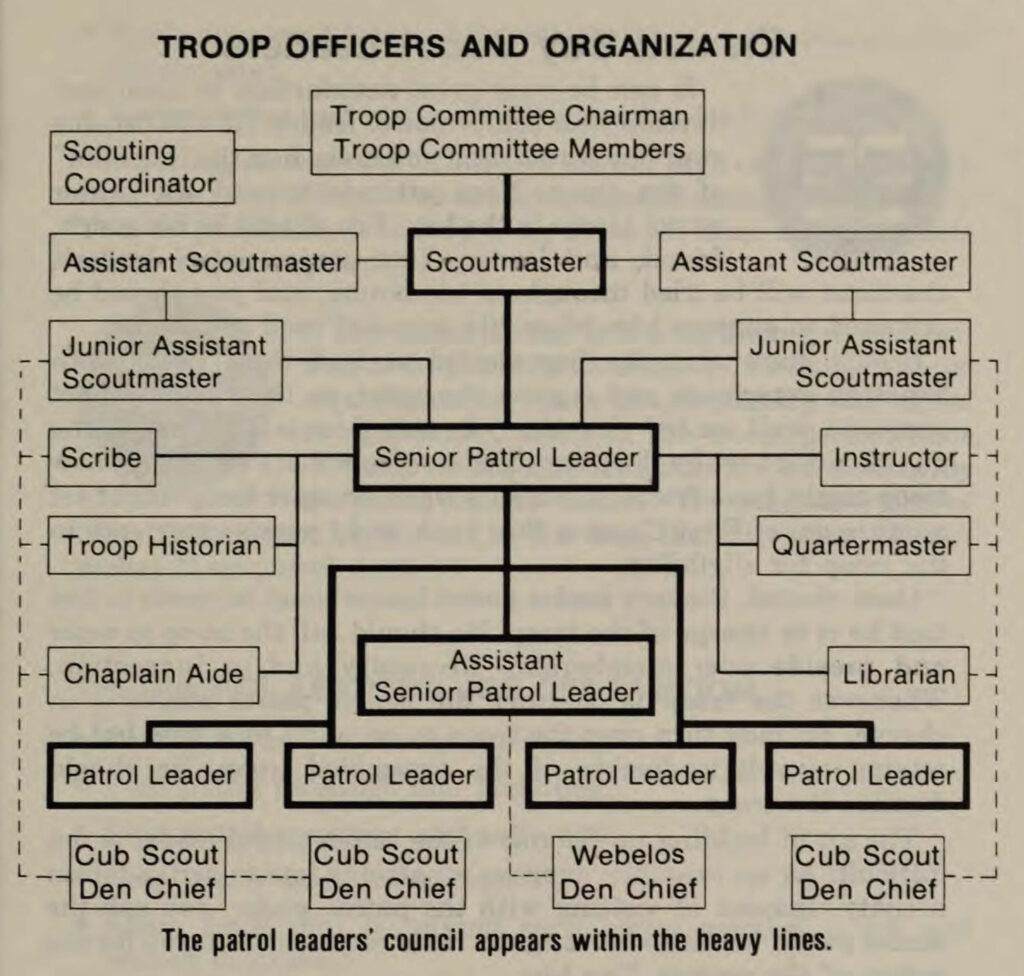
The above diagram shows a Patrol Leaders’ Council (PLC), indicated by the heavy lines. The PLC amplifies the drift. The PLC is an administrative board, implemented as a bureaucratic committee, whose main point is “to plan and run the troop’s activities and to train the patrol leaders”.33 It “runs the troop through democratic representation of the patrols”.34
This drives the point home: Patrol programs now exist at the whim of a troop-level bureaucratic structure. No longer leaders of independent teams, Patrol Leaders are diminished to just having a seat at the table in a bureaucratic committee. This often means patrols are reduced to labor pools. Patrol identity revolves around doing the chores described previously or doing activities ordered by the PLC.
The “suggested order of business” for a PLC meeting emphasizes the bureaucratic nature of this committee35:
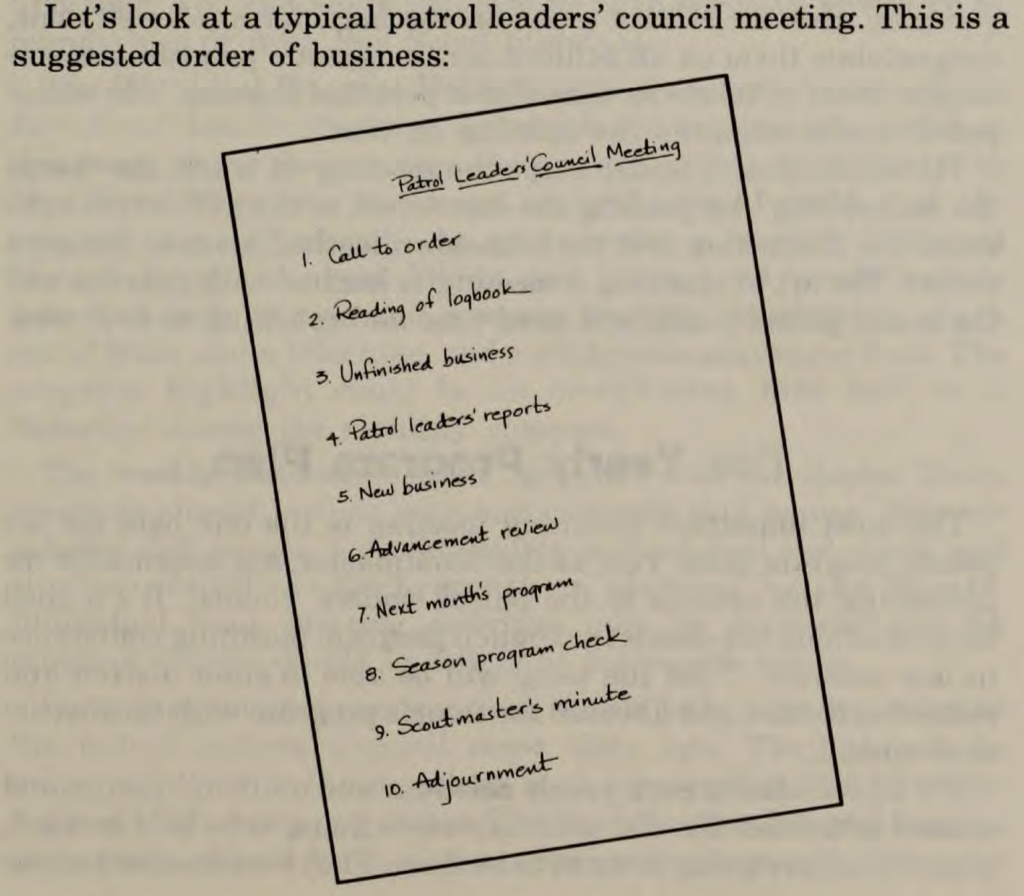
Note what isn’t on this agenda: any patrol’s own adventure. It is a production meeting for troop output.
1972 gave the machine a theory of itself
The popular account treats 1972 as the original sin. Gold loopers weakened outdoor requirements. A few years later, Hillcourt later restored the outing to Scouting. That is where the story often ends.
The outdoor-program grievance is real. It also crowds out the structural grievance. The handbook progression above shows the troop-office machinery was already built, youth-facing, and wired into advancement. Gold loopers used the 1972 Improved Scouting Program to ratify that six-decade trajectory.
What 1972 added was a theory of the machinery. The Improved Scouting Program was gold loopers’ broad overhaul of “every aspect of the Scout program”.36 It made the troop-office layer look like pedagogy. Office-holding was no longer merely administrative scaffolding. The office became the lesson.
White Stag, a Monterey Bay Area Council leadership-training experiment that predated the Improved Scouting Program, belongs in that 1972 context because it explains how the drift could be mistaken for leadership training rather than admitted as a retreat from patrol ownership. White Stag’s founder, Béla Bánáthy, and its program gave BSA the Eleven Skills of Leadership, a language of formal competencies and intentional training design.37
Gold loopers studied that approach, adapted it into Wood Badge, and later credited White Stag in the Troop Leader Development Staff Guide.38 Gold loopers’ own 1972 report to Congress says the new Wood Badge syllabus concentrated on leadership development for Scoutmasters, with youth-facing Troop Leader Development was being tested at Schiff and Philmont.39
Hillcourt resisted the shift from Scoutcraft to leadership competencies. White Stag’s history says John Larson reported that Hillcourt “fought us all the way,” that Hillcourt proposed a camping-oriented alternative, and that Chief Scout Executive Joseph Brunton approved Larson’s leadership-development plan instead.40 Hillcourt was contesting how the troop-office machine would be used: as support for Scoutcraft and patrol life, rather than as an explicit leadership-competency curriculum. Gold loopers chose the latter.
Gold loopers then carried the same theory down to youth training through Troop Leader Development. The 1974 staff-guide material traced the leadership-development concept through social-science studies, Army noncommissioned-officer experiments, White Stag, Wood Badge testing beginning in 1967, junior-leader expansion in 1969, a 1971 Philmont test, full Wood Badge integration in 1972, and use in every council beginning in 1973.41
Alongside that overhaul came the Leadership Corps, a new upper-age service layer. It assembled 14- and 15-year-old “[p]otential leaders” to serve the troop as bureaucrats and instructors. The Senior Patrol Leader ran that group.42 That is a revealing design. The older and more experienced Scouts were chiefly organized as a troop-staffing layer, an age-span problem taken up in part 5.
The same turn appeared in BSA’s youth-facing Patrol and Troop Leadership. With chapters on the patrol, the troop, troop operation, troop leaders’ council meetings, and the Leadership Corps, that book was part of the same early-1970s turn.43 Before this turn, a Quartermaster could be understood as someone who kept the gear sorted. After this turn, being Quartermaster could be framed as practicing leadership competencies. The bureaucracy acquired a curriculum.
The office-and-training machinery survived the rollback
Much of the 1972 program was later reversed. By 1978, gold loopers had largely scrapped much of their Improved Scouting Program.44 They turned to William Hillcourt to author the new Scout handbook that restored an emphasis on the outdoors.45
But restoring outdoor emphasis did not restore the patrol method because the outdoor-program grievance and the structural grievance were never the same thing. Gold loopers could put camping and Scoutcraft back into the handbook while preserving their corporate-bureaucracy simulation.
This may be the most compelling evidence that the corporate-bureaucracy simulation’s survival was not an accident. The broader framework survived because gold loopers had sold it as “leadership development”, tested it, evaluated it, and integrated it into training. White Stag’s historical material says an outside evaluator compared BSA’s leadership-development methods favorably with the best leadership-development programs available to managers.46
Hold on: the outside benchmark for Scouting’s “leadership development” was the best training available to managers? That is a confession! The design center was managerial training, which is not leadership, and the structure gold loopers built around it behaves accordingly. That makes the managerial character of the program hard to miss.
That is why “corporate-bureaucracy simulation” is the right name. Gold loopers’ structure did the work: a chief youth officer, assistants, department-like offices, chains of command, reports, training, troop-wide production, and high-school-aged Scouts often assigned to keep the machine running.
The current roster still reproduces the machine
Current Scouts BSA materials still show the same center of gravity. Official troop-position materials list a familiar roster of youth positions.47 The Senior Patrol Leader is treated as the troop’s top youth office and primary link between Scouts and adults.48 The Patrol Leaders’ Council is described as the troop’s elected and appointed governing body.49
The roster has power because positions of responsibility are tied to advancement. Star and Life require months in one or more listed positions of responsibility unless the Scout completes a Scoutmaster-approved leadership project. Eagle removes that project alternative.50 The recognized-position requirement remains. Once advancement depends on recognized offices, the troop-level bureaucracy becomes immortal: Adults feel pressure to keep offices available. Scouts feel pressure to occupy them. The troop chart becomes a credentialing system even when the patrol method needs none of those offices.
Adult training teaches the simulation, not the patrol method
The adult-training problem is part of the same story. While it continues to wave at the patrol method, adult training’s emphasis is on the corporate-bureaucracy simulation.
A key example comes from Montclair State University’s Building Evidence in Scouting Together (BEST) study of Scoutmaster Position-Specific Training, part of what allows Scoutmasters and Assistant Scoutmasters to be considered trained. The official syllabus treats the patrol method as required content. In the observed in-person courses, researchers found “zero instances” of trainers reinforcing the patrol method, even though they were instructed to do so!51
This finding makes sense. This is not just a practical response to time limitations. Given the prioritization and complexity of the corporate-bureaucracy simulation, when something must give to teach this simulation, trainers appear incentivized to skip the very thing that gold loopers have paved over: the patrol method.
(The BEST study was produced in collaboration with and is promoted by BSA52 and was funded by Stephen Bechtel Jr., a major Scouting donor and namesake of the Summit Bechtel Reserve.)
Wood Badge makes adults rehearse the machine
In BSA culture, Wood Badge is often treated as the mark of serious adult formation. BSA describes Wood Badge as an advanced national leadership course covering topics common with managers, such as conflict management, coaching, and project planning.53
Wood Badge is delivered as a five-day54 practical course, often run over two weekends, in which adults live inside a model Scouts BSA troop, living inside the corporate-bureaucracy simulation. They treat that simulation as the framework for practicing program skills.55
The objection is not that adults receive training. Adults need formation, knowledge, and practice mentoring youth. Wood Badge’s problem is the structure it normalizes. Its model troop teaches adults to inhabit the corporate-bureaucracy simulation that gold loopers built: troop offices, troop-wide coordination, management language, and a youth bureaucracy treated as the normal operating system.
Enormous documentation
The lengthy Wood Badge dress rehearsal is just part of it.
The Scouts BSA corporate-bureaucracy simulation is so complicated that the official BSA reference for program-side adult leaders in troops (Scoutmaster and Assistant Scoutmasters), the Troop Leader Guidebook, is two volumes. Together, these volumes are 338 pages and 180,738 words.
By comparison, the U.S. Constitution, with all its amendments, is only 7,591 words.
The patrol method is simple
The patrol method needs no immersion course, no mind-bogglingly long documentation, because it fits in four sentences!
Even Hillcourt, despite working inside gold loopers’ growing troop-level architecture, could still describe the older simplicity of the patrol method56:
If you want to be a Scout, you go and make up a patrol and go out and do scouting. That’s all it says in the early books in those days.
It was the out-of-doors, scouting and camping. The ideals also. The life of a small patrol in the out-df-doors with the campfires. That was the real appeal to me.
William Hillcourt musing on his experiences as a youth.
The next article turns from the historical buildout to the machinery itself: the official troop offices and positions of responsibility that move patrol work upward and turn youth bureaucracy into the apparent center of Scouts BSA.
Footnotes
- Handbook for Scout Masters, First Edition, Boy Scouts of America, 1913 & 1914, p. 22. ↩︎
- Ibid, p. 22. ↩︎
- Handbook for Scout Masters, First Edition, Boy Scouts of America, 1913 & 1914, p. 68. ↩︎
- Ibid, pp. 115, 118-119, 142. ↩︎
- Handbook for Scoutmasters: A Manual for Leadership, Second Edition, Boy Scouts of America, 1922, p. 17. The title page says this is the “third imprint”. ↩︎
- Ibid, p. 255. ↩︎
- Ibid, p. 17. ↩︎
- Ibid, p. 17. ↩︎
- Scouting’s Barriers to Abuse, Scouting America. Current policy prohibits one-on-one contact between adult leaders and youth members and requires two registered adult leaders at all Scouting activities. ↩︎
- Handbook for Scoutmasters, Volume One, Third Edition, Boy Scouts of America, 1938, pp. vi, 2-3, 130-132, 191-208. The copyright page indicates that the first imprint was in 1936. William Hillcourt’s authorship is mentioned on p. vi. ↩︎
- Scoutmaster’s Handbook, Fifth Edition, Boy Scouts of America, 1959, p. 32. ↩︎
- Ibid, pp. 40, 42. ↩︎
- Ibid, pp. 48-57. The handbook describes the Patrol Leader as both patrol leader and troop leader, describes the Senior Patrol Leader and Assistant Senior Patrol Leader, and lists troop warrants for youth offices. ↩︎
- Ibid, p. 40. ↩︎
- Bryan Wendell, One surprising fact about anyone who earned Eagle before Oct. 1, 1965, On Scouting, Dec. 27, 2021. (On Scouting is a recent, new brand for the online versions of Scouting and Scout Life magazines.) See also Jeff Snowden, BSA Rank Advancement Requirements, 1910-2019, Troop 97, Fort Collins, Colorado, updated Sept. 2019, pp. 9-10. ↩︎
- Star Rank Requirements, Life Rank Requirements, Eagle Rank Requirements, Boy Scouts of America. See the requirement in each that mentions “positions of responsibility”. ↩︎
- Patrol Leader’s Handbook, Boy Scouts of America, 1967, p 10. ↩︎
- Ibid, p. 7. ↩︎
- Ibid, p. 7. ↩︎
- Ibid, p. 14. ↩︎
- Ibid, p. 43. ↩︎
- Ibid, p. 63. ↩︎
- Ibid, p. 64. ↩︎
- Ibid, p. 89. ↩︎
- Scout Handbook, Boy Scouts of America, 1972, p. 26. ↩︎
- Ibid, pp. 22, 26-27. ↩︎
- The Official Scoutmaster Handbook, Seventh Edition, Boy Scouts of America, 1981, pp. 4-5. The table of contents places troop organization and the Patrol Leaders’ Council before the patrol method, and later lists advancement, junior-leader training, and troop administration as tools to do the job. ↩︎
- The Official Scoutmaster Handbook, Seventh Edition, Boy Scouts of America, 1981, p. 52. ↩︎
- Ibid, p. 51. ↩︎
- Ibid, p. 49. ↩︎
- Ibid, pp. 23-24. ↩︎
- Robert Baden-Powell, Aids to Scoutmastership, 1944, p. 3. ↩︎
- The Official Scoutmaster Handbook, Seventh Edition, Boy Scouts of America, 1981, p. 54. ↩︎
- Ibid, p. 54. ↩︎
- Ibid, p. 55. ↩︎
- Annual Report to Congress, Boy Scouts of America, 1972, pp. 8, 21-22.. ↩︎
- Béla H. Bánáthy, Founder of the White Stag Leadership Development Program, White Stag Leadership Development. The page describes Bánáthy as a systems scientist and founder of White Stag. See also The Eleven Skills of Leadership, White Stag Leadership Development. ↩︎
- U.S. Boy Scouts Adapted the White Stag Program, White Stag Leadership Development. ↩︎
- Annual Report to Congress, Boy Scouts of America, 1972, pp. 21-22. ↩︎
- U.S. Wood Badge Origins in White Stag, White Stag Leadership Development. ↩︎
- Troop Leadership Development’s Origins in White Stag, White Stag Leadership Development. The page reproduces material from the 1974 Troop Leader Development Staff Guide, pp. 94-95. ↩︎
- The Official Scoutmaster Handbook, Seventh Edition, Boy Scouts of America, 1981, pp. 50, 63-65. While not a primary source for this article, Leadership Corps (1972-89), Senior Scouting History, is worth a review. This summarizes the 1972 Leadership Corps program, including older Scouts serving as troop leaders and instructors. It has some information not corroborated by the 1981 Scoutmaster Handbook, such as the theory that Patrol Leaders are excluded from the Leadership Corps. ↩︎
- Patrol and Troop Leadership, Boy Scouts of America, 1972. ↩︎
- Lawrence van Gelder, “A Work of Love for ‘Boy Scout,’ 78“, The New York Times, Feb. 4, 1979. ↩︎
- Robert W. Peterson, “Bill Hillcourt — Still Going Strong on the Scouting Trail,” Scouting, vol. 73, no. 4 (Sept. 1985), p. 26. ↩︎
- Troop Leadership Development’s Origins in White Stag, White Stag Leadership Development. The page reproduces material from the 1974 Troop Leader Development Staff Guide, pp. 94-95; it says an outside evaluator compared BSA’s leadership-development methods favorably with leadership-development programs available to managers in public and private organizations. ↩︎
- Troop Positions, Troop Leader Resources, Boy Scouts of America. ↩︎
- Senior Patrol Leader, Troop Leader Resources, Boy Scouts of America. ↩︎
- Patrol Leader’s Council Monthly Planning, Troop Leader Resources, Boy Scouts of America. ↩︎
- 2025 Scouts BSA Requirements, Boy Scouts of America, 2025, pp. 17-22. ↩︎
- Implementing the BSA Scoutmaster Training Model as Designed: A Fidelity Assessment, Montclair State University, July 2019. ↩︎
- https://bsabeststudy.org/ ↩︎
- Wood Badge, Boy Scouts of America. ↩︎
- Bryan Wendell, “Inside the Wood Badge update that makes the program more accessible than ever“, Scouting Magazine, September 2020. ↩︎
- Wood Badge 2025, Suffolk County Council, Boy Scouts of America. The page describes the practical phase as conducted as a troop and using a model Scouts BSA troop as the foundation for training. ↩︎
- Lawrence van Gelder, “A Work of Love for ‘Boy Scout,’ 78“, The New York Times, Feb. 4, 1979. ↩︎

Leave a Reply