Author: Aren Cambre

  • How the troop bureaucracy acquired a leadership theory

    How the troop bureaucracy acquired a leadership theory

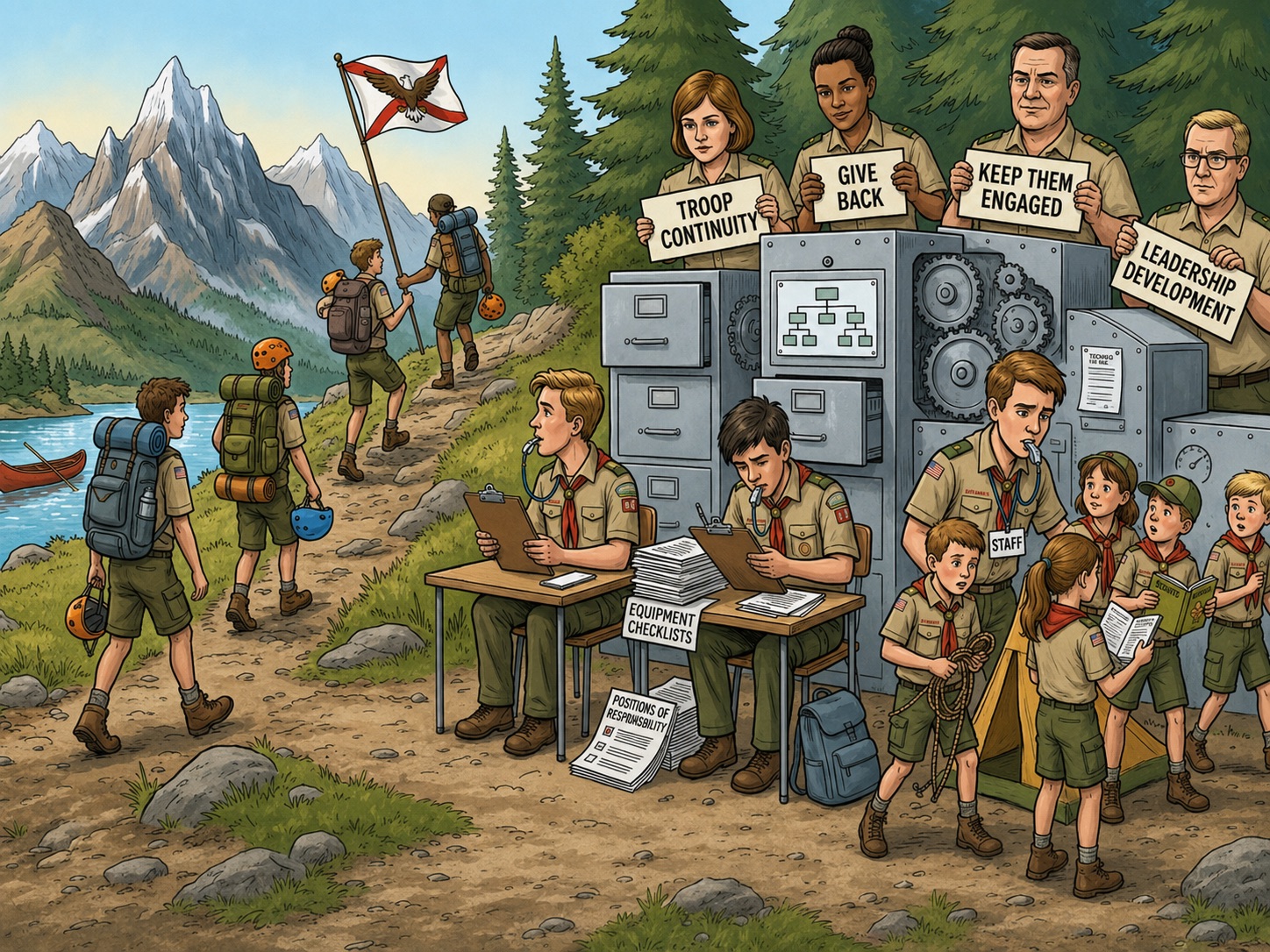
    The Scouts BSA corporate-bureaucracy simulation did not appear all at once. Gold loopers did this gradually. They built up the troop-office machinery, wired it into advancement, and then gave that machinery a faux leadership-development theory. In 1972, gold loopers used the Improved Scouting Program to validate their gradual creep and give it a curriculum.

    The first article explained that the patrol method means self-governing patrols, not youth administration of a troop machine. This article presents the institutional history, how BSA’s gold loopers gradually stole the patrol method from our youth.

    Series note: This is part two of a five-part series on how BSA’s gold loopers stole the patrol method, replacing it with a corporate-bureaucracy simulation. (The next articles will be published in a few days.)

    Part 1: The patrol method is not a youth bureaucracy
    Part 3: How troop positions of responsibility stole patrol ownership
    Part 4: Adults must stop hiding behind youth offices
    Part 5: High schoolers are not troop staff

    The theft was gradual

    Unit-level adults did not create the corporate-bureaucracy simulation. They inherited it from from gold loopers.

    Gold loopers did not commit a single midnight theft. The records show no single heist. Instead, we see accretion, one handbook at a time.

    A troop practicing the patrol method would feel like a collection of patrols, each mentored by adults, with a focus on the patrol agendas. Over the 20th century, gold loopers gradually imposed a troop-level office layer that grew in size and prominence. That shifted the Scouts BSA program’s focus away from patrols and toward a troop-level machine. It also pulled everyday adult association back from most youth, except for those in selected, troop-level offices.

    The handbooks show patrols giving way to offices

    The Scoutmaster handbooks show the original center of gravity and the building tension. Youth-facing books repeated the same machinery.

    The 1914 Handbook for Scout Masters, First Edition, does not yet present a durable troop-office layer as the normal center of Scout operations. Its early troop-organization material is sparse: Patrol Leaders and the Scout Scribe are the only visible youth structure.1

    While the Scout Scribe was a troop-level role, it was not a functionary in youth bureaucracy. Rather, the role was practical, to assist the Scoutmaster2:

    Troop records giving details of the progress of the boys enrolled are invaluable to the Local and National Organizations. A complete set of records should therefore be kept by every troop. Inasmuch as the Scout Master himself may not be able to give the time required in the preparation of data of this kind, it is important that one of the members of the troop be chosen as Scout Scribe or Troop Secretary.

    Description of the Scout Scribe role from the 1914 Handbook for Scout Masters. This youth role provided clerical support to the Scoutmaster. It was not an officer in a youth chain of command.

    Even in 1914, though, the first seed of troop-level youth authority is visible. In one ceremony, “[i]n case there is no Assistant
    Scout Master”, a senior patrol leader (SPL) handles some ceremonial details.3 Elsewhere, the book says the senior patrol leader usually presides at troop meetings, and a model troop constitution calls the Senior Patrol Leader the Troop Leader or Troop President, with general supervision over the troop and subordinate officers. The patrol-leader-training chapter then pulls the title back toward patrol merit. It describes the SPL as a situational role filled by the “advanced or senior Patrol Leader”, or more precisely “the Leader of the patrol doing the best work”. This is not a permanent, bureaucratic supervisor position. Instead, the SPL “should occasionally be in full charge” when the troop is assembled.4

    That is the first tension: a patrol-derived honor and occasional troop function already carrying the seed of later troop-office authority. Had this been the limit of the progression, then we could comfortably say that the patrol method was still in use. But that seed later germinates.

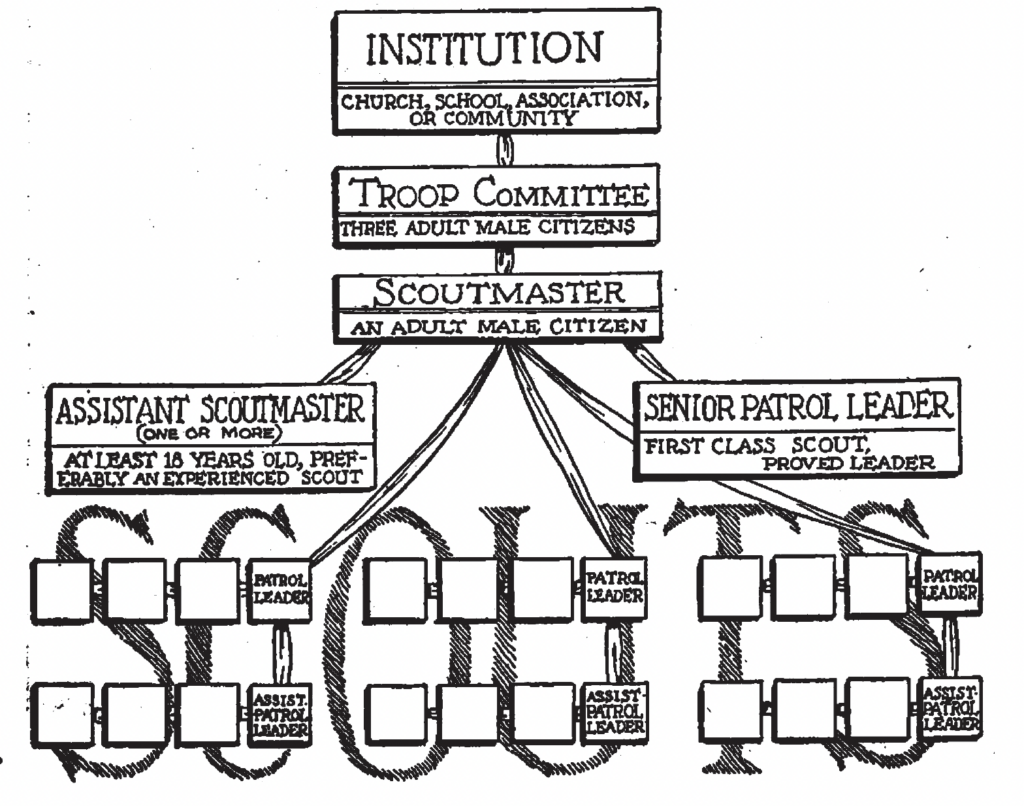
    The 1922 Handbook for Scoutmasters, Second Edition, illustrates the patrol method5:

    In the chart, the Patrol Leader answers to no other youth and is mentored directly by the Scoutmaster. But the text grows the 1914 tension by assigning a more expansive role to the senior patrol leader6:

    Senior Patrol Leader: Preside at meetings. Lead games. Carry out plans of the Scoutmaster. Supervise and direct work of Patrol Leaders and Scouts.

    Role description from the 1922 Handbook for Scoutmasters.

    This is still not a supervisor of an expansive youth bureaucracy, and use of lower case in other sections suggests it’s still an informal role. But the word “supervise” matters. By 1922, the troop-supervisory idea is no longer theoretical. It appears in a practical division-of-labor section.

    The 1922 Handbook for Scoutmasters also lays out other troop-level administrative roles for youth. The formally recognized roles were only “Bugler and Scout Scribe”.7 But by also listing not-formally-recognized roles that were “often added” by troops, gold loopers make an early admission of a drift away from a patrol focus: “Assistant Treasurer, Librarian, Quartermaster (in charge of troop property), Scout Assistant Instructors (experienced Scouts who help the younger members), Hike Master, Drill Master, Color Bearer, Game Leader, etc.”8

    The third edition of Handbook for Scoutmasters, first published in 1936, makes the tension more visible. It still gives an entire part to “THE PATROLS IN THE TROOP,” including chapters on the patrol method, Patrol Leaders, the Troop Leaders’ Council (the body later known as the Patrol Leaders’ Council or PLC), and the working of the patrol method. Written by William Hillcourt (the famous Green Bar Bill), this text asserts the patrol method: real patrols, real Patrol Leaders, patrol meetings without adults (no longer permitted9; the point here is the handbook’s focus on the patrol program), patrol hikes, patrol projects, patrol spirit, and boy responsibility.

    Compared with 1922, the 1936 edition gives the existing pieces a fuller operating system. The 1922 edition had already named some troop jobs. The change in 1936 was structure: a detailed Troop Leaders’ Council, Green Bar Patrol, formal Junior Assistant Scoutmaster role, and more explicit troop program and advancement machinery. The book still teaches the patrol method while building more machinery around it.10

    Hillcourt should not be cast as a Baden-Powell purist on troop structure. While his enduring focus on patrols is commendable, he tried to keep patrol vitality alive inside a growing troop-level architecture that he did not challenge. His own materials presupposed that architecture: Senior Patrol Leader, troop officers, Troop Leaders’ Council, Green Bar Patrol, and the troop-meeting-centered rhythm.

    While the 1936 version remains patrol-centered, it furthers the formal troop machinery that later overgrows the patrol.

    By 1959, troop offices had grown heavier

    The 1959 Scoutmaster’s Handbook still has the right official center of gravity. Its strongly affirms the patrol method with11:

    The Scoutmaster’s FIRST Job: Helping boy leaders make the PATROL METHOD work and to work with and through responsible adults to give Scouting to boys.

    Direction to Scoutmasters that affirms the patrol method.

    It also says the patrol method is an “absolute necessity” and affirms the adult-association method by asserting that freeing the Scoutmaster from details so that “above all, you have time to help each individual boy in the troop through frequent personal contacts”.12

    However, the 1959 handbook reveals that the troop-office architecture had grown heavier. The Senior Patrol Leader is described as the troop’s highest elective office and executive officer. Assistant Senior Patrol Leaders relieve the SPL of details. “Troop warrants,” formal recognition of youth officeholders, extend to Instructor, Junior Assistant Scoutmaster, Scribe, Quartermaster, Librarian, Den Chief, and other offices. The Patrol Leader’s transmission-belt role is also clearer: he represents his patrol in the Patrol Leaders’ Council, brings ideas from the patrol, and carries the accepted program back to the patrol for action.13

    Reaffirming this is mixed language. Despite language asserting the primacy of patrols, described above, other language conflates the patrol method with running the troop, such as “letting your boy leaders run THEIR troop”.14 This reveals a growing the tension about which gets primacy, the patrols or the troop. Is the program about the patrol method, or is it about the troop-level bureaucracy?

    While this book still argues for the patrol method, it furthers the administrative structure that would later overpower it.

    Advancement wired offices into rank

    In 1965, advancement gave the office machinery credentialing force. BSA’s own On Scouting summary says the Revised Boy Scout Advancement Plan took effect on October 1, 1965, and required Scouts to serve in positions of responsibility as part of rank advancement. A rank-history chart compiled from Boy Scout handbooks identifies Star, Life, and Eagle requirements in 1965 as requiring service as a troop “warrant officer”, which today is called a “position of responsibility”. Patrol Leader was included, but only as one position in a list that also included several other roles.15

    The list later evolved into something even more revealing. Today, for credentialing purposes, leading a patrol counts the same as maintaining the troop’s website. Assistant Patrol Leader, the only other titled, patrol-level role, counts for nothing.16 The advancement affirmed the troop-office layer.

    Youth-facing books taught the machinery

    The 1967 Patrol Leader’s Handbook confirms the troop-level focus. In its Patrol Leader’s Code, after listing personal and patrol-centric duties, says that, as a “leader in my troop”, the Patrol Leader should “[t]ake an active part in the patrol leaders’s council”, “[s]ee that the patrol is prepared to take an active part in all troop activities”, and “[w]ork with the Scoutmaster and other troop leaders to make the troop run well”.17

    This isn’t merely participating in a congress of patrols. Other parts of this book make clear that this is subsuming considerable parts of the Patrol Leader function into the troop-level machinery, such as working with the SPL in “plan[ning] the troop activities and mak[ing] sure they are carried out”18, that the Patrol Leader has a “share” of “[t]aking charge of the troop”19, conformance with a “troop … budget plan” and with a youth-staffed, bureaucratic finance apparatus,20 that activities run by a patrol on behalf of a troop are decided by the PLC and announced by the SPL21, that the agenda of the PLC is set by the SPL-“chairman” and Scoutmaster22, that the Patrol Leader is a transmission belt for planning that emerges from the PLC23, and more.

    The same 1967 youth-facing handbook gives the Patrol Leaders’ Council a parliamentary meeting structure. The Senior Patrol Leader chairs, the troop scribe keeps minutes, other troop leaders attend when their work is being planned, and the council holds annual and monthly planning meetings to build the troop program. It even warns that patrol hikes must not conflict with troop activities, because “the patrols must be present” for a troop function.24 That is youth-facing bureaucratization.

    The 1972 Scout Handbook, also youth-facing, carries the office-and-council model into the Improved Scouting Program era. It tells youth that the troop leaders’ council makes troop plans with help from the Scoutmaster and that, through that council, the Patrol Leader becomes the patrol’s voice in what the troop does.25

    The same 1972 youth handbook also describes an elected Senior Patrol Leader who sees that things happen in meetings and activities, chairs the troop leaders’ council, attends troop-committee meetings, may appoint an assistant, and may appoint Scouts to various troop-level roles.26

    The new-to-1972 feature was not the first youth-facing description of bureaucracy, nor the first advancement link. It was the concrete packaging of that bureaucracy.

    By 1981, the troop chart became the operating model

    The 1981 Official Scoutmaster Handbook, Seventh Edition, confirms the same emphasis. Its table of contents puts “Troop Organization and the Patrol Leaders’ Council” before “The Patrol Method,” then places Advancement, Training Junior Leaders, and Troop Administration inside a later section called “Tools to Do the Job.”27 It elevates the SPL to “the ‘big shot’ of the troop.”28

    The 1981 adult-leader handbook repeats the Patrol Leader’s troop-serving role in job-description form: the Patrol Leader is to “[p]repare [the] patrol to take part in all troop activities” and “[w]ork with other troop leaders to make the troop run well”.29 This is not mostly autonomous patrols. The patrol is just a cog in a troop machine.

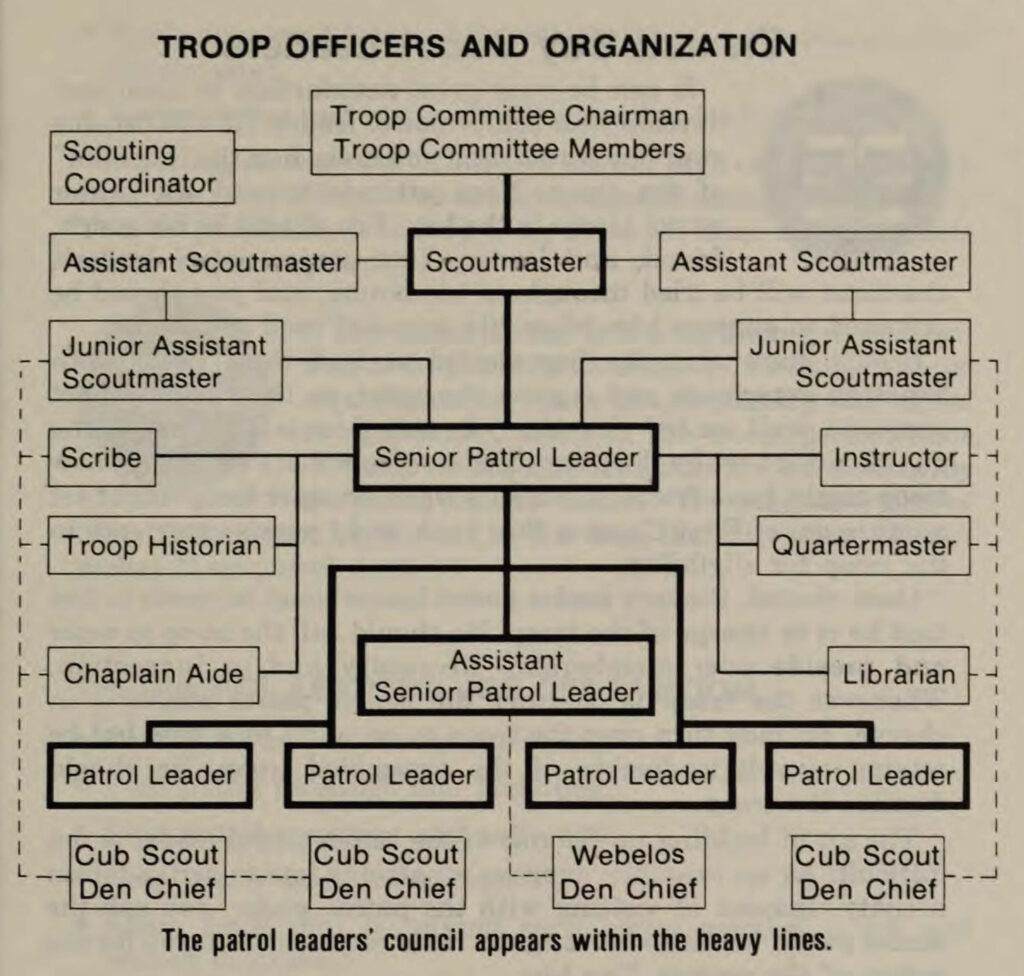
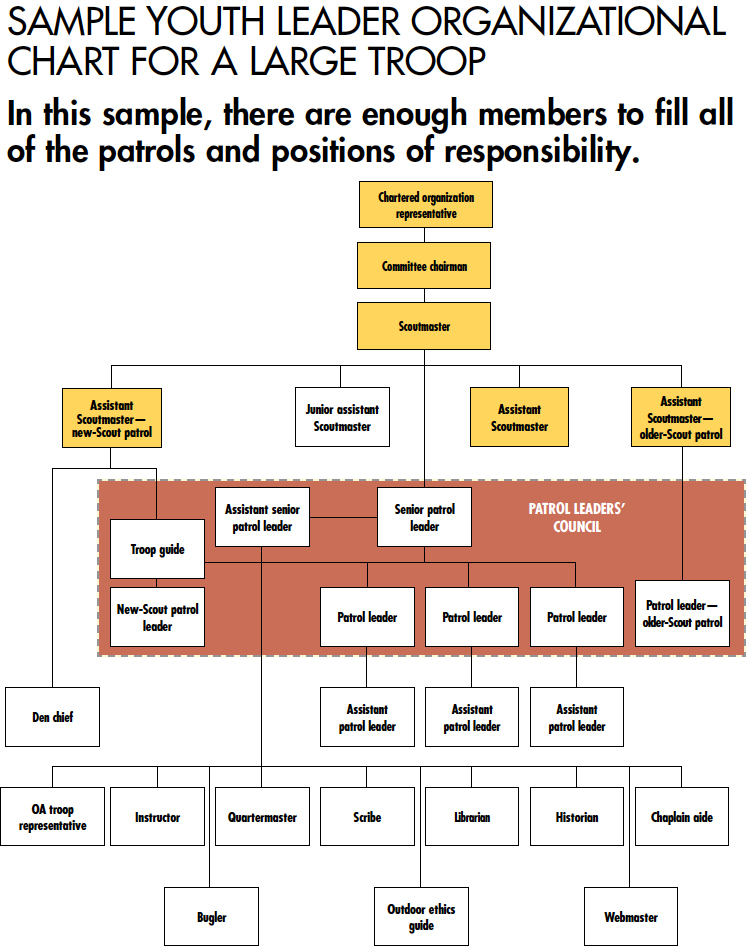
    The focus of the troop is also clarified by the troop organization chart30, which is below. Here, gold loopers now mainly define a troop as a roster of troop-level officers. Patrols do not even appear on the chart. Patrol Leaders sit on the bottom tier of a chain of command. Notably, the chart almost entirely routes ordinary mentoring through the troop’s youth offices. Direct adult association, key to Baden-Powell’s patrol method, is displaced to scheduled set-pieces, like the Scoutmaster conference. With how these conferences are conveyed, they amount to a sideshow scheduled at the convenience of the Scoutmaster31, considerably different than Baden-Powell’s vision of adults as “older brother[s]” in a “jolly fraternity”.32

    Troop organization chart, as recommended by the 1981 Scoutmaster’s Handbook, Seventh Edition.

    The above diagram shows a Patrol Leaders’ Council (PLC), indicated by the heavy lines. The PLC amplifies the drift. The PLC is an administrative board, implemented as a bureaucratic committee, whose main point is “to plan and run the troop’s activities and to train the patrol leaders”.33 It “runs the troop through democratic representation of the patrols”.34

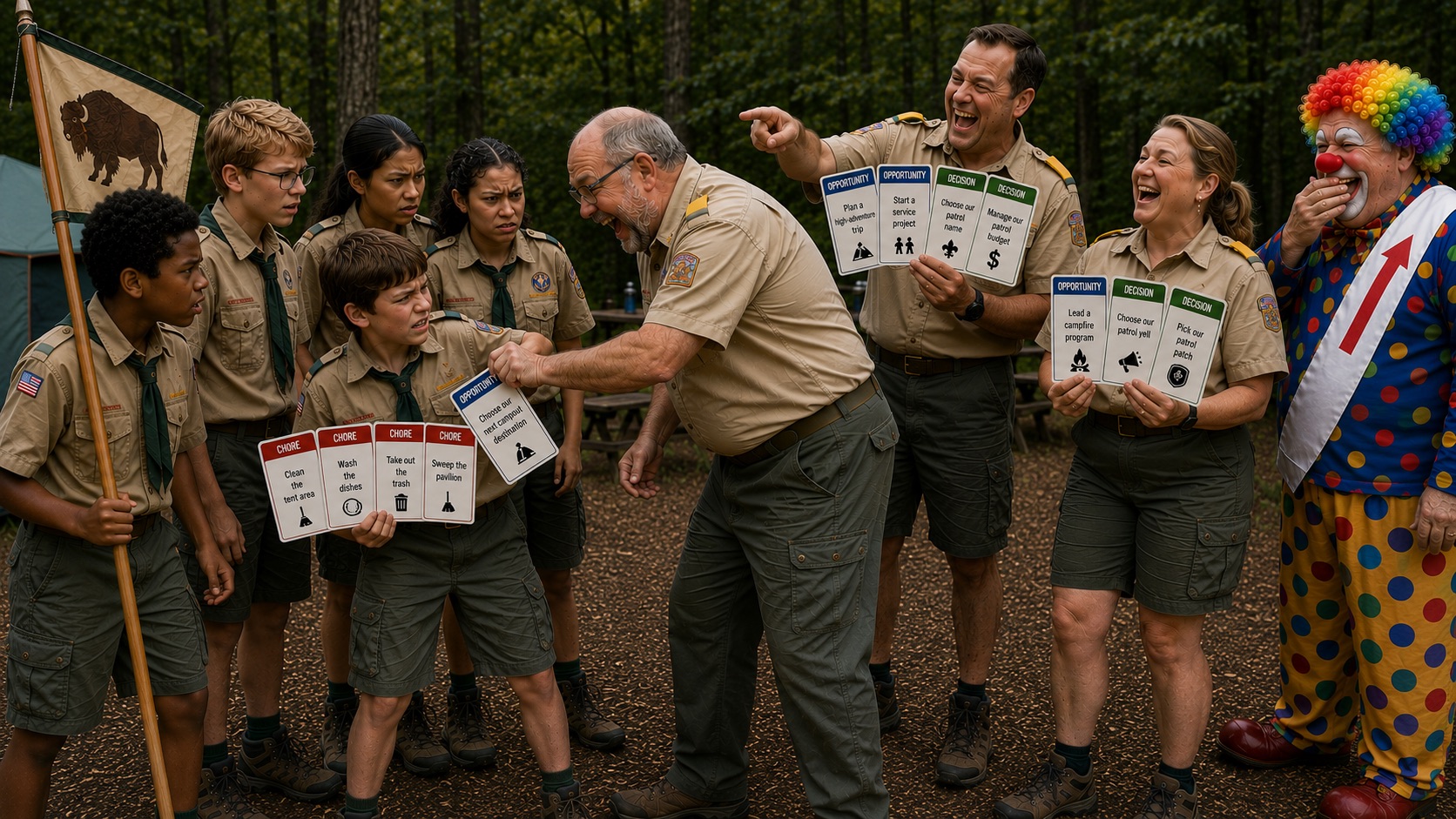
    This drives the point home: Patrol programs now exist at the whim of a troop-level bureaucratic structure. No longer leaders of independent teams, Patrol Leaders are diminished to just having a seat at the table in a bureaucratic committee. This often means patrols are reduced to labor pools. Patrol identity revolves around doing the chores described previously or doing activities ordered by the PLC.

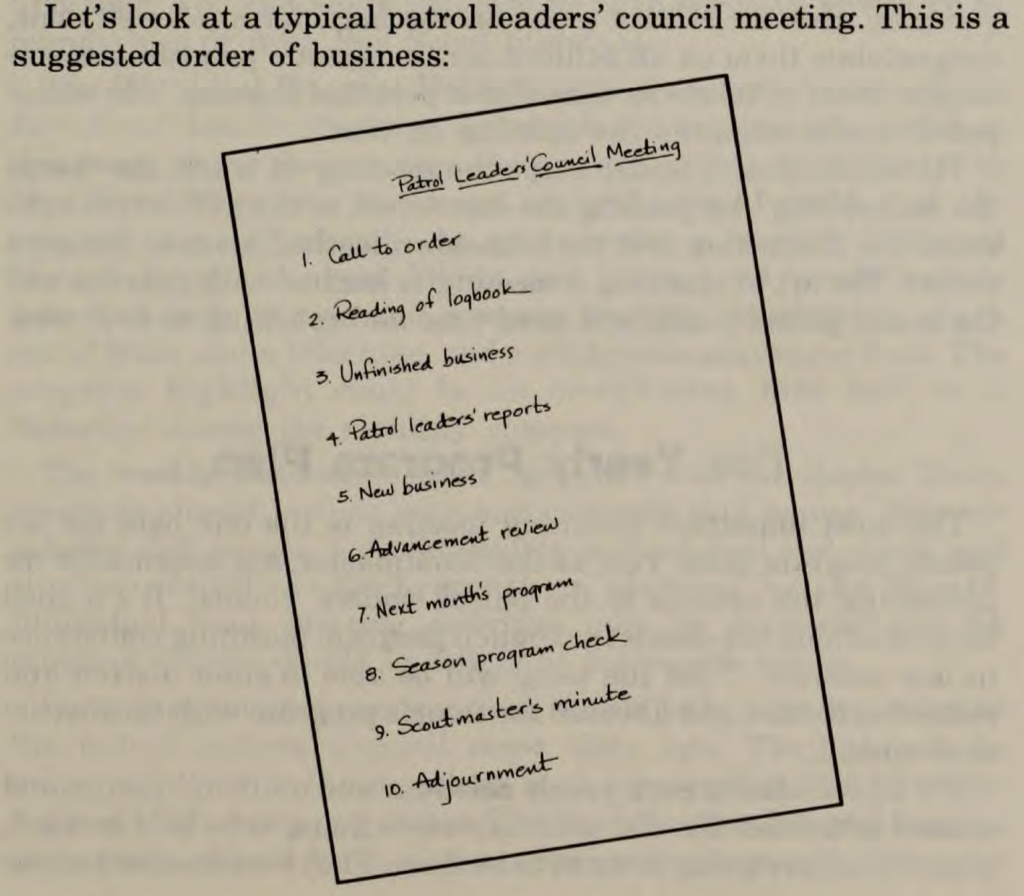
    The “suggested order of business” for a PLC meeting emphasizes the bureaucratic nature of this committee35:

    The bureaucratic nature of the Patrol Leaders’ Council, as revealed in a recommended agenda in the 1981 The Official Scoutmaster Handbook, Seventh Edition.

    Note what isn’t on this agenda: any patrol’s own adventure. It is a production meeting for troop output.

    1972 gave the machine a theory of itself

    The popular account treats 1972 as the original sin. Gold loopers weakened outdoor requirements. A few years later, Hillcourt later restored the outing to Scouting. That is where the story often ends.

    The outdoor-program grievance is real. It also crowds out the structural grievance. The handbook progression above shows the troop-office machinery was already built, youth-facing, and wired into advancement. Gold loopers used the 1972 Improved Scouting Program to ratify that six-decade trajectory.

    What 1972 added was a theory of the machinery. The Improved Scouting Program was gold loopers’ broad overhaul of “every aspect of the Scout program”.36 It made the troop-office layer look like pedagogy. Office-holding was no longer merely administrative scaffolding. The office became the lesson.

    White Stag, a Monterey Bay Area Council leadership-training experiment that predated the Improved Scouting Program, belongs in that 1972 context because it explains how the drift could be mistaken for leadership training rather than admitted as a retreat from patrol ownership. White Stag’s founder, Béla Bánáthy, and its program gave BSA the Eleven Skills of Leadership, a language of formal competencies and intentional training design.37

    Gold loopers studied that approach, adapted it into Wood Badge, and later credited White Stag in the Troop Leader Development Staff Guide.38 Gold loopers’ own 1972 report to Congress says the new Wood Badge syllabus concentrated on leadership development for Scoutmasters, with youth-facing Troop Leader Development was being tested at Schiff and Philmont.39

    Hillcourt resisted the shift from Scoutcraft to leadership competencies. White Stag’s history says John Larson reported that Hillcourt “fought us all the way,” that Hillcourt proposed a camping-oriented alternative, and that Chief Scout Executive Joseph Brunton approved Larson’s leadership-development plan instead.40 Hillcourt was contesting how the troop-office machine would be used: as support for Scoutcraft and patrol life, rather than as an explicit leadership-competency curriculum. Gold loopers chose the latter.

    Gold loopers then carried the same theory down to youth training through Troop Leader Development. The 1974 staff-guide material traced the leadership-development concept through social-science studies, Army noncommissioned-officer experiments, White Stag, Wood Badge testing beginning in 1967, junior-leader expansion in 1969, a 1971 Philmont test, full Wood Badge integration in 1972, and use in every council beginning in 1973.41

    Alongside that overhaul came the Leadership Corps, a new upper-age service layer. It assembled 14- and 15-year-old “[p]otential leaders” to serve the troop as bureaucrats and instructors. The Senior Patrol Leader ran that group.42 That is a revealing design. The older and more experienced Scouts were chiefly organized as a troop-staffing layer, an age-span problem taken up in part 5. ADD LINK: Older Scouts Are Not Troop Staff

    The same turn appeared in BSA’s youth-facing Patrol and Troop Leadership. With chapters on the patrol, the troop, troop operation, troop leaders’ council meetings, and the Leadership Corps, that book was part of the same early-1970s turn.43 Before this turn, a Quartermaster could be understood as someone who kept the gear sorted. After this turn, being Quartermaster could be framed as practicing leadership competencies. The bureaucracy acquired a curriculum.

    The office-and-training machinery survived the rollback

    Much of the 1972 program was later reversed. By 1978, gold loopers had largely scrapped much of their Improved Scouting Program.44 They turned to William Hillcourt to author the new Scout handbook that restored an emphasis on the outdoors.45

    But restoring outdoor emphasis did not restore the patrol method because the outdoor-program grievance and the structural grievance were never the same thing. Gold loopers could put camping and Scoutcraft back into the handbook while preserving their corporate-bureaucracy simulation.

    This may be the most compelling evidence that the corporate-bureaucracy simulation’s survival was not an accident. The broader framework survived because gold loopers had sold it as “leadership development”, tested it, evaluated it, and integrated it into training. White Stag’s historical material says an outside evaluator compared BSA’s leadership-development methods favorably with the best leadership-development programs available to managers.46

    Hold on: the outside benchmark for Scouting’s “leadership development” was the best training available to managers? That is a confession! The design center was managerial training, which is not leadership, and the structure gold loopers built around it behaves accordingly. That makes the managerial character of the program hard to miss.

    That is why “corporate-bureaucracy simulation” is the right name. Gold loopers’ structure did the work: a chief youth officer, assistants, department-like offices, chains of command, reports, training, troop-wide production, and high-school-aged Scouts often assigned to keep the machine running.

    The current roster still reproduces the machine

    Current Scouts BSA materials still show the same center of gravity. Official troop-position materials list a familiar roster of youth positions.47 The Senior Patrol Leader is treated as the troop’s top youth office and primary link between Scouts and adults.48 The Patrol Leaders’ Council is described as the troop’s elected and appointed governing body.49

    The roster has power because positions of responsibility are tied to advancement. Star and Life require months in one or more listed positions of responsibility unless the Scout completes a Scoutmaster-approved leadership project. Eagle removes that project alternative.50 The recognized-position requirement remains. Once advancement depends on recognized offices, the troop-level bureaucracy becomes immortal: Adults feel pressure to keep offices available. Scouts feel pressure to occupy them. The troop chart becomes a credentialing system even when the patrol method needs none of those offices.

    Adult training teaches the simulation, not the patrol method

    The adult-training problem is part of the same story. While it continues to wave at the patrol method, adult training’s emphasis is on the corporate-bureaucracy simulation.

    A key example comes from Montclair State University’s Building Evidence in Scouting Together (BEST) study of Scoutmaster Position-Specific Training, part of what allows Scoutmasters and Assistant Scoutmasters to be considered trained. The official syllabus treats the patrol method as required content. In the observed in-person courses, researchers found “zero instances” of trainers reinforcing the patrol method, even though they were instructed to do so!51

    This finding makes sense. This is not just a practical response to time limitations. Given the prioritization and complexity of the corporate-bureaucracy simulation, when something must give to teach this simulation, trainers appear incentivized to skip the very thing that gold loopers have paved over: the patrol method.

    (The BEST study was produced in collaboration with and is promoted by BSA52 and was funded by Stephen Bechtel Jr., a major Scouting donor and namesake of the Summit Bechtel Reserve.)

    Wood Badge makes adults rehearse the machine

    In BSA culture, Wood Badge is often treated as the mark of serious adult formation. BSA describes Wood Badge as an advanced national leadership course covering topics common with managers, such as conflict management, coaching, and project planning.53

    Wood Badge is delivered as a five-day54 practical course, often run over two weekends, in which adults live inside a model Scouts BSA troop, living inside the corporate-bureaucracy simulation. They treat that simulation as the framework for practicing program skills.55

    The objection is not that adults receive training. Adults need formation, knowledge, and practice mentoring youth. Wood Badge’s problem is the structure it normalizes. Its model troop teaches adults to inhabit the corporate-bureaucracy simulation that gold loopers built: troop offices, troop-wide coordination, management language, and a youth bureaucracy treated as the normal operating system.

    The patrol method needs no immersion course because it fits in four sentences!

    Even Hillcourt, despite working inside gold loopers’ growing troop-level architecture, could still describe the older simplicity of the patrol method56:

    If you want to be a Scout, you go and make up a patrol and go out and do scouting. That’s all it says in the early books in those days.

    It was the out-of-doors, scouting and camping. The ideals also. The life of a small patrol in the out-df-doors with the campfires. That was the real appeal to me.

    William Hillcourt musing on his experiences as a youth.

    The next article turns from the historical buildout to the machinery itself: the official troop offices and positions of responsibility that move patrol work upward and turn youth bureaucracy into the apparent center of Scouts BSA.

    Footnotes

    1. Handbook for Scout Masters, First Edition, Boy Scouts of America, 1913 & 1914, p. 22. ↩︎
    2. Ibid, p. 22. ↩︎
    3. Handbook for Scout Masters, First Edition, Boy Scouts of America, 1913 & 1914, p. 68. ↩︎
    4. Ibid, pp. 115, 118-119, 142. ↩︎
    5. Handbook for Scoutmasters: A Manual for Leadership, Second Edition, Boy Scouts of America, 1922, p. 17. The title page says this is the “third imprint”. ↩︎
    6. Ibid, p. 255. ↩︎
    7. Ibid, p. 17. ↩︎
    8. Ibid, p. 17. ↩︎
    9. Scouting’s Barriers to Abuse, Scouting America. Current policy prohibits one-on-one contact between adult leaders and youth members and requires two registered adult leaders at all Scouting activities. ↩︎
    10. Handbook for Scoutmasters, Volume One, Third Edition, Boy Scouts of America, 1938, pp. vi, 2-3, 130-132, 191-208. The copyright page indicates that the first imprint was in 1936. William Hillcourt’s authorship is mentioned on p. vi. ↩︎
    11. Scoutmaster’s Handbook, Fifth Edition, Boy Scouts of America, 1959, p. 32. ↩︎
    12. Ibid, pp. 40, 42. ↩︎
    13. Ibid, pp. 48-57. The handbook describes the Patrol Leader as both patrol leader and troop leader, describes the Senior Patrol Leader and Assistant Senior Patrol Leader, and lists troop warrants for youth offices. ↩︎
    14. Ibid, p. 40. ↩︎
    15. Bryan Wendell, One surprising fact about anyone who earned Eagle before Oct. 1, 1965, On Scouting, Dec. 27, 2021. (On Scouting is a recent, new brand for the online versions of Scouting and Scout Life magazines.) See also Jeff Snowden, BSA Rank Advancement Requirements, 1910-2019, Troop 97, Fort Collins, Colorado, updated Sept. 2019, pp. 9-10. ↩︎
    16. Star Rank Requirements, Life Rank Requirements, Eagle Rank Requirements, Boy Scouts of America. See the requirement in each that mentions “positions of responsibility”. ↩︎
    17. Patrol Leader’s Handbook, Boy Scouts of America, 1967, p 10. ↩︎
    18. Ibid, p. 7. ↩︎
    19. Ibid, p. 7. ↩︎
    20. Ibid, p. 14. ↩︎
    21. Ibid, p. 43. ↩︎
    22. Ibid, p. 63. ↩︎
    23. Ibid, p. 64. ↩︎
    24. Ibid, p. 89. ↩︎
    25. Scout Handbook, Boy Scouts of America, 1972, p. 26. ↩︎
    26. Ibid, pp. 22, 26-27. ↩︎
    27. The Official Scoutmaster Handbook, Seventh Edition, Boy Scouts of America, 1981, pp. 4-5. The table of contents places troop organization and the Patrol Leaders’ Council before the patrol method, and later lists advancement, junior-leader training, and troop administration as tools to do the job. ↩︎
    28. The Official Scoutmaster Handbook, Seventh Edition, Boy Scouts of America, 1981, p. 52. ↩︎
    29. Ibid, p. 51. ↩︎
    30. Ibid, p. 49. ↩︎
    31. Ibid, pp. 23-24. ↩︎
    32. Robert Baden-Powell, Aids to Scoutmastership, 1944, p. 3. ↩︎
    33. The Official Scoutmaster Handbook, Seventh Edition, Boy Scouts of America, 1981, p. 54. ↩︎
    34. Ibid, p. 54. ↩︎
    35. Ibid, p. 55. ↩︎
    36. Annual Report to Congress, Boy Scouts of America, 1972, pp. 8, 21-22.. ↩︎
    37. Béla H. Bánáthy, Founder of the White Stag Leadership Development Program, White Stag Leadership Development. The page describes Bánáthy as a systems scientist and founder of White Stag. See also The Eleven Skills of Leadership, White Stag Leadership Development. ↩︎
    38. U.S. Boy Scouts Adapted the White Stag Program, White Stag Leadership Development. ↩︎
    39. Annual Report to Congress, Boy Scouts of America, 1972, pp. 21-22. ↩︎
    40. U.S. Wood Badge Origins in White Stag, White Stag Leadership Development. ↩︎
    41. Troop Leadership Development’s Origins in White Stag, White Stag Leadership Development. The page reproduces material from the 1974 Troop Leader Development Staff Guide, pp. 94-95. ↩︎
    42. The Official Scoutmaster Handbook, Seventh Edition, Boy Scouts of America, 1981, pp. 50, 63-65. While not a primary source for this article, Leadership Corps (1972-89), Senior Scouting History, is worth a review. This summarizes the 1972 Leadership Corps program, including older Scouts serving as troop leaders and instructors. It has some information not corroborated by the 1981 Scoutmaster Handbook, such as the theory that Patrol Leaders are excluded from the Leadership Corps. ↩︎
    43. Patrol and Troop Leadership, Boy Scouts of America, 1972. ↩︎
    44. Lawrence van Gelder, “A Work of Love for ‘Boy Scout,’ 78“, The New York Times, Feb. 4, 1979. ↩︎
    45. Robert W. Peterson, “Bill Hillcourt — Still Going Strong on the Scouting Trail,” Scouting, vol. 73, no. 4 (Sept. 1985), p. 26. ↩︎
    46. Troop Leadership Development’s Origins in White Stag, White Stag Leadership Development. The page reproduces material from the 1974 Troop Leader Development Staff Guide, pp. 94-95; it says an outside evaluator compared BSA’s leadership-development methods favorably with leadership-development programs available to managers in public and private organizations. ↩︎
    47. Troop Positions, Troop Leader Resources, Boy Scouts of America. ↩︎
    48. Senior Patrol Leader, Troop Leader Resources, Boy Scouts of America. ↩︎
    49. Patrol Leader’s Council Monthly Planning, Troop Leader Resources, Boy Scouts of America. ↩︎
    50. 2025 Scouts BSA Requirements, Boy Scouts of America, 2025, pp. 17-22. ↩︎
    51. Implementing the BSA Scoutmaster Training Model as Designed: A Fidelity Assessment, Montclair State University, July 2019. ↩︎
    52. https://bsabeststudy.org/ ↩︎
    53. Wood Badge, Boy Scouts of America. ↩︎
    54. Bryan Wendell, “Inside the Wood Badge update that makes the program more accessible than ever“, Scouting Magazine, September 2020. ↩︎
    55. Wood Badge 2025, Suffolk County Council, Boy Scouts of America. The page describes the practical phase as conducted as a troop and using a model Scouts BSA troop as the foundation for training. ↩︎
    56. Lawrence van Gelder, “A Work of Love for ‘Boy Scout,’ 78“, The New York Times, Feb. 4, 1979. ↩︎
  • The patrol method is not a youth bureaucracy

    The patrol method is not a youth bureaucracy

    The patrol method is not complicated. That is its strength.

    The patrol method–the core of Scouting–means small teams of youth pursuing adventures they actually own, with adult support. That’s really it.

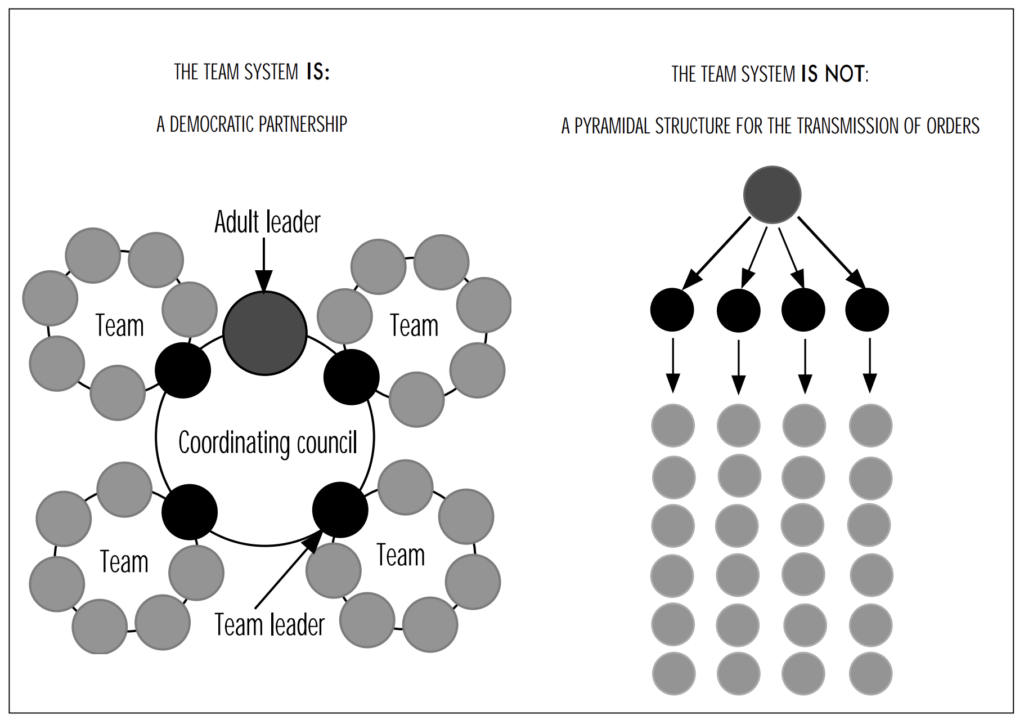
    Genuine leadership happens there: in the patrol, not in a youth-operated troop bureaucracy or a management structure staffed by youth wearing officer patches.

    While BSA’s gold loopers1 still use “patrol method” when talking about the Scouts BSA program, they are using the words while abandoning the thing. Over the past century, gold loopers have mostly paved over the patrol method, filling that space with a corporate-bureaucracy simulation.

    Before I go on, some level setting:

    Scouts BSA’s focus has strayed far from youth leading self-governing patrols. Instead, the focus is on youth filling bureaucratic roles in an adult-authored, troop-level structure.

    Series note: This is part one of a five-part series on how BSA’s gold loopers stole the patrol method, replacing it with a corporate-bureaucracy simulation. (The next articles will be published in a few days.)

    Part 2: How the troop bureaucracy acquired a leadership theory
    Part 3: How troop positions of responsibility stole patrol ownership
    Part 4: Adults must stop hiding behind youth offices
    Part 5: High schoolers are not troop staff

    What the patrol owns

    A patrol is more than a seating chart or a camping subunit. Again, it a small team of youth pursuing adventures they actually own.

    BSA’s material describes a patrol as a small team where youth “learn skills together, share responsibilities and take on leadership roles”.2 World Scouting treats the “Scout Method”3 (its equivalent to “patrol method”) as “essential and unique system for progressive self-education”4.

    The patrol method is the timeless vision of Scouting’s founder, Robert Baden-Powell5:

    The Patrol System is the one essential feature in which Scout training differs from that of all other organizations, and where the System is properly applied, it is absolutely bound to bring success. It cannot help itself!

    Robert Baden-Powell, Aids to Scoutmastership, 1920 edition

    It is also visible in BSA’s international peer organizations. The exact wording varies, but the center of gravity is familiar: patrols do the program, adults support. For example:

    • Scouting Ireland says the troop program should be based around “Patrol based adventure and interaction”, that camp should be patrol based, and that Scouts should decide and organize their own program while working in patrols with adult support.6
    • Scouts Australia says the patrol method “is integral to Scouting” and that “[v]irtually all Scouting activities occur in Patrols”.7
    • The Scout Association in the United Kingdom says patrols “should be able to conduct their weekly programme on their own” with “adult[s] providing advice and guidance where needed”.8

    The adult-support point is crucial. The patrol method is not youth isolation. In BSA terminology, the support comes through “adult association”9: adults close enough to guide and restrained enough not to own the result.

    Scouts BSA’s own aims and methods point the same way. Leadership development is the only item that appears both as an aim and as a method.10 The patrol method develops leadership because it gives small teams the space for real decisions, real peer influence, and real consequences.

    The patrol is the natural unit of action

    No ordinary group of youth, handed a blank page and a trail map, would invent a corporate-bureaucracy simulation. They would invent a patrol. A leader would emerge. They would choose a destination, argue about what would make the trip worth doing, decide how bold they want to be, and come home with a story that belongs to them. They will stumble. That is part of the work. The patrol method gives them a real space in which to try.

    That instinct sits near the beginning of Scouting. Baden-Powell wrote about the natural youth gang as raw material for Scouting11, and Ernest Thompson Seton likewise built from the tendency of boys to form groups1213.

    Seton’s Woodcraft Indians program formalized that instinct into small bands, which were essentially patrols, with their own youth leaders and adult guides. (Some cross-band youth roles also existed, but they supported the patrols in rotating, episodic terms, such as during a campout. They were not a lasting bureaucracy that replaced small-team ownership.)14

    This is much of the magic of the patrol method: personal development by harnessing a natural tendency of youth.

    The patrol is the unit of action. It is where a Scout with a vision has to motivate actual peers, not simply occupy a titled office inside a structure written by gold loopers.

    The troop exists to support patrols

    The patrol method means Scouts acting through small, self-directed teams. It does not mean youth filling offices in a troop-wide administrative chart.

    The patrol method places the spotlight on patrol programs, not troop machinery. The troop supports the patrol method by being a container for patrols and a support structure around them. It is not supposed to be the operating unit that consumes patrol autonomy.

    That said, the support of patrol autonomy still needs guardrails. A working troop has safety expectations, adult availability, transportation limits, calendar realities, facility reservations, and shared patrol commitments. However, those limits come from practical necessity, not obedience to a youth bureaucracy.

    For example, the Patrol Leaders and Scoutmaster might agree that the troop will host a campout at Tyler State Park in October and that all patrols will share a Saturday evening meal. That facility and meal choice will bound the option space for patrol adventures. This bounding is a result of the decision of the patrols, and the remaining option space is expansive, allowing real patrol autonomy.

    The simple test is this: Who gets to answer the patrol’s real questions? What adventure do we want to attempt? What would make this ours? What risks are we ready to manage? What help should we ask from adults? Which mistakes are ours to learn from? What traditions and habits do we want to build?

    If those questions are answered by a troop bureaucracy before the patrol ever asks them, the patrol method has been stolen. And that is what the next article will help us see, the gradual theft of the patrol method and how it was replaced with a troop-level youth bureaucracy.

    A council of patrol leaders is not troop staff

    Some will point to Baden-Powell’s own council of Patrol Leaders as evidence of troop-level staffing. That council was not a troop staff meeting. It was Patrol Leaders guarding collective standards and settling inter-patrol questions while each patrol kept its own program.15 Authority flowed up, from the patrols, into this council from the patrols.

    In the gold-loopers’ Scouts BSA corporate-bureaucracy simulation, the PLC inverts that authority. The modern PLC is where a Senior Patrol Leader chairs a standing committee whose stated purpose is to “review[…] and carr[y] out” the “troop’s plans”16 (emphasis added), and patrols then share in execution of PLC decisions alongside troop-level youth bureaucrats.

    Baden-Powell’s PLC was patrols in congress. BSA’s PLC is operation of a corporate bureaucracy.

    The semantic fate of “court of honor” tells the same story. In Baden-Powell’s formulation, the court of honor was a narrower form of the Patrol Leaders’ Council, intended to handle the more thorny issues, such as advancement and discipline. Advancement and discipline are now adult-managed, and that is appropriate.17 However, this name survives today as a ceremony to hand out patches.18 The disappearance of the original court of honor function is a symptom of a larger shift, which requires us to ask, “What meaningful responsibility remains for Patrol Leaders and patrols, especially beyond contributing to planning troop activities and supplying labor to a troop-level youth bureaucracy?”

    Gold loopers stole the patrol method from youth

    In the Scouts BSA program, we often see teams that cook together, camp together, make duty rosters, clean gear, and solve ordinary camp problems. We mistakenly believe this is evidence of the patrol method.

    While those chores are necessary, they are not proof that the patrol method is being used. An adult can point to Scouts planning a menu and still miss the deeper thing: patrol self-government.

    The patrol method depends on the patrol having meaningful control over its own life. The patrol should be able to form its identity, choose its adventure, make its arrangements, develop its habits, and live with the consequences.

    The question is not whether a team is performing chores together. Essential to the patrol method is that the patrol owns its adventure.

    Gold loopers stole the patrol method from BSA’s youth. Their design for the Scouts BSA program displaces the patrol method with a corporate-bureaucracy simulation19:

    The teams are still there, and they are still called patrols. That is why Scouts BSA can appear to preserve patrol-method vocabulary even though the patrol’s crucial self-government opportunity is hollowed out.

    The patrol flag remains. The patrol name remains. The patch remains. The chores remain. But gold loopers captured the patrols, moving the center of decision-making into a troop-level youth bureaucracy. They eviscerated the very thing Baden-Powell said the patrol method exists to do20:

    The object of the Patrol System is mainly to give real responsibility to as many of the boys as possible with a view to developing their character. If the Scoutmaster gives his Patrol Leader real power, expects a great deal from him, and leaves him a free hand in carrying out his work, he will have done more for that boy’s character expansion than any amount of school-training could ever do.

    Robert Baden-Powell’s reflection on the point of patrols in Aids to Scoutmastership, 1919 edition (emphasis added).

    Leadership is influence, not administration

    The Patrol Leader is supposed to be the leader of a largely self-governing patrol. That means this youth helps turn the patrol’s own will into action: drawing out a vision, persuading peers, coordinating preparation, settling friction, noticing who needs help, and keeping the patrol moving toward a shared purpose.

    The Patrol Leader’s authority is peer-based leadership. This is trust, competence, and respect inside the patrol, not a titled slot inside a troop chain of command.

    The Scouts BSA corporate-bureaucracy simulation changes the Patrol Leader’s work. Instead of leading a semi-autonomous patrol, the Patrol Leader becomes a transmission belt inside a troop machine: attend the PLC21, receive the troop plan, relay it to the patrol, supply labor for troop activities, report upward, and keep the patrol aligned with decisions made elsewhere.

    Management keeps the institution running. Supervision keeps people in line. Administration keeps the files straight. These are what the corporate-bureaucracy simulation emphasizes.

    Leadership is different: it is mutual influence around a shared vision.

    That distinction is not some eccentric Scouting obsession. For example, Abraham Zaleznik‘s classic Harvard Business Review essay, “Managers and Leaders: Are They Different?”, contrasts the managerial concern for competence, control, and balancing groups with the imaginative, desire-driven work of leadership.22 Translate that into Scouts BSA, and the problem becomes obvious. The corporate-bureaucracy simulation gives adults the neat surface of management. The patrol method, which gold loopers paved over, gives youth the messy social space where leadership can actually form.

    Administration does not become leadership because youth do it

    Competence with the English language can help one be a better plumber, yet it would be absurd to claim that high-school English classes constitute training for plumbers. The same goes for administration, management, and supervision: they are not leadership. While training in those competencies can have value to leaders, they do not cause a person to become a leader.

    A Scout can chair a meeting, direct traffic, enforce a schedule, assign tasks, or take minutes without practicing leadership. Those actions may be useful. They may even be necessary in a bureaucracy. But usefulness does not make them leadership.

    Nor does foisting troop-level administrative duties on youth, especially in the sense of lasting, titled roles, cause leadership development. Those tasks can be useful. A particular older youth might even want some of them as an additional challenge. But just because a youth occupies that titled role does not transform it into leadership.

    Also, there is nothing essential to Scouting that requires troop-level administration to sit at the center of any youth’s experience. What this mainly does is redirect youth attention out of the leadership-oriented patrol experience towards troop-level bureaucratic concerns, and it removes from patrols the decision points that make self-directed teams real.

    Even worse, this troop-level youth bureaucracy stands in for adult mentoring, filtering it through a youth-run, supervisory chain of command.

    None of this enhances BSA’s mission to develop leaders.

    When adults snort, “But the youth lead the troop,” they have not answered the charge. They have repeated the problem. Instead of being provided leadership opportunity, the youth were presented with a bureaucratic scheme and told to operate it.

    The burden of proof belongs on gold loopers

    In BSA culture, those who doubt gold loopers are treated with disdain. This culture puts the burden of proof on supporters of the patrol method, requiring them to explain why they resist the corporate-bureaucracy simulation. That has it backwards, and the burden should run in the other direction.

    Unlike the corporate-bureaucracy simulation, the patrol method has the founder’s warrant, remains recognizable in world Scouting, fits the natural way youth form small teams around shared adventures, and supports genuine leadership development. If gold loopers want to replace leadership development with a bureaucratic, troop-office scheme, the burden is on them to explain why their substitute is better.

    Gold loopers’ usual answer is that troop offices and positions of responsibility teach leadership. But a bureaucratic office does not become leadership merely because gold loopers say so. Gold loopers have mostly kept the patrol-method vocabulary while training Scouts and adults to operate something else.

    Adjacent programs show the shape

    The irony is that the programs on either side of Scouts BSA preserve the small-team shape better than Scouts BSA itself.

    Cub Scouts adapts the small-team pattern for younger children. Elementary-school children need adults much closer at hand, so the program is adult-led. But structurally, the den remains the small team, the Den Leader works directly with that team, and dens generally run independent programs.23

    Venturing adapts the same spirit for high schoolers. Adult Advisors advise rather than command24, and the crew design allow officer duties and team structure to vary with the crew’s needs.25 High schoolers can mentor within their own ranks: planning age-level adventures, apprentice younger high schoolers into real responsibility, and build a peer culture appropriate to their age.

    The next article follows the historical buildout of the Scouts BSA corporate-bureaucracy simulation, where gold loopers gradually built a troop-office machine, wired it into advancement, and then gave that machine a leadership-development theory.

    Footnotes

    1. Gold loopers are people associated with BSA’s national organization, which also includes territories, wear yellow shoulder loops on their uniforms. Formally, this color is called “gold”. While shoulder loops date only to the uniform redesign from around 1980, I apply the term retroactively to BSA’s national-level volunteers and professionals of every era. (Council and district adults, not a subject of this series, wear silver loops.) ↩︎
    2. The Patrol, Troop Leader Resources, Boy Scouts of America. ↩︎
    3. Constitution of the World Organization of the Scout Movement, World Scout Bureau, August 2024 ed., Chap. I, Art. III, p. 7. The team system is a constitutional element of the Scout Method, agreed by all member organizations, including BSA. ↩︎
    4. Scout Method, World Scouting. ↩︎
    5. Robert Baden-Powell, Aids to Scoutmastership, 1944. p. 8. This is the World Brotherhood edition. Pagination is based on the digitized PDF copy with three columns. ↩︎
    6. How to Run Scouts, Scouting Ireland, pp. 21-22. ↩︎
    7. The Adventure Begins – Scout Method, Scouts Australia, Feb. 1, 2018. ↩︎
    8. Leadership, The Scout Association. ↩︎
    9. Scouts BSA: The Aims and Methods of Scouting, Boy Scouts of America. BSA lists “Association with Adults” as one of the methods of Scouts BSA. ↩︎
    10. Scouts BSA: The Aims and Methods of Scouting, Boy Scouts of America. BSA identifies leadership development as one of Scouting’s aims and also as one of the methods of Scouts BSA. ↩︎
    11. Robert Baden-Powell, Aids to Scoutmastership, 1944, p. 8. ↩︎
    12. David C. Scott, Ernest Thompson Seton: The Beginnings of Controversy, Scouting Milestones, curated by Colin Walker. ↩︎
    13. Ernest Thompson Seton, The Birch-Bark Roll, 6th Edition, 1906, p. 3. ↩︎
    14. Ernest Thompson Seton, The Book of Woodcraft, 1921, pp. 179-189. ↩︎
    15. Robert Baden-Powell, Aids to Scoutmastership, 1944, p. 8. ↩︎
    16. Patrol Leader’s Council Monthly Planning, Boy Scouts of America. ↩︎
    17. This evolution is appropriate. The Barriers to Abuse places discipline under the Adult Supervision section. While the Guide to Advancement, 2025, permits limited youth involvement in selected advancement mechanics, it is always at the discretion of adults. For example, section 4.2.1.2 The Scout Is Tested leads with “The Scout’s unit leader authorizes those who may test and pass the Scout on rank requirements”, then lists selected, titled youth roles the unit leader might consider authorizing for this duty. ↩︎
    18. Troop Courts of Honor, Boy Scouts of America. ↩︎
    19. Troop Structure, Boy Scouts of America. ↩︎
    20. Robert Baden-Powell, Aids to Scoutmastership, 1919, p. 47. ↩︎
    21. Despite the name, the Patrol Leaders’ Council (PLC) does not focus on Patrol Leaders or patrols. The focus is on the troop-level machinery. Patrol Leader’s Council Monthly Planning, the main documentation for how this committee works, leads with “The troop’s plans…” ↩︎
    22. Abraham Zaleznik, Managers and Leaders: Are They Different?, Harvard Business Review, Jan. 2004. Zaleznik contrasts the managerial concern for competence, control, and balance with the imaginative work of leadership. ↩︎
    23. How Cub Scouting is Organized, Boy Scouts of America. ↩︎
    24. Venturing Terminology, Boy Scouts of America. ↩︎
    25. Crew Officer Orientation: Facilitator’s Guide, Boy Scouts of America, 2025. ↩︎
  • OA’s tribal agreements are a fraud

    OA’s tribal agreements are a fraud

    Order of the Arrow, a BSA-branded operation, is known best for 111 years of redface minstrel shows.

    In an incomplete reform attempt, BSA now requires OA-branded council operations to put some Native-themed programming under tribal purview. The authority is to be documented in a written agreement.

    I am using “fraud” in a public-accountability sense: these agreements look like tribal oversight, but they are blanket permission slips, vague enough to let councils continue their OA-branded redface minstrel shows.

    Given the powerful incentives for OA to perpetuate its redface minstrel show, I always suspected we’d see fraudulent tribal agreements. All of the agreements I have found are fraudulent.

    OA’s ethical problem

    One form of OA’s redface minstrel shows is where non-Native, teenage actors perform pageants based on “the legend”, which is just Western children’s fantasy fiction. The legend has a phony Native connection, where OA decorated this fantasy fiction with remixed, stolen, and fake tribal culture. OA treats tribal culture like war trophies of conquered peoples.

    Many have been scammed by OA’s false claims of being an honor society or by its phony religion. The ensuing emotional connection drives aggressive, counterfactual defenses of OA. One example is that OA’s cosplay pageants are vital to preserving tribal culture.1 Others White-wash this cultural theft as respect, honor, or appreciation of tribes.2 There’s more. No matter the defenses, OA’s ethic celebrates the intended outcome of the USA’s white-supremacist tribal-eradication campaign. Had the campaign been successful, we’d be in a dystopia where tribal culture is divorced from any sense of ownership, and non-Indigenous people would be needed to preserve this culture.

    Thankfully, the campaign was stopped. Tribes still exist.

    The naked truth is OA has always stolen tribal culture for its own profit. This profit is measured in coherence. With this stolen culture, OA concocts a faux, animist-pagan religion. This religion distracts everyone from OA’s incoherence. Without the religion, OA’s absurdity becomes obvious, and OA collapses.

    This profit shows up in other facets of the OA redface minstrel show. For example, OA permits3 councils to name their OA operations—lodges and chapters—with words stolen from Indigenous peoples, often from the Lenape people.4 OA gains gravitas from its use of these stolen words, similar to how military impostors benefit from stolen valor.

    OA’s intent

    In 2024, OA announced it will clean up some of its act, only allowing Indigenous-themed performances in councils that have a written agreement with a local state- or federally-recognized tribe.5 This policy went into effect on January 1, 2026.6

    Few councils appear to be publicly disclosing agreements. I am currently aware of three agreements, and each is fraudulent: it evades the intent of OA’s restriction, or it was struck with a fraudulent entity, or both!

    OA intends that councils restrict AIA to what is authorized under a written agreement with a local7 tribe.

    In its AIA Policy page, OA says “[t]ribes may determine to what extent they want [councils] to conduct American Indian programming.”8 As it would be unethical for a tribe to authorize use of any other tribe’s culture, the most a tribe could authorize is use of that tribe’s own culture.

    OA further clarifies that councils “are free to pursue multiple agreements if they would like to offer a wider variety of programs that appreciate the different traditions in their area.”9 The only reason that OA would say that is because each tribe can only ethically authorize use of its own culture. Councils that wish to employ culture of additional tribes must reach an agreement with those tribes.

    To summarize, tribal agreements may only authorize councils to use the culture of the tribe they struck an agreement with. The ethics of this are obvious, and OA’s own words reinforce those ethics.

    Fraud: Old Hickory Council evades intent

    Here’s an example agreement that Old Hickory Council struck with a tribe (names of the tribe and individuals, other than the council CEO, are redacted):

    This agreement does not restrict this council to using only the culture of the signing tribe. In fact, the first bullet’s phrase “the practices of the American Indian people vary from tribe to tribe” does a lot of work. It is a license to continue the old practices, where the council may freely steal from any tribe!

    As evidence of theft, Old Hickory Council’s OA operation is named “Wahissa Lodge”. While “wahissa” is likely a Lenape-derived word10, the agreement was signed with a group claiming Siouan heritage, a different branch of tribes that cannot ethically grant use of Lenape culture.

    In granting this unethical, universal license, the signing tribe gets little in return: an annual written report and “best efforts” to support an annual tribe event.

    The important point is how this agreement evades a key intent behind tribal agreements. It does not restrict the council to use of the signing tribe’s culture.

    Fraud: Indian Waters Council evades intent

    Here’s another agreement, this time between the Indian Waters Council and a tribe11:

    Did you see that? It’s based on the same template! Look at the first bullet. The truck-sized loophole appears again, freely allowing resumption of OA’s 111 years of racist cultural theft. And the theft is laid out in the document, which indicates that Indian Water Council’s OA operation is named “Muscogee Lodge”. “Muscogee” is obviously a reference to the Muscogee people, yet this agreement was signed with an entity claiming Cherokee association.

    Just stammer “honor” and “respect”, and the redface minstrel show resumes!

    Fraud: Indian Waters Council’s agreement with a fraudulent entity

    It gets worse. The “tribe” Indian Waters Council signed with appears on the Cherokee Identity Protection Committee’s list of fabricated groups.

    The Cherokee Identity Protection Committee, a collaboration of the three federally-recognized Cherokee tribes–Eastern Band of Cherokee Indians, Cherokee Nation, United Keetoowah Band of Cherokee Indians–is a 2011 initiative to root out fake tribes. It compiled a list of 211 “fabricated groups” on what it calls a “Fraud List”.12

    In this collaboration, these tribes “protect our elders and traditionalists by stopping these [fake tribes] and individuals from appropriating our culture, language and traditions.”13

    These tribes later released an forceful 2020 joint statement condemning the fake tribes. One section also eviscerates OA’s 111 years of redface minstrel shows14:

    6)  We condemn all individuals and collectivities that ‘play Indian’ or ‘play Cherokee’ in all its forms, regardless of the intent.  This includes the widespread practice of forming fraudulent, so-called ‘state-recognized’ Cherokee tribes or nonprofit organizations that claim to confer Cherokee citizenship.  Non-Cherokees should never participate in Cherokee cultural expressions unless under the direct guidance of a Cherokee citizen.

    Put differently, these tribes are concerned about fake entities that, just like OA’s redface minstrel show, use stolen, native culture for their own profit. By entering into a loophole-ridden agreement with a fake tribe, the Indian Waters Council is perpetuating the act that the Cherokee tribes find deeply harmful!

    For the sake of argument, let’s suppose they are wrong, and these entities are legitimate? Even if that is true, by entering into an agreement with an entity on that list, Indian Waters Council picked a side in a major dispute, and it picked the side the major Cherokee tribes find deeply harmful.

    Native people and their advocates have warned me about this. Deciding what counts as a legitimate tribe, or who is a Native American, is complex. It is beyond the scope of Scouting to weigh in on this, but these tribal agreements force us to do so. Why, though? Why does BSA permit councils to pick sides in a dispute where it has no skin in the game? How does this help BSA do Scouting better?

    Fraud: Northeast Georgia Council does all of the above

    Northeast Georgia Council provides another example of the duplicity of OA culture.

    This is the council’s tribal agreement15:

    The childish font and that the council didn’t publish a signed agreement reveal the unseriousness of this document. The words confirm its a fraud.

    First, this is yet another agreement with what the recognized Cherokee tribes have declared a fraudulent entity. As per above, even if this entity is not a fraud, by picking sides in this dispute, BSA enters a space it does not belong.

    Second, this agreement does not clearly limit the lodge to use of any tribe’s culture. With its soft, aspirational language; avoidance of words or phrases like “must”, “limited to” “shall only”, or similar; and no compliance mechanism, this agreement does not restrict which Native culture Northeast Georgia Council may use.

    Even worse, the first provision blesses BSA’s longstanding theft of Native culture as “a celebrated part of its programming”. That frames this agreement as continuity of OA’s racist pageantry, not a corrective restriction on it.

    Other provisions confirm the above:

    • While provision 4 includes “more locally focused”, that is not a boundary, it’s just an aspirational emphasis.
    • Provision 5’s aspirational language is undercut by “the traditions of those Native Americans who were and are a part of the geographic area shared by both parties”. This is a permission slip for Northeast Georgia Council to use any tribe’s tradition as long as its current or historical territory roughly corresponds to the council’s territory or broader Cherokee territory, which historically overlapped multiple states.

    Fraud: North Florida Council also evades transparency

    I have called for OA to require transparency on tribal agreements. I insist they be posted on council websites. This is necessary because 111 years of racist sins, combined with aggressive denials of these sins, eviscerates trust. Non-public agreements are as good as no agreement. Also, OA is about appreciating tribes, right? Wouldn’t councils want to brag about formal agreements that confirm this appreciation?

    North Florida Council validates my concern. After learning that this council struck an agreement with a tribe, an adult member asked this council’s Lodge Advisor–the adult-volunteer role that oversees a council’s OA operation–for a copy of the agreement. The Lodge Advisor refused.

    Why? Because it’s another fraudulent agreement!

    First, it’s with another fraudulent entity on the Cherokee list!

    Second, the Advisor admitted the agreement has no end date, despite OA’s guidance that agreements should “have a set duration”.16

    Third, this agreement has the truck-sized loophole. The Advisor confirmed this when he said that with the fraudulent agreement, the faux-Cherokee tribe gave North Florida Council cover to keep naming its OA operation with a word stolen from the Seminole people. He then twists the knife, diminishing the Seminole people’s ownership of their own culture by stating (paraphrased) “there are a lot of people who wear Seminole-style jackets as fashion items!”

    The Lodge Advisor signed off on his conversation with a “trust me, bro”-style statement (again, paraphrased): “A Scout is Trustworthy. You can take my word for it and don’t need to see the letter.”

    Sorry, bro, after 111 years of OA’s racist sins, we can’t trust you. No public agreement is as good as the agreement not existing. If these are real, show the receipts.

    OA does not verify tribal agreements

    BSA’s national OA office doesn’t verify these agreements. Councils only “attest” to the existence of an agreement.17 It’s more “trust me, bro”, captured in a checkbox on an annual form.18

    In a conversation with a concerned person, a national OA representative implausibly conveyed that BSA does not have time to review tribal agreements. With a large OA national committee, BSA can review these agreements.19 It doesn’t want to.

    And I can understand why. The OA committee performs poorly. For example, it took almost 5 years to rewrite its children’s fantasy fiction.

    But the problem cuts more deeply. If OA reviewed these agreements, they wouldn’t pass muster. But OA needs these agreements. OA is addicted to its redface minstrel show. It can’t stop. That’s why:

    • OA fraudulently claims reform while allowing loophole-ridden agreements.
    • OA fraudulently claims tribal oversight while refusing to verify agreements.
    • OA fraudulently claims “respect”, “honor”, etc. while continuing to steal Indigenous culture for use as institutional decoration.

    Retire it!

    OA is a fraud. OA is an embarrassment to Scouting.

    It gets worse. OA isn’t even a program of BSA.20 It’s just a branded operation that has crept so far outside its lane, it cannibalizes and displaces the actual programs, and it helps trap high schoolers in a middle-school program. It maps poorly to what Scouting even is.

    Why is anyone bothering to save this?

    OA must be retired. We must instead invest in the actual Scouting programs.

    1. (this is provided as a representative example) National Bulletin, Order of the Arrow, Issue 1, Volume LXII, Spring 2015. See page 9 where someone associated with a different country’s Scouting movement proclaims that “Native American history and legacy is preserved and honored by the [OA] Scouts”. Given that this person doesn’t live in the USA and is likely unfamiliar with OA, he was likely to have been told the preserving-culture scam by the redface minstrel show’s actors. ↩︎
    2. (this is provided as a representative example) Field Operations Handbook, Order of the Arrow, November 2025. Page 27 includes “Respect for American Indian culture, tradition, and heritage is a key component of Order of
      the Arrow programs.” ↩︎
    3. AIA Policy, Order of the Arrow. See section titled “Do lodges or chapters need to change their names, totems, or other items that use American Indian names or terms?” This section upholds the longstanding practice of decorating facets of OA with stolen tribal culture. ↩︎
    4. Order of the Arrow cleanliness audit. See the source data, linked below the graph. ↩︎
    5. Policy Update: Changes Regarding American Indian Programming“, Order of the Arrow website, September 24, 2024. ↩︎
    6. Ibid. ↩︎
    7. AIA Policy, Order of the Arrow. Throughout the policy, “local” is exclusively used to define geographic limits on the tribe’s location. ↩︎
    8. AIA Policy, Order of the Arrow. See section titled “Will lodges be provided with a template or sample agreement needed to establish a relationship with their local tribe?” ↩︎
    9. Ibid. ↩︎
    10. Various clues suggest this is an Anglicized spelling of a Lenape word relating to goddess, beauty, or happiness. ↩︎
    11. Muscogee Ensures Future of AIA Program, Indian Waters Council (via its website for its OA operation, named Muscogee Lodge) ↩︎
    12. Matthew L.M. Fletcher, “Eastern Band Establishes Cherokee Identity Protection Committee“, Turtle Talk, October 17, 2011. While this article claims 212 entities, its data source lists 211. ↩︎
    13. Ibid. ↩︎
    14. Cherokee Scholars’ Statement on Sovereignty and Identity“, Think Tsalagi ᎢᏓᏓᏅᏛᎵ ᏣᎳᎩ, February 13, 2020. ↩︎
    15. A New Day… A New Era…, Northeast Georgia Council (through the website of its OA operation, named Mowogo Lodge) ↩︎
    16. AIA Policy, Order of the Arrow. See section titled “Will lodges be provided with a template or sample agreement needed to establish a relationship with their local tribe?” ↩︎
    17. AIA Policy, Order of the Arrow. See section titled “Who is responsible for maintaining the agreement between the lodge and the tribe?” ↩︎
    18. AIA Policy, Order of the Arrow. See section titled “How often does the agreement with a tribe need to be renewed?” ↩︎
    19. National Order of the Arrow Committee“, from the Order of the Arrow website of the Boy Scouts of America. ↩︎
    20. Rules and Regulations of the Boy Scouts of America, October 28, 2025. At the top of page 12 is “The youth programs of the Boy Scouts of America are Cub Scouts, Scouts BSA, Venturing, Sea Scouts, and Lone Scout.” ↩︎
  • Scouting’s real crisis is not marketing. It is decades of neglect.

    Scouting’s real crisis is not marketing. It is decades of neglect.

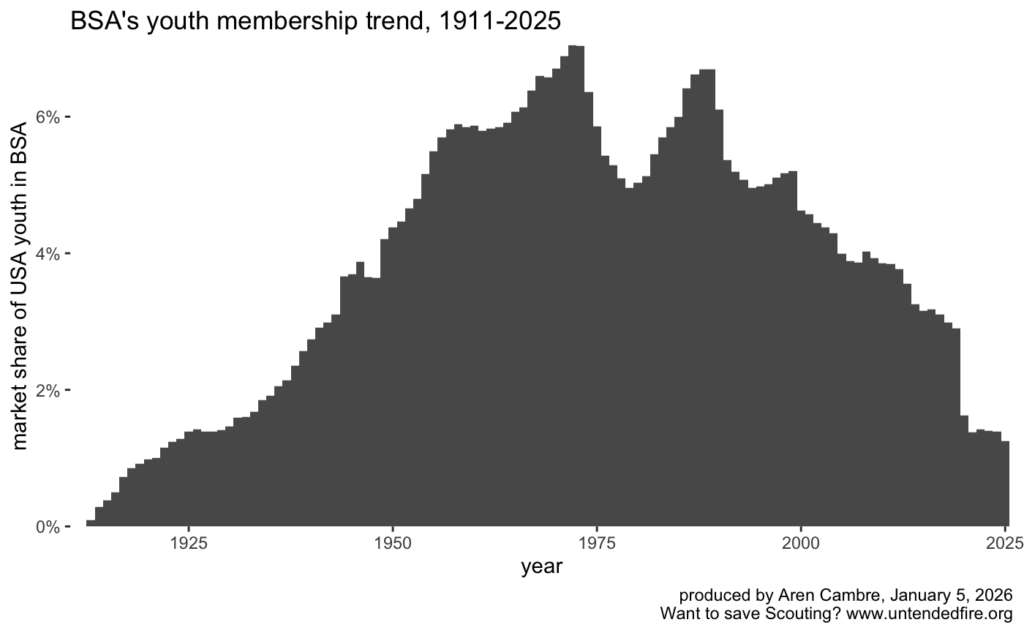
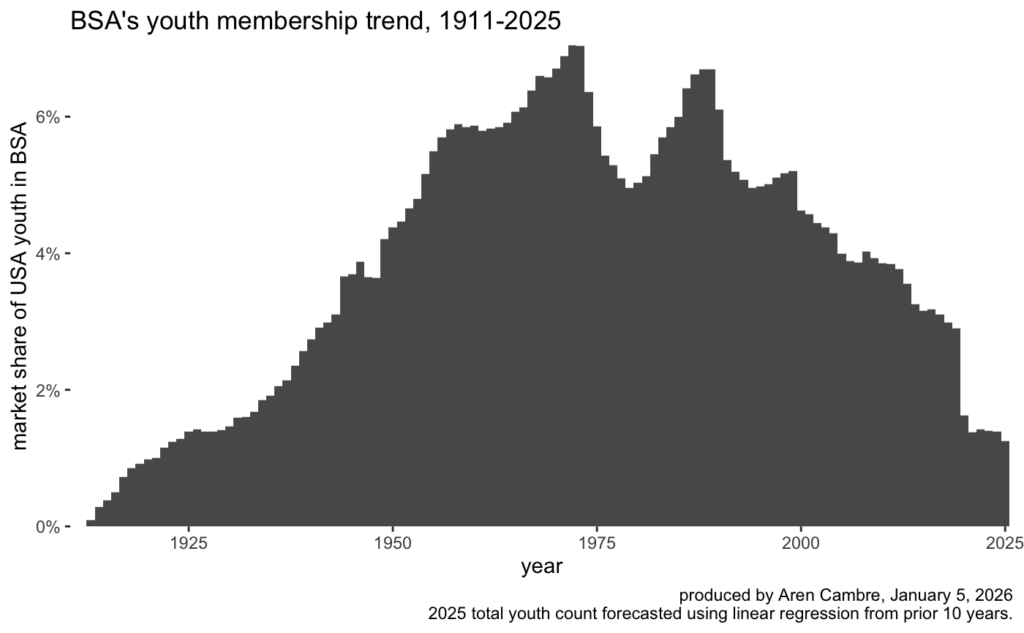
    When the Boy Scouts of America, recently rebranded as Scouting America, gathers in Dallas May 11-15 for its National Annual Meeting, its leaders will confront a crisis that messaging cannot solve. At the end of 2025, the organization’s market share sank to about 1.25 percent of American youth, the lowest since about 1923. The organization has not strung together a multi-year recovery in 25 years.

    BSA’s decline is not the generic story of a youth organization losing ground to phones, sports, or overscheduling. Those affect everyone. BSA’s problem is more specific. Its historic advantages—brand recognition, inexpensive outdoor access, and the prestige of Eagle Scout—once masked program defects. As those advantages diminish, families see the defects more clearly.

    The obstacle is BSA’s national culture. Inside BSA, career advancement and volunteer appointments are too often detached from producing better youth programs. Instead, they are commonly prestige markers awarded to those who avoid candor. Accountability is optional; institutional deference is not. The result is a class of insiders who deny decline with cheerful press releases while treating internal critics as disloyal.

    This culture validates bad ideas. The clearest example is the program Americans still picture when they hear “Boy Scouts”: Scouts BSA, the tan-uniform program that runs from 10-year-old fifth-graders to high-school seniors. No school, sports league, or serious youth-development program would treat children leaving elementary school and young adults preparing to graduate as one developmental audience. BSA does.

    This pattern extends to BSA’s other programs. Cub Scouts makes fifth graders share a program that also accommodates kindergartners. Venturing and Sea Scouts run from eighth graders to 20-year-old adults. The pattern is not developmental clarity. It is administrative convenience.

    BSA is an outlier in world Scouting. International peer organizations typically use age spans of three to five years, and none merge middle schoolers and high schoolers into one program. Those age bands are where development moves fastest, and BSA chose to blur it.

    The cost falls on both ends of Scouts BSA. That program is optimal for middle schoolers, but middle schoolers are not trusted to own it. They are managed by older youth instead. High schoolers fare no better. Instead of receiving programming built around autonomy, peer challenge, advanced outdoor adventure, and responsibility suited to their age, the vast majority are trapped in a middle-school program where their main role is supervising the younger Scouts. BSA romanticizes this as mentoring. Teenagers see it as babysitting. They know the difference, and they leave.

    That culture’s deepest failure is conceptual. Leadership is a key Scouting promise, the only item common to its methods and aims, and the promise BSA often invokes to justify Eagle Scout1, youth offices2, patrols3, and adult training4. But leadership is not a patch. It is not a title, office, authority, or chain of command. Leadership is influence: persuading voluntary followers to move toward a shared vision for change.

    BSA has spent decades replacing leadership with administration. This substitution is evident in how BSA replaced the patrol method with a corporate-bureaucracy simulation. Widely used internationally, the patrol method is small, independent, self-governing teams of youth making real decisions, solving real problems, and learning through consequences. It centers on the patrol and Patrol Leader. Decades ago, BSA evicted the patrol method in favor of emerging corporate-management theories5. Patrols became roster slots inside a bureaucracy of titled youth roles, layered reporting6, meeting scripts7, and committee procedure8. BSA never stopped saying “patrol method.” It preserved the vocabulary while replacing the operating system.

    Wood Badge, the organization’s premier adult-training program, reinforces the substitution. Marketed as leadership training, it functions mainly as a bureaucrat-polishing school. Adults rehearse the corporate-bureaucracy simulation and return home to faithfully implement what undermines leadership development.

    The Eagle Scout rank illustrates the same drift. American society gives BSA an extraordinary gift: it treats Eagle as a distinction among high schoolers, a signal of maturity and leadership. BSA undercuts that gift. Eagle is just part of a middle-school advancement ladder, and 11-year-olds can earn it.9 Instead of certifying tested leadership, it often rewards advancement velocity, compliance, and tenure in bureaucratic titled offices. Its famous service project is mostly a worksheet exercise10, accompanied, tellingly, by no project-management training.

    The culture’s aversion to candor extends to public missteps. After emerging from a sexual-abuse bankruptcy, BSA rebranded itself “Scouting America.” The new name initializes to “SA,” common shorthand for sexual assault. National leadership appears to know: BSA forbids use of the SA acronym, and on its official volunteer forum, national bureaucrats censor SA. When an initialism-rich organization chooses an initialism-prone brand yet forbids the initialism, it admits competence and candor problems.

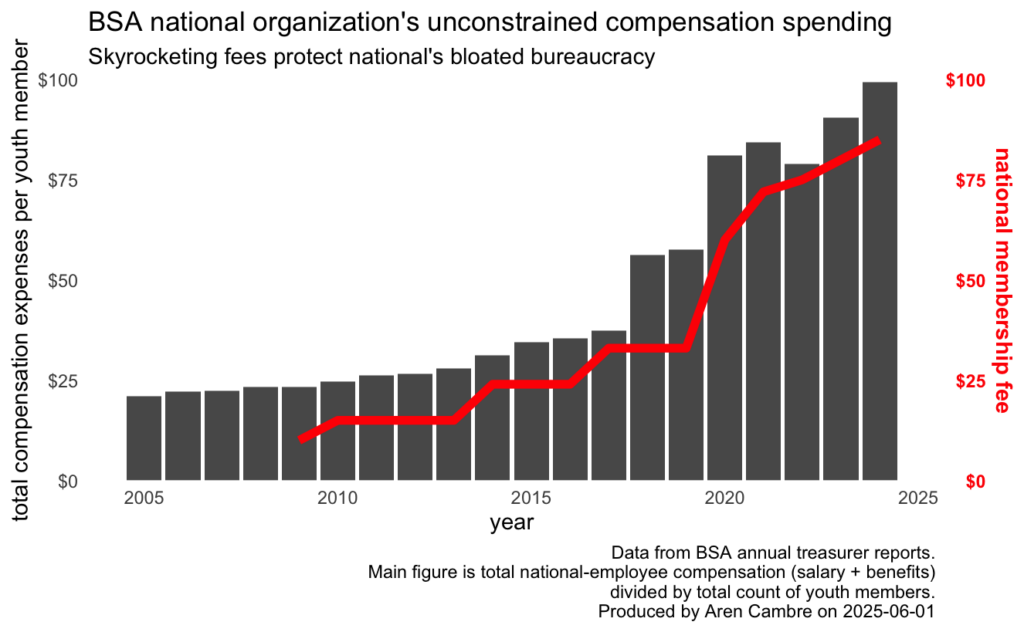
    The institutional priorities are visible elsewhere. BSA’s 2024 audited statements list about $329 million in debt, including roughly $186 million in bonds for a West Virginia facility that in 2023 was utilized 97 percent below expectations. And when Secretary of War Pete Hegseth threatened military support, BSA quickly abandoned DEI initiatives, discontinued the Citizenship in Society merit badge, and undid inclusive policies. While readers may disagree about those policies, the institutional lesson is clear: BSA can act fast when outside pressure threatens the convenience or prestige of its national bureaucrats. It does not act at all when youth flee its programs.

    Dallas is the moment for truth. A serious agenda would begin with admissions: middle-schoolers deserve ownership of their own program; high-schoolers deserve a program built for their life stage; the corporate-bureaucracy simulation must be evicted and the patrol method restored; adult training must focus on genuine leadership; Eagle’s public meaning is being squandered; and the new corporate brand is an unforced error. These are starting points, not the full agenda. None of this requires another pilot program. It requires leaders willing to name the problems in public.

    This hard work is unlikely. Reform at BSA follows a familiar arc: stalled for decades, then bungled when finally implemented. The admission of gay members and girls took this course. National leadership has convinced itself that doing little, offending no one, and appeasing every constituency will produce the turnaround it needs. It will not.

    The membership trendline does not care about institutional feelings. If national leadership will not eat a few sacred cows in Dallas, the organization will be eaten by its own irrelevance. Anything less than candor is cheerful packaging around continued neglect. And if inaction means high-schoolers will remain in a middle-school program to supervise younger youth, BSA should at least have the honesty to pay the babysitters.

    Continue the conversation

    Keep the discussion going by leaving a comment below or joining social-media groups friendly to discussing Scouting’s hard topics:

    1. This justification is typically in loose language, but a specific example is in BSA’s 2024 Report to the Nation, where Eagle Scouts are introduced as exemplifying character, leadership, and service. ↩︎
    2. In the Troop Positions page of the Troop Leader Resources website, BSA lists the 16 different titled roles for Scouts BSA. These are titled roles in a child-sized corporate-bureaucracy simulation. ↩︎
    3. In the Patrols page of the Troop Leader Resources website, BSA references the Brownsea Island experiment. There, BSA praises the patrol method as the “one essential feature” of Scouting. In the patrol method, patrols are largely independent, and Patrol Leaders are elevated, being mentored directly by the Scoutmaster. Ironically, BSA undermines this “one essential feature” with its corporate-bureaucracy simulation, which changes Scouts BSA from where “[t]he patrol is the unit of Scouting always” to the troop itself being the essential unit, with patrols buried under the bureaucracy. ↩︎
    4. For most, Wood Badge is seen as the ultimate adult-training goal. Regrettably, Wood Badge has been undermined, reduced to mainly training on how to act as a corporate middle-manager and an extensive dress rehearsal of the Scouts BSA corporate-bureaucracy simulation. ↩︎
    5. The White Stag initiative seems to have been especially influential on the Scouts BSA design. While its focus on the ways of corporate middle management has value, that is different than leadership. By confusing management with leadership, BSA has undermined its leadership training for youth and has misinformed generations of adult leaders. ↩︎
    6. The Troop Structure page of BSA’s Troop Leader Resources website reveals that troops are a complex, youth-run bureaucracy. This contrasts starkly to the patrol method, still practiced nearly universally in the rest of the world, which generally only has patrols and Patrol Leaders and no child-sized bureaucracy. ↩︎
    7. BSA’s model treats the troop meeting as a scripted, centrally coordinated procedure rather than as the natural expression of independent patrol life. Its Troop Meeting Agenda page of the Troop Leader Resources site illustrates this, describing the weekly troop meeting as something to be managed through “planning and preparation”, directs the Patrol Leaders’ Council to use a “Troop Meeting Planning Form” to keep the meeting “organized and productive”, and divides a standard meeting into prescribed components. The form further structures the meeting by activity, description, who will run each part, and time allocation. This is not objectionable merely because it is an agenda; the point is that the script is the central part of a bureaucracy-run agenda, subsuming independent patrols into a corporate simulation. ↩︎
    8. In the Patrol Leader’s Council Monthly Planning page of Troop Leader Resources, BSA shows the committee layer that squashed patrol life. The page defines the Patrol Leaders’ Council as a monthly body that “fine-tune[s]” the troop program, composed of titled officeholders and attended by a scribe who takes notes and keeps minutes. It calls the PLC the troop’s “elected and duly appointed governing body” and assigns it responsibility for the “planning, preparation, and presentation” of the troop program, with a meeting agenda and planning worksheets linked below. This is youth administration, not leadership. Under this corporate-bureaucracy simulation, Patrol Leaders are pulled into a troop-wide committee procedure, and patrols are diminished as components of a managed troop program. ↩︎
    9. The shortest path to Eagle is 19 months. A Cub Scout can switch to Scouts BSA upon earning the Arrow of Light badge. As long as the Arrow of Light is earned within 5 months of turning 10, then that Scout can earn Eagle as an 11-year-old. ↩︎
    10. The Eagle Scout Service Project Workbook is a 32-page PDF that is often accompanied by additional materials. The Eagle candidate can easily spent many more hours on paperwork exercises than in the project itself. ↩︎
  • When careers come first, Scouting falls apart

    When careers come first, Scouting falls apart

    In any healthy nonprofit, the professional staff exists to serve the mission. Their value is measured by their effectiveness, their innovation, and their ability to deliver results for the movement.

    For decades, the Boy Scouts of America (why SA is a bad name) has operated under a different set of rules, an employment model that functions like a medieval guild.

    I call it the commissioned-bureaucrat system.

    On the surface, it looks like a brotherhood of youth-service experts. But peel back the layers, and you find a career-protection racket. It is a system designed not to identify the best talent but to filter for compliance. It is a structure where loyalty to the bureaucracy outweighs competence, and where the primary objective shifts from growing the movement to preserving the status quo of the employees.

    To understand why Scouting struggles to adapt to the modern world, we have to look at who is running it and the archaic system that put them there.

    A primer on BSA’s employment lines

    BSA has two categories of permanent employees: administrative and commissioned.

    Administrative employees do customary corporate functions, like HR, technology, marketing, and finance.

    The other employment line is the commissioned-bureaucrat system. This is generally for bureaucrats who directly work with the program and their chain of command.

    Becoming commissioned

    Part of becoming a commissioned bureaucrat is a training that’s about a week, typically at BSA’s Irving, TX headquarters. Once commissioned, the employee is essentially ordained, like how ministers are ordained in churches.

    That framing isn’t accidental. Commissioning is treated as a credential that unlocks access, authority, and advancement across program-side bureaucrat roles.

    The system’s phases

    The commissioned-bureaucrat system has three phases:

    1. Hazing: This is the District Executive role, an assignment heavily focused on numbers, called PDS goals. It is brutal, with low pay and often 60 to 80 hours a week. This phase runs off all but those most loyal to the bureaucracy. Those with leadership potential or valuable, distinct skills often exit BSA early.
    2. Middle career: These are typically middle-tier bureaucrats. While often less brutal than the DE role, loyalty to the bureaucracy continues to be tested and rewarded. Those with leadership talent and valuable skills continue to be pushed out or sidelined, further shrinking the pool to bureaucrats optimized for internal compliance.
    3. You’ve Made It™️: After enough years of proving one’s loyalty to the bureaucracy, remaining bureaucrats enter a “good ol’ boys” club. Such bureaucrats often land relatively well-paid, cushy, or prestigious roles. You’ve Made It™️ status often starts with the Scout Executive (council CEO) role.

    This is not a leadership pipeline. It is a career-protection system for bureaucrats.

    Closed shop

    BSA props up the commissioned-bureaucrat system through extensive role gating. It’s essentially a closed shop. In addition to protecting careers of bureaucrats, it eliminates competition, starving BSA of diverse talent.

    Most of BSA’s permanent, full-time, professional roles are gated to commissioned bureaucrats, including1:

    • District Executives (DEs), an entry-level sales and customer-service role that also does many miscellaneous duties
    • A “year-round program position” or a “unit growth executive”
    • Any other council or national-organization position that the national CEO (Chief Scout Executive) declares is gated2
    • Any council position supervising a commissioned bureaucrat
    • Council CEOs (also called Scout Executives)

    Because of this gating, councils can only fill program-side roles from inside the commissioned-bureaucrat pipeline. Even though national has a higher percentage of non-commissioned employees3, the commissioned-bureaucrat system still exerts outsized influence as it controls the feeder pipeline for program-related jobs and for upper-tier bureaucrat roles.

    This kind of role-gating doesn’t just protect jobs. Because it concentrates power and decision-making inside a bureaucrat caste, it reinforces institutional capture. I unpack the governance mechanics of that capture in BSA excludes the movement from governance.

    Career protection

    The implied promise for You’ve Made It™️ bureaucrats is lifetime employment. This promise is conveyed during commissioning, when bureaucrat-ordinands are paraded through the Chief Scout Executive’s office. Multiple commissioned bureaucrats have independently told me that the message is clear: Stay loyal, and you will be protected. Stay loyal long enough, and you may rise to the top.

    Whether stated outright or conveyed by tradition and incentives, the result is the same: a caste for the most loyal bureaucrats, where protection trumps accountability.

    Unsuited to roles

    The extensive gating, career protection, preference for loyalty over competence, and bias toward internal compliance means many roles are filled by bureaucrats unprepared to succeed.

    Notably, many of BSA’s top corporate-leadership roles are occupied by career bureaucrats. This creates a structural mismatch. The talents needed to thrive as an executive—vision, courage, strategic clarity, and a service posture toward the movement—are not talents that the commissioned-bureaucrat system values.

    That mismatch is why the halo product of the commissioned-bureaucrat system—the Chief Scout Executive (national CEO)—has always been a weak leader.

    When your system rewards caretaking, compliance, and careerism, you will reliably surface caretakers, compliant managers, and careerists. These are yes-man bureaucrats, not competent leaders.

    Protecting bureaucrats from accountability

    A function of the closed shop is protecting careers of poorly performing You’ve Made It™️ bureaucrats.

    Stories abound of the national organization protecting careers by warehousing failed You’ve Made It™️ bureaucrats in low-value roles until they can be placed back into a council. Not by coincidence, these low-value roles are often difficult to measure for impact, such as “Relationship Manager”. Such positions, where outcomes are vague, timelines are elastic, and accountability is easily blurred, are perfect for low-performing bureaucrats.

    Sometimes national instead orchestrates lateral transfers of failed-out You’ve Made It™️ bureaucrats to equivalent roles in other councils. This preserves the bureaucrat’s career, not the mission.

    Some allege this culture changed after the 2020 layoffs. I don’t buy it. Just recently, we’ve seen the same old pattern: a council CEO alienated volunteers, stunning them with a massive increase in bureaucracy-preservation fees. He then piloted his council’s fundraising to a seven-figure loss. Predictably, the good ol’ boy network saved his bacon: he failed over to a You’ve Made It™️ bureaucrat friend’s council, resurfacing as–wait for it–the lead fundraiser!

    Valuing career protection over competence foments a bad culture: disdain for the movement, tolerance of poor performance, and reflexive insulation of bureaucrats from consequences.

    When careers must be protected at all costs, the organization cannot learn. When the organization cannot learn, it cannot change. And when it cannot change, it cannot survive.

    What this system costs BSA

    This system taxes BSA in several ways:

    1. It drives away talent. People with leadership chops and modern skills leave early because the incentive structure punishes them.
    2. It confuses ends and means. Fundraising and internal career preservation become the product. The movement is just a pretext.
    3. It creates a leadership vacuum. The top tier is optimized for not rocking boats, not leading change, just for saying yes.
    4. It undermines volunteer trust. Volunteers sense when they are being managed, not served.
    5. It institutionalizes mediocrity. The system selects for survival inside the system, not for results in the real world.

    The net of these harms is over 75 years of neglect of the programs and culture. No wonder the movement is tanking!

    These taxes are not limited to the professional side. Remember how the commissioned-bureaucrat system captured the organization? Those who rise in volunteer ranks usually do so through extensive fealty to the capturers–the commissioned bureaucrats. In other words, volunteers above the unit level are strongly encouraged to take on the culture of the bureaucrats, where prestige and protection of the volunteer’s appointment are the main aims. Seen as a threat, competent, high-performing volunteers are suppressed or not considered.

    What BSA should do instead

    If BSA wants a future, it must break the closed shop.

    Here are pragmatic steps:

    • Open hiring for all roles. All employees will be hired based on qualifications. While experience inside Scouting can be a plus, it is no longer a bludgeon to exclude external candidates.
    • Eliminate the DE-hazing funnel. No role will be a brutal loyalty test for new employees. All employees are treated with dignity and value.
    • The job is to provide value to the movement. All professional roles must create value for unit-level volunteers, the ones delivering the program.
    • Enforce accountability. When people fail in a senior role, the default response must no longer be, “transfer them somewhere else”.
    • Abolish commissioning. Some roles may retain a required training component, but this is just an onboarding credential for a specific job family. No longer is it a skeleton key that lets bureaucrats control the movement.

    BSA’s future depends on leadership, accountability, and openness. The commissioned-bureaucrat system is engineered to suppress all three. It must be abolished.

    1. All of this is defined in Rules and Regulations of the Boy Scouts of America, Oct. 28, 2025. ↩︎
    2. Ibid. See Employment of Professionals subsection, Rules and Guidelines sub-subsection, page. 16. ↩︎
    3. I am inferring this as a good deal of national’s functions are not in program delivery. Some examples include HR for all councils, IT for the entire organization, Scout Shops, and high-adventure bases. ↩︎
  • BSA excludes the movement from governance

    BSA excludes the movement from governance

    TL;DR: On October 28, 2025, the National Executive Board removed chartered organizations as automatic voting members of local councils. That matters because chartered organizations were the Scouting movement’s formal pathway into governance, even if that pathway was often unused. With it gone, BSA’s governance becomes even more self-selecting, more insulated, and more vulnerable to capture by commissioned bureaucrats.

    BSA’s biggest structural problem isn’t a single policy. It’s that the movement–families, youth, and unit-level volunteers–is moated off from governance. This leaves BSA with little accountability to the movement.

    This has led to capture, where staff incentives dominate organizational outcomes.

    BSA’s National Executive Board just cemented this capture. BSA’s rules and regulations once gave the movement a voice in governance. In an October 2025 revision, the NEB removed this.

    Thanks to capture, the BSA organization‘s overriding goal is not a vibrant, relevant Scouting movement. Instead, BSA’s main goal is career protection for senior, commissioned bureaucrats.

    IMPORTANT DISCLAIMER: BSA has many dedicated, productive professionals and volunteers. The problem is structural: culture eats strategy, and a small number of bad incentives can sustain bad outcomes, regardless of how many good people are trying to do the right thing.

    BSA’s governance is neutered

    First, a brief explanation on councils: BSA has a national organization and over 200 local councils. Local councils are like franchisees, each with a geographic monopoly to supervise program delivery. On with the story:

    This is how BSA’s governance is supposed to work:

    1. Many positions on council boards of directors are elected by council members.
    2. Each council board appoints its national representatives.
    3. Council national representatives elect the national board of directors, the National Executive Board (NEB).

    Importantly, council boards are the entry point to BSA’s governance system.

    I emphasized council members above. Many members, sometimes the majority, of a council’s board are elected by council members.1 The remainder of council-board roles are mostly ex officio, meaning they are filled by virtue of one’s position within the organization. This includes council committee chairs, district committee chairs, and more.2

    Let’s go back to council members, those who elect board members. Until October 2025, they were in two groups:

    • Chartered Organization Representatives (CORs)
    • Council Members at Large

    Let’s talk about them.

    Enter the chartered-organization model

    In BSA’s chartered-organization (CO) model, Scout units are (on paper) an operation of community-minded organizations, such as churches and civic clubs. To become a CO, an organization signs a charter agreement (license) with BSA, which allows it to run a Scout unit.

    Suppose First Presbylutheran Church becomes a CO, chartering Pack 123. Pack 123 is then a literal operation of that church, operating inside the church’s corporate veil. Everything Pack 123 does is the same as if a First Presbylutheran Church employee did it. The pack uses the church’s EIN.3

    Running an operation that serves mostly external youth is a big responsibility. Enter the Chartered Organization Representative (COR). A COR is a member of the CO appointed to supervise the CO’s Scout units.

    In practice, much of the above is a fiction. Few COs truly understand the contract they sign, and fully involved CORs are unusual. “Key relationships” are not uncommon. This is where the CO does little beyond handing over a building key and signing a paper once a year.

    Unsurprisingly, CORs rarely showed up to council annual business meetings, where council board members are elected. Go ask any well-connected, council-level person about how many CORs show up at that meeting. All you will get is laughter. CORs didn’t show up!

    Squelching the movement = institutionalism

    Absent CORs mean the voice of the movement is absent from council governance. Without the movement’s voice, institutionalism prevails.

    Recall that two groups used to elect board members: CORs and council members-at-large (CMALs). It appears that CORs outnumber CMALs by almost a 10:1 ratio.4 As CORs directly represent the movement, COR influence on board composition could have powerfully injected the voice of the movement into council governance.

    With CORs absent from governance, electing board members is left to CMALs. Who appoints CMALs? Themselves. That’s right: CMALs themselves elect the next round of CMALs. You get a self-reinforcing dynamic where CMALs are effectively products of the institution. When products of the institution are the only ones who elect board members, this dynamic frees council boards from accountability to the movement!5

    What flavor of “institutionalism” do we get? The one desired by those who dominate the institution: commissioned bureaucrats! As nearly all influential council-employee roles are gated to commissioned bureaucrats, the gravitational pull on council governance is toward the whims of the commissioned-bureaucrat system.

    It doesn’t stop at councils. Institutionalist council boards appoint their own types as national representatives. These institutionalist national representatives elect their own type to the national board of directors.

    At all levels, institutionalists conditioned to be responsive to the interests of the commissioned-bureaucrat system control BSA’s governance. This yields passive governance, often deferring to the whims of the commissioned-bureaucrat system. This is capture.

    In a shocking turn, in October 2025, BSA cemented this capture.

    What changed in October 2025

    In the October 28, 2025 revision to the latest Rules and Regulations, the NEB stated that “chartered organizations will no longer be automatic voting members of the local councils”6.

    If you’re a unit-level volunteer, here’s what that means in plain English:

    • The movement already had weak influence in governance, courtesy of an obsolete ownership model for Scout units.
    • Now the movement has little influence by design, because the only channel was removed.

    This is not a minor procedural tweak. It’s a governance signal: BSA is formalizing distance between the movement (families, youth, and unit-level volunteers) and the institution (governance, bureaucrats, and support systems).

    With this move, the NEB overturned at least 108 years of precedent. The earliest reference I can find is in BSA’s 1917 Constitution, which on page 33 states that “each chartered institution shall be entitled to elect one of its members … as a member of the local council”7.

    Consequences of squelching the movement

    BSA’s movement has been effectively squelched, subjugated to the interests of the bureaucracy, likely for at least 75 years8. Disregarding the movement used to simply be a practice. Now formalized by policy, the movement is officially no longer a priority.

    This begets even more problems: mission drift, accountability void, alienation, neglect of programs and culture, and institutional mismanagement.

    BSA has many, many professionals and volunteers who are productive, dedicated to the Scouting mission, and responsive to the movement. I celebrate you! But one bad apple can spoil the barrel. Scouting’s bad apples–fruits of decades of neglect of culture and programs–are driving the movement to oblivion. If we want another 100 years of Scouting, we must overcome this neglect. To get there, it is essential for us to improve governance.

    Mission drift

    The BSA organization has strayed from its mission. Courtesy of capture, in many ways, BSA is mainly an employment scheme for commissioned bureaucrats.

    The movement often comes across as an inconvenience that commissioned bureaucrats have to deal with. We see this today with open hostility toward the movement over matters that have no merit except to maintain salary lines for bureaucrats, such as allowing councils to impose bureaucracy-preservation fees, maintaining far too many councils on the roster (inflates job roles for senior bureaucrats), or skyrocketing member fees that track skyrocketing, per-youth-member salary spend:

    Disinterest in serving the movement isn’t new. Dr. Jay Mechling, author of On My Honor, reflecting on his experience in BSA in the 1970s-1990s, wrote:

    The “professional Scouters,” the bureaucrats who work for the national office of the Boy Scouts of America, feel compelled to speak authoritatively about what is good or bad for children and adolescents without actually asking any young people what they think about it.9

    Even today, the National Executive Board keeps allowing the national organization to flout the movement, such as:

    It’s not just about malice. National’s lack of leadership talent–a product of a defective career-advancement system that prioritizes loyalty and protecting jobs–and ineffective governance opens a leadership vacuum. For decades, this vacuum has been filled by culture warriors, who squandered BSA’s treasure and goodwill. They used BSA as a tool in their societal wars on girls, gays, and God. This resulted in Pyrrhic victories, such as the landmark 2000 Supreme Court decision, Boy Scouts of America vs. Dale.

    By casting a nationwide spotlight on BSA’s bigotry, this case kicked off a decades-long membership slump. Today, we are 82% below our peak market share of youth:

    That slump compares poorly with The Scout Association (BSA’s peer in the UK), which is overwhelmed with demand.

    This lack of leadership is also why national is just a collection of program-silos. With nobody to advocate for the movement as a whole, these program-silos optimize for their own interests and prestige.

    Because BSA lacks effective leadership, inertia and neglect are the norms. This is why BSA was decades late to including girls. Even then, it took 8.5 years to cast off a misogynist-appeasement regime!10

    BSA’s neglect is behind poor program designs. For example, our Scouts BSA program is stuck in an obsolete design that even Scouting’s founder, Robert Baden-Powell, rejected in 1918. This poor design infantilizes older Scouts, endangers younger Scouts, and undermines leadership training. Even worse, it undermines BSA’s most prestigious rank, Eagle Scout. Instead of meaningfully distinguishing high schoolers, 11-year-olds can earn it.11 (Solutions for all this are defined in Move Forward: Save Scouting.)

    Accountability void

    BSA is notorious for a lack of accountability. It stems from the You’ve Made It™️ promise to its bureaucrats. Essentially, once one becomes a senior-enough commissioned bureaucrat and has a track record of loyalty to higher-up bureaucrats, that person enters a “good ol’ boys” network, and the system pulls out all the stops to protect careers, on both the front and back sides.

    The front end of career protection is how many roles are gated to commissioned bureaucrats, causing roles to be filled by bureaucrats unprepared to succeed. For example, for many decades, all national CEOs from the commissioned-bureaucrat system have been poorly prepared for their roles, with predictably poor results.

    The back end of the accountability void is a culture of protecting low-performing You’ve Made It™️ bureaucrats. Stories abound of them being shuffled into low-value roles, especially at national, until they can be placed in a different council.

    To facilitate accountability void, the national organization adopted a culture of indifference about competence. Otherwise, protecting low-performing bureaucrats would not be possible.

    Low expectations breeds repetitive failures, such as:

    • A poor implementation of a rolling-membership scheme, which is likely behind recent membership losses.
    • Even though it just emerged from a colossal, record-setting, SA-related bankruptcy, national chose a new corporate name that initializes to SA (sexual assault).
    • National botched the rollout of coed troops. Instead of communicating to unit leaders, national routed messaging through favored elites, then through its bureaucratic hierarchy. For weeks after the decision, troop leaders nationwide reported incomplete and absent communications on how to move forward.

    Passive governance sustains the capture that allows low performers to keep getting away with it.

    This accountability void doesn’t end with commissioned bureaucrats. As national-level volunteer appointments are essentially appointed by the bureaucrats or by captured governance, selection is mainly informed by the same factor that landed bureaucrats their spots: demonstrating unwavering loyalty to bureaucrats.

    This is why national committees are notorious for low output, poor performance, and passivity. They hide it with a lack of transparency.

    For example, the National Order of the Arrow Committee has taken five years12 just to revise children’s fantasy fiction (i.e., OA’s fake legend and the redface minstrel shows based on that legend).

    Also, in watering down Cub Scout advancement, the National Cub Scout Committee largely divorced its program’s essentials from adventure:

    Alienation

    Unit-level volunteers are sidelined in BSA. Receiving little meaningful support from bureaucrats, they must navigate programs created or fomented by the bureaucrats and their volunteer allies: red tape, bloated documentation, lack of program focus, and obsolete program designs.

    Regarding red tape and bloated documentation, the national organization permits runaway bureaucracies to manage crucial concerns. As an example, volunteers have to wrangle a 60,000-word, 101-page document, with five levels of subsections, just to do advancement. By diverting scarce volunteer resources to serve bureaucratic nonsense, BSA’s advancement system impinges access to Scouting’s key distinction: outdoor adventure.

    Essentially, volunteers are the unpaid labor force for a bureaucratic class that views them with disdain. When unit volunteers burn out from the administrative burden, the bureaucrat system engenders a culture that blames volunteers for a lack of dedication. E.g., when observing that trapping high schoolers in a middle-school program is a recipe for boredom, volunteers are blamed for problems induced by national’s faulty program design. This incentivizes continued neglect of programs and culture, not fixing the broken processes or improving obsolete designs that drove them away.

    Financial and corporate mismanagement

    When the movement is excluded from governance, financial priorities shift from missional excellence to sustaining the bureaucracy. This manifests in deep secrecy surrounding council and national finances; the average volunteer has little visibility into how their dues and fundraising dollars are spent.

    For example, if it wasn’t buried in the bare-minimum disclosures BSA makes, few would be aware that BSA has $186 million of outstanding bond debt for SBR13, a money-losing, white-elephant vanity project. That is on top of $213 million of other debts, mainly to pay bankruptcy attorneys.

    It also leads to inflated salaries for You’ve Made It™️ bureaucrats. Scout Executives (council CEOs) often command high salaries. The average Scout Executive (SE) is paid $65 per registered Scout. You read that correctly–in the average council, the first $65 collected per Scout just goes to the SE’s salary! The top 20% of SEs rake in between $91 and $352 per Scout!14 This drains resources that should be improving camps or lowering costs for families.

    Where does high SE pay come from? In a dwindling number of healthy councils, fundraising. However, it appears that most councils now assess bureaucracy-preservation fees on top of the $85 national membership.

    Finally, the ultimate indicator of mismanagement was the organization’s bankruptcy. Triggered by sexual abuse lawsuits, the bankruptcy was decades in the making—a direct result of passive governance that excused rampant abuse, declined to address the flawed CO model, and insulated bureaucrats from the consequences of their (in)actions.

    Today, BSA’s national organization is so fiscally fragile that, at the current member-loss rate, it may have less than a ten-year runway to liquidation.

    The mission is not a priority

    If the above isn’t enough, let’s review the current, NEB-approved institutional priorities of BSA:

    Little of this is connected to serving the movement or overcoming over seven decades of neglect of programs and culture. Instead, it’s mostly bureaucrat games. Beholden to capture, governance’s priority is obedience to bureaucrats. This reveals a NEB that is mainly concerned with the institution, not with the Scouting movement.

    This contrasts mightily with Baden-Powell’s vision. In response to a flunky’s proposal for a bureaucratic change, Baden-Powell rebuked him with, “WE ARE A MOVEMENT, NOT AN ORGANISATION.”15

    The flunky’s proposal wasn’t bad. It was about standardization. But BP rebuked him because it was not tied to value for the movement. BP emphasized that all in Scouting are “working for the boy and not for me”.

    Paths to reform

    Fixing the BSA requires more than minor policy tweaks. It demands a dismantling of the structures that allowed the bureaucrat class to capture the organization.

    First, we must abolish the commissioned-bureaucrat system. We must treat Scouting employment like any other job. Hiring must be based on skills and merit, not gated by ordination into a brotherhood. We need competent administrators, not career bureaucrats protected by a “good ol’ boy” network.

    Second, we must abolish the chartered-organization system. This model is a grand fiction. It obscures liability and obstructs genuine ownership and accountability. We should move to a model where all units are operations of councils, with each unit governed by its own unit committee. Instead of charter agreements, councils would enter into affiliation agreements with community organizations. This maintains community affiliations while ending the shifting of responsibility and liability to third parties.

    Third, the movement must have a direct stake in the organization, becoming a powerful force in governance. This starts with opening governance to the movement, giving it a major stake in selecting council boards and in determining strategic priorities.

    Without these structural changes, the BSA will remain a zombie: wandering forward, eating resources, but lacking the soul and vision necessary to survive.

    While changes are important, many more are needed. BSA shrinks annually because its core products are unappealing. Move Forward: Save Scouting describes many more pivots BSA needs to make to ensure another century of Scouting.

    1. This is a loose estimate and can vary depending on characteristics of each council. However, with the 2025 changes to BSA’s Rules and Regulations, councils now have even more power to oppose the movement. ↩︎
    2. More details were in the April 8, 2025 version of the Charter and Bylaws of the Boy Scouts of America, Article VI, Section 6, Clause 2. Importantly, 25-50 council executive board members were elected by the council members. I estimate that non-elected members, such as district committee chairs, council committee chairs, and a small number of other roles, would have totaled around 25 at most. ↩︎
    3. It is unlawful for Scout units to use any EIN other than that of their chartered organizations. Partly due to bad guidance promulgated by BSA’s national organization, it is not uncommon for Scout units to use a separate EIN from their CO. ↩︎
    4. Per a source at the national organization (thank you), as of fall 2025, and accounting for multiple registrations, across BSA councils there are almost 29,000 CORs and almost 3000 CMALs. ↩︎
    5. While this paragraph is in present tense, it reflects the April 8, 2025 revision of BSA’s Charter and Bylaws (Article VI, Section 6, Clause 1 (p. 13)). This is the revision that immediately preceded the Oct. 28, 2025 revision. Not only does the Oct. 28, 2025 revision relieve councils of any need to give CORs any say in council governance, it requires no other path for the voice of the movement to be included in council governance. Capture is powerful, so without clear incentives, it is unlikely councils will voluntarily stray from institutionalist boards. ↩︎
    6. Rules and Regulations of the Boy Scouts of America, October 28, 2025, p. i. ↩︎
    7. Constitution and By-Laws of the Boy Scouts of America, February 26, 1917 (as amended to December 31, 1925), p. 33. See the Clause 6–Representation section. Because this is prominently conveyed as a 1917 edition, I assume that the ensuing eight years of amendments, major provisions are generally intact. ↩︎
    8. An outcome of squelching the movement is bureaucrat culture becomes dominant, leading to bureaucracy being seen as a preferred model. A clear sign of this is how, between roughly 1940 and 1960, BSA abandoned leadership training and the patrol method in its Scouts BSA (nee Boy Scouts) program, replacing it with a youth-operated bureaucracy. This suggests that institutional capture at least goes back to around 1950 (midpoint between 1940 and 1960). ↩︎
    9. Dr. Jay Mechling, On My Honor: Boy Scouts and the Making of American Youth, University of Chicago Press, 2001. This book represents Dr. Mechling’s observations of Boy Scouts while he served as an adult leader for a California troop in the 1970s, 1980s, and 1990s. ↩︎
    10. The misogynist-appeasement regime was kicked off by Michael Surbaugh’s platforming of misogynistic tropes in his keynote at the 2017 National Annual Meeting, then responding to them by announcing the linked-troop model and bans on coed troops and dens. Rather than promoting inclusion, as originally announced, Surbaugh’s model sought to maximize gendered separation. The national organization justified with this a shoddy corpus of misinformation and folklore. A thorough rundown is in The case for equity and inclusion: Ending BSA’s specious coed ban. ↩︎
    11. The shortest path to earning Eagle is 19 months. Therefore, if a Cub Scout earns Arrow of Light within five months of turning 10, that Scout could complete Eagle before turning 12. ↩︎
    12. In the The National Order of the Arrow Committee could care less section of OA’s pretendian core ceremonies celebrate racist oppression, mock tribes, must be blown up is a letter that substantiates that OA has been revising its children’s fantasy fiction since at least 2021. ↩︎
    13. See BSA’s 2024 IRS Form 990. On Schedule K, Part 1, it shows that BSA issued $225 million of bonds for SBR “[c]onstruction & equipping”. Schedule K, Part 2 shows that only $39,200,615 has been paid off. Ergo, almost $186 million remains. ↩︎
    14. All Scout Executive salary information comes from SE Compensation, compiled by Ryan Tashma. ↩︎
    15. Robert Baden-Powell, “The Hang of the Thing”, B-P’s Outlook, July 1921, p. 59. ↩︎
  • Only 15% of Scouts are in healthy BSA councils

    Only 15% of Scouts are in healthy BSA councils

    Per BSA’s data, 85% of Scouts are in unhealthy councils.

    It’s no surprise. We’ve shrunk 84% below our peak youth count, and we’re still shrinking.

    This could change with the positive vision in Move Forward: Save Scouting. However, national prefers failure, so it has different priorities like adopting toxic brands, perpetuating cultural theft, appeasing misogynists, attacking adventure, avoiding authentic leadership development, clinging to a money-losing amusement park, worshiping itself, sustaining a good-old-boy career system, scamming Eagle Scouts, infantilizing high schoolers, and attacking those who share feedback.

    How councils are ranked

    Using their operating margins (short-term and long-term), endowments (scale and growth), and liquidity (cash on hand), BSA classifies councils as:

    • Healthy
    • Stable
    • Vulnerable
    • At Risk

    Maps

    Here’s a static map with points scaled by counts of youth members1 (scroll down for a crosswalk of council numbers to names):

    The same data in Google Maps:

    We need fewer councils

    BSA has 236 councils. This means 236 Scout Executives, bureaucracies, corporations, boards of directors, support infrastructures, and more.

    While Girl Scouts USA is not a benchmark, it is a valid comparison. Currently, GSUSA serves its 1.1 million members with 111 councils2, with a mean of just under 10,000 scouts per council.

    With 764,651 members across BSA, each of BSA’s 236 councils, on average, serves about 3,200 Scouts.

    Compared to GSUSA, BSA has 112% more councils to serve 30% fewer youth. This means lower efficiency and a higher burden of bureaucracy and red tape per Scout. It also means many councils lack the critical mass to have an effective community presence, which hampers fundraising, recognition, and marketing. It’s hard to imagine how this helps deliver Scouting.

    Even if we managed to reduce our council count by half, we’d still have 36% fewer Scouts per council than GSUSA.

    Underlying data

    The underlying data:

    1. Count from April 2025. ↩︎
    2. Girl Scouts: Facts and Figures, Girl Scouts USA. ↩︎
  • Despite (weak) promises, OA still needs to be abolished

    Despite (weak) promises, OA still needs to be abolished

    In December 2024, the Order of the Arrow (OA) released its 2025-2027 business plan. This is OA’s latest drop in a reform plan where it claims it will abandon 110 years of cultural theft. In OA’s new world, it sees itself as a retention tool for high school-aged youth.

    OA’s plan is improper. It is not ending cultural theft. Also, its new direction simply prolongs Boy Scouts of America’s (BSA) 115-year-old, weird, and failed experiment at retaining high schoolers.

    It is time to pivot to a positive, rational vision. In Move Forward: Save Scouting, BSA would address its retention problem by overcoming over 75 years of neglect of its programs. It would no longer paper over this neglect with OA.

    This makes OA’s new direction obsolete. With quality programs, there is no need for a branded operation, like OA, to aid retention.

    OA’s has some beneficial elements. These should be repurposed. The rest of OA, especially its racist legacy, must be retired.

    OA’s inadequate plan: papering over the babysitting regime

    OA’s latest proposal papers over BSA’s failed approach to older-youth engagement.

    For 115 years, BSA has held to a strange belief that saddling high schoolers with babysitting chores will cause retention. Justifying this, BSA perpetuates a a false narrative that babysitting duties are leadership.

    BSA knows its babysitting regime is a failure. That’s why it uses shiny objects to distract older youth from babysitting chores. These shiny objects are high adventure, camp staff, and OA. While high adventure and staff are valuable opportunities, once done, the high schooler returns to babysitting chores.

    Despite 115 years of this experiment–the babysitting regime and shiny-object distractions–BSA’s “older boy youth problem” is as bad as ever. The experiment failed! Older youth remain infantilized, and their retention is as poor as always.

    Instead of helping retention, OA’s strategy is to perpetuate BSA’s babysitting regime. Instead of more of the same, BSA needs to modernize its programs. This makes OA’s vision obsolete. (More below.)

    OA still cannot be trusted

    OA is unwilling to genuinely reform. It refuses to move away from its racist legacy of tribal mockery, which I call the redface minstrel show.

    First, I need to clarify the best-known parts of OA’s redface minstrel show:

    • Ceremonies: This refers to the pretendian parodies OA uses for its core rites, like the call-out ceremony seen at camporees and summer camps.
    • AIA: This is “American Indian Activities”, allegedly authentic employment of tribal culture. Rarely done under tribal supervision, almost all AIA is cultural theft.
    • Names: Nearly every council OA operation’s name uses a word stolen from a tribe.

    Secret tribal agreements

    Starting January 1, 2026, OA’s American Indian Activities (AIA) must occur under supervision of a Native American tribe. However, OA permits fraudulent tribal agreements.1 This wink to cultural thieves aligns with OA’s longstanding problems with secrecy.

    Once you’re in OA long enough, you’ll hear fairy tales about some mysterious indigenous person who, decades ago, locally “blessed” use of indigenous culture. This fairy tale was around when I was a youth (I am old!) and in my parents’ generation. I still see reports of it!

    If you seek specifics on this alleged blessing, you only find Canadian girlfriends: “I wish you could meet my Canadian girlfriend, But you can’t because she is in Canada.”2

    Illustration of OA’s Canadian girlfriends, the ones who supposedly blessed local cultural theft.

    Given OA’s 110 years of cultural theft and lies about its intent to change (keep reading this article), there’s no reason to believe that OA at its word. Secret tribal agreements are as good as no agreement.

    Taking 4 years to rewrite children’s fantasy fiction (ceremonies)

    Still unaddressed is the worst part of OA’s tribal mockery, the ceremonies. This includes the ceremony that most Scouts aged 10 and up eventually see–the call out–and ceremonies only viewed by insiders, such as those relating to Ordeal, Brotherhood, and Vigil.

    These ceremonies are just children’s fantasy fiction. They are based on a fake legend. Their inauthenticity, combined with how they so tackily steal Native American culture, renders these ceremonies open mockery of tribes. (Did you know OA founder E. Urner Goodman regretted that the ceremonies’ lies filled the minds of youth, displacing accurate history of tribes?)

    Allegedly, OA is rewriting these ceremonies to remove the mockery of tribes. But this lacks credibility.

    First, this rewriting started in fall 2021. As of press time, the rewriting has been going on for 3.5 years. Allegedly, they will be released in July 2025. That’s almost four years! (Update: A draft was secretly released to a very limited group in July 2025. It was poorly received.3)

    It does not take 4 years to revise children’s fantasy fiction! In my spare time, I could define new themes in a few evenings and churn out revised scripts in three more weeks. One month! But OA needs 48 months?

    Even worse, around two years ago, a group led by the founder of OA’s elangomat system offered the OA fully revised ceremonies, freed of cultural theft. OA’s response? Pound sand.

    OA, where’s these theft-free ceremonies? You have nothing to show after 3.5 years?

    Still recommending cultural theft in costumes

    In the 1950s through the 1970s, the United States ended White-supremacist polices of ethnic genocide and forced assimilation of Native Americans. Had this campaign succeeded, all tribes would have been eradicated, which would have caused a dystopia where tribal customs have no sense of ownership. In this dystopia, it would be ethically sound for anyone to use and remix tribal customs as no tribes exist to own them.

    The end of the White-supremacist, ethic-genocide campaign was also a pivot to tribal self-determination. In this new ethic, an essential sign of respect is to defer to tribes on all matters regarding their own customs.

    Over 50 years after this pivot, OA still mocks tribes with cultural theft. For example, when acting out its phony legend in ceremonies, OA recommends actor play Indian in “American Indian attire”.4 Yes, recommends: redface cosplay is the first recommendation in a list. There are no qualifiers beyond weak “should” language that lodges may freely ignore.

    This language could have been updated years ago. That it’s still present in mid-2025 speaks volumes.

    Truck-sized hole: keep all the stolen, parody names!

    Even worse are the names. The part of OA experienced by nearly all members are operations of local councils, called lodges. The vast majority of lodge names appears to be words thieved from Native American languages. Even then, some of these are in fact not thieved, instead gibberish parodies of indigenous language. Few lodge names use non-indigenous words. While some lodge uses of indigenous words could be pursuant to a tribal agreement, I expect vanishingly few to fall under this category–why bother when cultural theft is endemic–and it’s difficult to verify due to OA’s secret tribal agreements. (Note: Councils are divided into districts, and councils generally use district boundaries to divide lodges into chapters. Like lodges, chapter names are also typically stolen indigenous words or gibberish.)

    Per OA’s National AIA Transition Plan and Timeline, “[t]here are no changes required to lodge or chapter names“!

    This. Is. Huge!

    Let’s explore the power of names:

    • “A name pronounced is the recognition of the individual to whom it belongs. He who can pronounce my name aright, he can call me, and is entitled to my love and service.” -Henry David Thoreau5
    • “Remember that a person’s name is to that person the sweetest and most important sound in any language.” -Dale Carnegie6
    • “Proper names are poetry in the raw. Like all poetry they are untranslatable.” -W. H. Auden7
    • “The beginning of wisdom is to call things by their proper name.” -Confucius8
    • “Your name is your brand, and your brand is your reputation. Protect it wisely.” -Richard Branson

    Your name is your essence, your brand. Your name defines you in crucial ways. It is the first verbal way people experience you, your front door.

    When an organization’s name evokes a theme, that theme is tied to the organization.

    OA’s own names cements its continued commitment to Native American parody and tribal mockery!

    A recent example: Onerahtokha Lodge

    In fall 2024, a new lodge was formed in Virginia, Onerahtokha Lodge. Onerahtokha is a Mohawk word9, meaning the time of budding. Contemporarily, it also refers to the month April10. It’s can be a name.11

    Did this lodge get permission to use “onerahtokha”? Unlikely. Again, given OA’s pattern, it’s reasonable to assume the word is stolen. Onerahtokha Lodge has never advanced a case that it sought permission.

    The St. Regis Mohawk Tribe would be the only Mohawk people12 that meets OA’s standard for a Mohawk tribe that a lodge may work with.13 I have asked St. Regis’s public relations staff for comment. As of press time, they have only acknowledged my inquiry and shared that I am one of several asking them, but they did not provide evidence of collaboration. (I do not blame them! Several Native Americans and their allies have cautioned me that tribes may have little desire to work with an organization defined by a century of cultural theft. If the St. Regis Mohawk Tribe responds, I’ll update this article.)

    I also note that the historic territory of the Mohawk people appears to be well north of this lodge.

    Altogether, we have no basis to even suspect that this lodge’s use of “onerahtokha” is morally sound.

    What’s jarring is national knew about this!14 OA’s Eastern Region Merger Team, part of the national organization, guided this lodge’s formation. Certainly OA’s national representatives would have been aware of OA’s prevailing guidance, released in December 2023: “For OA lodges using or planning to use American Indian traditions—but not yet engaging with local tribal leadership—the national OA committee expects them to establish these relationships before proceeding with existing or new programs.”15 It’s hard to see how stealing a word from a distant tribe meets the spirit of this guidance.

    Onerahtokha Lodge, if I am wrong, if you gained permission from a tribe to use this word, you’re invited to show the receipts. I’ll happily celebrate that here.

    For more fun, look at one of this lodge’s chapter names: “Shawanogi”. A Shawnee word meaning “Southerners”, Westerners corrupted it to “Shawnee”, which became the tribe name.16 Did this lodge get permission from the Shawnee Tribe to use its word?17

    OA is not stopping cultural theft

    Let’s recap:

    • OA lodges and chapters will retain names that are stolen or spoofed indigenous words.
    • OA’s four-year timeline to rewrite its children’s fantasy fiction is absurd, with no public results.
    • OA allows secret tribal agreements that nobody can verify.

    With these, OA makes clear that it will not stop its theft of indigenous culture.

    OA unravels without its cultural theft

    OA’s cultural theft papers over that OA makes little sense.

    OA’s original raison d’etre was to bring “outstanding campers with the service spirit … into a fellowship to improve and further camping.”18

    OA’s scope has crept badly, where today’s OA is a hodgepodge of additional, unrelated activities–camp promotions, redface cosplay, and high-school-oriented activities, and high-school-level leadership training.

    OA uses its children’s fantasy fiction–the fake legend–to fill in for its absent raison d’etre. A false religion, this children’s fantasy fiction is essentially a Western riff on indigenous, animist spirituality, expressed through noble-savage parodies of Native Americans. With the children’s fantasy fiction, OA creates a sense of woo-woo, providing a faux-spiritual sense of connection that transcends OA’s incoherence.

    If OA left behind its 110 years of cultural theft, the woo-woo goes away. Without that woo-woo, OA’s incoherence is no longer masked. When people realize the emperor has no clothes, OA unravels.

    A better plan: abolish OA, repurpose some of it

    Let’s get back to OA’s new vision, which is papering over BSA’s poor program design. BSA instead needs to modernize. This mainly means improving its main programs so that they are relevant to today’s middle schoolers, high schoolers, and young adults. Once that is done, OA’s new mission is obsolete.

    Also, per above and per my prior update, OA is unrepentant, refusing to move past its shameful legacy.

    OA has one morally straight path forward: abolishment. We can salvage OA’s useful parts towards proper ends in line with Move Forward: Save Scouting. This means:

    1. End all Native American-themed programming in BSA. OA’s Native American-themed programming is almost entirely cultural theft, for OA’s profit.19 Going forward, BSA respects tribal ownership of their own customs and rejects the white-savior trope that tribes depend on, benefit from, or are expected to appreciate outsiders thieving their culture. Those interested in exploration of Native American culture, beyond the Indian Lore merit badge (which is the product of a good collaboration!), must stop trying to drag tribal culture into Scouting. They aren’t related. Instead, on your own, to go a willing tribe and collaborate with that tribe in ways the tribe finds beneficial. (Note: Council or unit activities conducted in collaboration with local tribes are are fine. So are collaborations in the context of episodic national activities. But formal, enduring, nationwide-scope activities that use Native American culture must end.)
    2. Discontinue OA’s camp promotions. These were always dumb, just dispassionate youth going through the paces. I did them as a kid, and I’ve seen them as an adult. They have no value.
    3. Transition all local, section, and national OA events, OA training programs, and OA officers to Venturing. OA’s events are oriented towards high schoolers. They will be continued under Venturing, led by Venturing Officers Associations. In some cases, they will be new-to-Venturing events. For example, I suspect OA’s section conclaves will transition to Venturing territory events. In other cases, their strengths will be merged with existing programs, especially on the council level. High-school-aged OA officers will find new homes on council, territory, and national VOAs.
    4. Transition all young-adult officers and members to a new Rovers program. They will have ground-level opportunities to kickstart a new Scouting opportunity for post-high-school through age 25.
    5. Continue camp service under council ownership. As OA lodges are nothing more than branded council operations, lodge service events can continue, just without the OA brand. They become ordinary council activities. And there’s precedent for this as many councils already have non-OA camp-service opportunities. Council-level camp service needs no national brand. National high-adventure camps can also contntue offering service experiences. For example, Philmont’s Order Of The Arrow Trail Crew Trek improves to be the Trail Crew Trek.

    Ironically, councils continuing service opportunities without OA’s weirdness most cleanly fulfills the original goal of Order of the Arrow:

    [OA’s] purpose, as a Local Council activity, was to single out, from various Troops, outstanding campers with the service spirit, and bring them into a fellowship to improve and further camping.

    William D. Murray20, The History of the Boy Scouts of America, Boy Scouts of America, 1937, p. 386 (emphasis added)

    With these changes, OA will make the ultimate gift to the movement, realizing its original goal while helping assure Scouting’s future.

    Footnotes

    1. Per OA’s National AIA Transition Plan and Timeline, agreements are fully managed by councils. Nobody outside of councils reviews the agreements. Councils simply check a box on a form each year to signify whether an agreement exists. This abets fraudulent agreements. ↩︎
    2. This is a line from “My Girlfriend, Who Lives in Canada“, a song from the Avenue Q musical. ↩︎
    3. The best concrete evidence is at https://www.reddit.com/r/orderofthearrow/comments/1ma8myd/ceremony_changes/. While many of the comments are written in a code of appeasement to gold loopers, the truth isn’t hard to mine from these comments. Also, that the ceremonies were delayed 15 months longer is OA’s admission of how bad they are. In other places, they are compared to Dr. Seuss-style writing. ↩︎
    4. https://oa-scouting.org/resources/inductions/approved-attire ↩︎
    5. https://www.thoreau-online.org/a-week-on-the-concord-and-merrimack-rivers-page137.html ↩︎
    6. https://www.goodreads.com/quotes/1398947-remember-that-a-person-s-name-is-to-that-person-the ↩︎
    7. https://www.goodreads.com/quotes/9503096-proper-names-are-poetry-in-the-raw-like-all-poetry ↩︎
    8. https://www.goodreads.com/quotes/106313-the-beginning-of-wisdom-is-to-call-things-by-their ↩︎
    9. https://x.com/chiefswood/status/1247508092373340160 ↩︎
    10. https://ecampusontario.pressbooks.pub/mohawklanguageresource/chapter/days-months/ ↩︎
    11. https://www.concordia.ca/cunews/offices/advancement/2021/04/19/onerahtokha-karlie-marquis-named-executive-director-of-mohawk-council-of-kahnawake.html ↩︎
    12. Several groups who identify as Mohawk. The only USA federal- or state-recognized Mohawk tribe is the St. Regis Mohawk Tribe. ↩︎
    13. American Indian Activities in the Order of the Arrow at 2024 NOAC“, Order of the Arrow, December 22, 2023. It mentions “574 federally recognized tribes/Indian nations across the United States” as who “lodges should seek approval from…to use [tribal culture] and ensure that our members understand their proper context.” While later documents expanded allowed tribes to include state-recognized tribes, it appears that the federally recognized Saint Regis Mohawk Tribe is the only Mohawk tribe in the USA. ↩︎
    14. Ibid. That announcement was created by the national organization and sent shockwaves through OA, so it’s reasonable to assume that it was well known. Someone acting in good faith would have sought permission from a tribe before using that tribe’s word for a lodge name. As no agreement with any tribe has been publicly conveyed by this lodge, and given OA’s 110 years of theft, it’s quite likely this was simply more cultural theft. ↩︎
    15. Ibid. ↩︎
    16. Oren F. Morton, A History of Pendleton County, West Virginia, 1910, p. 15 ↩︎
    17. The other three chapter names are fine. One is a portmanteau of the names of counties it encompasses. The other two are named after local rivers. While those local rivers use Native American names, this is a great case of “nothing is perfectly black and white.” It is generally acceptable to use local place names that are not not in dispute. ↩︎
    18. William D. Murray, The History of the Boy Scouts of America, 1937, p. 386. ↩︎
    19. There are notable exceptions, like local collaboration with Florida’s Seminole tribe, but these are rare. Nearly all of BSA’s employment of tribal customs is inauthentic or for BSA’s own profit, divorced from a relationship with or benefit to tribes. ↩︎
    20. Mr. Murray was a charter member of BSA’s National Executive Board. When he wrote this book, he was its chairman. ↩︎
  • Scouts BSA: a middle-school program unsuitable for high schoolers

    Scouts BSA: a middle-school program unsuitable for high schoolers

    High schoolers do not belong in a program built for middle schoolers.

    If I suggested that a high-school senior join a sixth-grade debate team, swim team, or band, I’d be laughed out of the room. That’s absurd! Yet Boy Scouts of America (BSA) does essentially this by insisting that high schoolers linger in Scouts BSA (formerly Boy Scouts), a program optimized for middle schoolers.

    This weird expectation has underpinned BSA’s infamous “older boy youth problem”. This is the observation, for over a century, of how high-school-aged youth flee the program or minimize involvement.

    This weird expectation is why BSA (why I don’t like the new SA name) struggles to keep teens engaged. This weird expectation causes BSA to undermine leadership training.

    It’s time to take high-school youth seriously. Instead of saddling them with babysitting chores, we must provide them their own opportunities in Venturing, BSA’s excellent high-school program that already exists!

    Scouts BSA is built for middle schoolers

    Scouts BSA is a middle-school program. A well-run troop delivers a great program for middle-schoolers with activities aligned to their interests and abilities. The traditional troop experience–the patrol system, a focus on Scoutcraft skills, the structure of summer camps, a large part of the merit badge curriculum1, and more–is optimized for this early-adolescence cohort.

    The bulk of active Scouts BSA members are middle schoolers. Each year, troops replenish with a new class of fifth-graders.

    In contrast, what is the main role of a high schooler in a middle-school program? Babysitting.

    Denied a peer-level program that meets their developmental needs, high-school youth in Scouts BSA are mostly just keeping the 11-year-olds in line. That’s not genuine youth leadership development. It’s just babysitting chores. This is an infantilizing experience for the high-school youth, a recipe for boredom.

    Beware of those who describe this babysitting with a veneer of a Norman Rockwell painting. These stories are inauthentic nostalgia, ignoring norms of high-school and middle-school experiences.

    Baden-Powell got it

    It wasn’t supposed to be this way. Robert Baden-Powell is the founder of Scouting. His 1907 Brownsea Island experiment is the origin of today’s Scouts BSA program.

    Baden-Powell’s experiment included youth aged 10–172 . However, he quickly realized that this included distinct age cohorts who are best served with different approaches.

    BP’s musings on differentiation

    Not long after his Brownsea Island experiment, and before the UK Boy Scouts Association3 (UK BSA4) was even formed, Baden-Powell started developing thoughts on distinctions between the middle-school and high-school age cohorts.5 While the details varied, his musings aligned with program separation:

    • He identified a special relevance of his original Scouting program for boys ages 11 to 14.6
    • He calls out ages 11-15 as when Scouts helps boys be “imbued with … patriotism and unselfishness”.7
    • He proposed redesigning the program into three sections. In one case, he suggested Wolf Cubs (ages 9-11), Boy Scouts (ages 12-14), and Service Scouts (ages 14-18), with Service Scouts being a alternative to “compulsory Cadet Training”.8 In another case, he proposed preparatory (8-11), character (11-16), and civic (16-18) sections.9
    • He differentiated between the suitability of the British Army’s cadet program for “older boys” (roughly ages 15+) versus the “young ones” (roughly 11-14).10
    • He proposed a program at “continuation schools” for “all boys of fourteen to sixteen”.11
    • He characterized troops where different age cohorts are combined as “ridiculous”.12
    • In 1916, he laid out a preliminary plan for providing a differentiated program for “Elder Scouts” that is more relevant to their life stage, which he found to be distinct from the 11-14 cohort.13

    Scouts Defence Corps

    A brief experiment with the Scouts Defence Corps, starting in 1915, aided retention of boys aged 15-years-old and up. This program’s termination placed this cohort’s retention problems back on Baden-Powell’s mind:

    Many Scouts Defence Corps Officers noted that their membership had been made up of older lads who were leaving their Scout Groups at 15-plus, as there were no specific activities or badges for lads of this age group at that time. With the demise of the Defence Corps, ‘retention’ became a major problem and in answer to it the Senior Scouts Section was started 1917.

    Colin Walker, “The Scouts Defence Corps and ‘The Red Feather’“, “Johnny” Walker’s Scouting Milestones

    Rovers, for ages 15 and up

    As mentioned in the above quote, a Senior Scouts section was started in 1917.

    Baden-Powell proposed formalizing this as Rovers, which was to be for ages 15 and up. In his September 1918 book, Provisional Rules for Rover-Scouts, 6th Edition, Baden-Powell started with an impactful preamble14 (“older lad” refers to the boys 15 and older, roughly correlating to modern USA high-school ages):

    It is obvious that just as the boy of 8-11 is constitutionally different and requires different training from the boy of 11-15, so the older lad, developing into manhood, requires a separate education and treatment of his own. The loss from the Scout Movement of many of these lads … is due … to the constant repetition, without novelty, of the old Tests and games. The older lads want to do bigger things, to do things as men do them, and to have more vigorous Scouting work than that which is applicable to the lower mental and physical capacity of the younger boys.

    Provisional Rules for Rover-Scouts, 6th Edition, The Boy Scouts Association (UK), Sept. 1918 (emphasis added)

    Provisional Rules for Rover Scouts laid out how Rover Scouts were to operate. Meant to employ Scouting fundamentals similar to those in Scouting for Boys15, this publication defined a program for “for Scouts over fifteen”16. In other words, Baden-Powell found that Scouting’s universal tenets need different approaches for age cohorts that map to today’s middle-school and high-school life stages.

    Just as Wolf Cubs got a program distinct from Scouts (“Scouts” refers to Baden-Powell’s original program, still named Scouts today in the UK, and that maps to the Scouts BSA program in BSA), Baden-Powell recommended Rovers also get a program distinct from Scouts17:

    The Rover Patrol must have its own separate hour or night for meeting. This may present a difficulty. One solution is the holding of the Rover meeting after the Scout troop has finished its evening’s work in the same room. The boys will prefer, however, to have their own meeting place, which is always open to them, or to which all have keys.

    Provisional Rules for Rover-Scouts , 6th Edition, The Boy Scouts Association (UK), Sept. 1918, p. 5 (emphasis added)

    While Baden-Powell’s Provisional Rules for Rover Scouts made a great case for differentiation, his organizational improvements were shot down. In June 191818, at a meeting Baden-Powell could not attend, the 15+ cohort was excluded from Rovers.19 Rovers was changed to an early-adult program, with a minimum age of 17.20 This course change was because accommodating young soldiers, starting to stream back from World War 1 tours of duty, was viewed as urgent.21

    Aids to Scoutmastership

    In Aids to Scoutmastership, Baden-Powell writes:

    [Scouting] is a game in which elder brothers (or sisters) can give their younger brothers healthy environment and encourage them to healthy activities such as will help them to develop CITIZENSHIP.

    Robert Baden-Powell, Aids to Scoutmastership, 1919, p. 13

    A facial read may lead one to believe Baden-Powell believes that older Scouts are who give younger Scouts this game. In fact, Baden-Powell uses “older brother” to describe adults!

    Later in Aids to Scoutmastership, Baden-Powell describes the right adult leader as a “Boy-Man” who not only must “realise the psychology of the differen’t ages of boy life” but also “has got to put himself on the level of the older brother, that is to see things from the boy’s point of view, and to lead and guide and give enthusiasm in the right direction.”22 He reinforces with that moral education needs a “a close confidence between teacher and pupil, on the relationship of elder and younger brother”.23 He tempers with that the Scoutmaster “brings a great responsibility on himself” because “[i]t is easy to become the hero as well as the elder brother of the boy”.24

    In all this, Baden-Powell is reinforcing the adult association method of Scouting. That is a remarkably different vision than BSA, where adults commonly abdicate adult association, barking “Ask your SPL!”25 Abetting this abdication is a long-failed experiment. In this experiment, BSA undermines the high-school experience, mostly reducing it to babysitting chores. Also, the most important youth role, the Patrol Leader, is undermined by being lost in a fog of youth-operated corporate-bureaucracy simulation. More on this later.

    Finally, in the book’s introduction, Baden-Powell criticizes Cadet training because it treats boys in different life stages “all on the same footing.”26 He contrasts it to “Scout training”, which provides differentiated programming for “seniors and juniors27…to meet the different stages of the boys’ progressivity.”28

    UK achieves BP’s vision in 1967

    Baden-Powell’s vision for differentiated programming for seniors and juniors wasn’t fully met for decades. He was frustrated by this, with a biographer saying he “deplored” the slow speed in starting programs for older Scouts, to the point where in response to this stalling, he was once observed “raging at the rotten way in which the Committee try to put on the brake and the disgracefully ungrateful manner in which they behave”.29 

    Back to 1918, once the age for Rovers was increased to 17, older youth were sent back to the middle-school program, and it stayed that way for the remainder of Baden-Powell’s leadership in UK BSA.

    In 1946, UK BSA created a modest differentiation, called Senior Scouts, for ages 15-18.30 This still operated in troops, alongside the ages 11-14 Scouts. A UK citizen, who was a Senior Scout in the 1950s, described the experience as a mix between independence and activities this author found closely resembled BSA’s babysitting regime.

    It wasn’t until a late 1967 reform31, driven by the Advance Party Report, that Baden-Powell’s vision was fully realized. Along with the UK BSA renaming itself The Scout Association (TSA), it created a separate section for ages 15.532-20 named Venture Scouts33. Today, this section is known as Explorer Scouts and is for ages 14-18.34

    TSA is now joined by 100% of BSA’s international peers in providing separate Scouting opportunities for middle-school and high-school youth. Stuck way in the past, lagging behind its international peers, and fighting rational norms of the country it serves, BSA infantilizes its high schoolers, saddling them with babysitting chores while keeping them in middle-school purgatory.

    Ernest Thompson Seton got it

    Ernest Thompson Seton came up with several core ideas of Scouting in Woodcraft Indians, which he founded in 1901. Intrigued by Seton’s ideas, Baden-Powell adopted core aspects of Seton’s Woodcraft Indians into his fledgling Scouts program.

    Seton became a founder of BSA. By the time he co-authored BSA’s first Official Handbook in 1910, Seton had almost a decade of experience with youth. The Handbook‘s introduction includes Seton’s nine “leading principles”. In principle 8, “A Heroic Ideal”, Seton wrote that “[t]he boy from ten to fifteen … is purely physical in his ideals.”35 With this, Seton was implicitly bracketing the core age where the Boy Scout program had most relevance.36

    This age band wasn’t accidental. The same statement appears a few years later, in Seton’s The Book of Woodcraft37, which reignited his Woodcraft Indians program after he was pushed out of BSA38.

    BSA’s international peers get it

    As mentioned above, BSA stands out from its international peers by infantilizing high schoolers, forcing most to linger in a middle-school program, saddled with babysitting chores:

    Red bands roughly map to USA middle-school ages, and green bands roughly map to USA high-school ages.39

    BSA’s brown band is where its middle- and high-school programs overlap, competing for members. Per data shared later, the vast majority of BSA’s high schoolers are stuck in its middle-school program!

    Further harming BSA’s programs (Cub Scouts, Scouts BSA, and Venturing40) are how many ages BSA crams into each. BSA sticks out from its WOSM peers in its huge per-program age range, which leads to unfocused, diluted programs:

    Contemporary adolescent psychology is aligned with program separation

    USA educational system organized around adolescent developmental stages

    Numerous peer-reviewed research articles or quality publications cluster adolescents into age bands. The National Academies of Science gives an example41:

    National Academies of Science

    This is just one example. The age bands’ names and brackets vary between publications.

    For this article, I will use the age bands as defined by Professor John P. Cunha, DO42 and others, which are aligned to societal norms of middle-school, high-school, and post-high-school life stages:

    Life stageGradesAges
    Early adolescence6-8 (middle school)11-14
    Middle adolescence9-12 (high school)14-18
    Late adolescenceearly adulthood (after high school)18-25

    An aside on the middle-school concept

    While it is beyond the scope of this article, you are invited to review the history of the USA middle-school concept. Before this concept emerged, children up to 8th grade were generally in elementary schools (primary education), and grades 9-12 were generally in high schools (secondary education).

    The kickoff to today’s customary middle schools was Indianola Junior High School, which in 1909 took on grades 7 and 8.43

    Importantly, education was improved by differentiating service to different life stages with different programs.

    Importantly, there has never been a serious movement to adopt a model like BSA, merging middle schools with high schools. That would be absurd.

    Adolescent developmental stages

    Adolescence is a complex set of concurrent changes. Kicked off by puberty, adolescence “involv[es] a number of physiological and structural changes that tend to occur over a variable time period.”44 The timing and pace of each change has variable individual expression.45 Still, reasonable norms can be established for adolescent life stages:

    FactorEarly Adolescence (middle school)Mid-Adolescence (high school)Late Adolescence (after high school)
    GrowthRapid growth spurt, height and weight increaseRapid growth, approaching adult heightAdult height
    Pubertal changesOnset of puberty, sexual characteristics developSexual maturation continues, mostly completesHormone levels stabilize
    Cognitive abilityMostly concrete and black-and-white, limited abstract reasoningAbstract reasoning and problem-solving improves, but still impulsiveAdvanced abstract thinking, hypothetical reasoning
    Romantic interestsEmerging interest in crushes, infatuationsMore intense relationships, intimacy more importantDeveloping long-term, enduring relationships
    Gender-identity expressionExploration of gender roles & societal norms, may question gender identityExploration intensifies, peers influence expressionMore stability, with self-acceptance
    Peer InfluencePeer approval and conformity importantPeer influence narrows, risk taking in line with peer normsModerated by independence, identity, and life goals
    Interest in body changesCuriosity and anxiety about rapid change, concerns about normalcyBody image concerns persist, focus on body acceptanceLess preoccupation with appearance, shifts to style and fitness
    Gender relationsCross-gender friendships start to appearMore mixed-gender friendships, romantic interest can drive this furtherMature cross-gender friendships, romantic partnerships
    Leadership capabilityParticipation in group activitiesLeadership abilities emergingLeadership roles in academic, social, or work settings
    IndependenceSeeking autonomy, desire for independence from parentsIncreased arguments with parents, independent decision-makingIncreasing independence, self-reliance, and responsibility
    Desire for sexual explorationCuriosity, exploration of sexual feelings and attractionsHeightened interest, experimentation, masturbationDeveloping sexual identity, forming intimate relationships

    There’s room to disagree on the details of this table. The main point is of significant differences between these life stages. You are invited to dig deeper into research articles and other resources in Appendix A.

    Societal norms set helpful expectations

    These life stages are also USA’s societal norms, deeply ingrained. Our educational system is set up around them, and it’s common for youth-serving programs to use them.46 These norms help set expectations for risk management and acceptable intra-cohort differences.

    Society has not conferred wide acceptance of combining different age cohorts as peers in the same program. For example, it is unusual to slice off only ninth grade and place it in middle schools.47 This, plus the rationale for how each cohort maps to a distinct developmental phase, exposes us to risk and program-quality problems when we combine different stages as program peers.

    Returning to societal norms, consider a problematic interaction between an 8th grader and a 6th grader. Middle schools deal with this all the time, so abundant experience and guidance is available. That’s far different than, say, a problematic interaction between a new, 10-year-old, 5th-grade Scout48, who is attending her first campout in a Scouts BSA troop, and an experienced 12th grader49, who are peers in Scouts BSA due to BSA’s poor program design50.

    Deviating from these cohorts, especially with no rational basis, is ill-advised. But that is BSA’s approach!

    These cohorts benefit from distinct approaches

    Due to considerable differences between middle schoolers and high schoolers, different approaches are beneficial.

    One example is a dramatic difference in sexual experience. For example, 17-year-olds are 1300% more likely to have had sex than 11-year-olds.51 While I support BSA’s prohibition of sexual activity at Scout events, an adult leader’s approach for high schoolers will be different than the approach for younger cohorts.

    This also includes big differences in an ability to learn and practice leadership.

    First, a crucial note: I am using an authentic meaning of leadership for this article. Widespread confusion causes many to conflate leadership with administration and management. Leadership is about a vision for change and voluntary followership, not about hierarchies, formal roles, completing checklists, etc. This is covered in more depth at Unleash True Leadership: Break Free from BSA’s Outdated Program Design.

    Per the above chart, emergence from black-and-white thinking into abstract reasoning and gaining an ability to manage peer influence–among several factors crucial for one to be a true leader–occur during the high-school life stage.

    While middle schoolers are not devoid of capacity to learn leadership, their ability is in a much different state than high schoolers. Leadership training acceptable for middle schoolers is too dumbed down for high schoolers.

    We could continue, compiling a long list of substantiative differences between middle schoolers and high schoolers where program differentiation is beneficial to each cohort. With its head in the sand, BSA clings to obsolete thinking, that 17-year-olds should be peers to 11-year-olds in the same program.

    BSA bastardized it

    Contrary to its international peers, BSA rejects Baden-Powell’s and Seton’s wisdom, it rejects USA societal norms, and it rejects science. Instead, BSA bastardizes the high-school Scouting experience.

    With no evidence supporting its stance, BSA clings to the myth that high schoolers are best served by lingering in its middle-school program as babysitters. This fairy tale pervades BSA’s decades of failure at serving high schoolers.

    BSA has always insisted on babysitting chores for high schoolers

    In BSA’s first guide for high-school programming, it formalized this myth in a 1938 publication, The Guide Book of Senior Scouting.

    In Guide Book, in a section titled “The Psychology of Young Manhood”, BSA lays out a great, 12-point case for why high schoolers are different than middle schoolers.

    SA then goes incoherent. After making a great case for program separation, BSA recommends infantilization, insisting that high schoolers remain in middle-school purgatory:

    …upon reaching the age of 15 the Scout may acquire the status of Senior Scout which accords him certain privileges and responsibilities but which encourages him to remain as a Scout in the Troop except in special situations…

    The Guide Book of Senior Scouting, Boy Scouts of America, 1938, p. 9 (emphasis added)

    Why does BSA want the high schooler to “remain as a Scout in the Troop”? In various places in Guide Book, BSA makes clear that age-appropriate programming is provided under the expectation that older Scouts continue their babysitting chores.

    Few high-school units exist

    BSA has been quite successful in failing high schoolers. First, for its 115 year history, it has never truly tried to solve the older-youth problem. To do that, BSA must leave behind obsolete ideas, especially the babysitting regime.

    BSA’s insistence on high schoolers remaining in middle-school purgatory is evident in availability of each type of unit. As of October 15, 2024, BSA has about a 10:1 ratio of middle-school units to high-school units:

    • 20,148 middle-school units (Scouts BSA troops) (91%)
    • 2,012 high-school units (Venturing crews) (9%)

    In terms of youth-member count, high-school programs barely have any youth. See the green Venturing bars:

    The vast majority of BSA’s high schoolers are stuck in middle-school purgatory.

    Many high-school units are sabotaged

    Even worse, the integrity of many of these high-school units is questionable. Much of BSA’s alleged high-school programming may be a subterfuge.

    Over 3/4 of crew members are simultaneously registered in a troop. This pits crews against the middle-school program, competing for high-schoolers’ time. Combining BSA’s longstanding expectation of high schoolers remaining in middle-school purgatory with that few high-school youth have the time to fully invest in more than one Scouting program, dual-registered youth likely feel they must allowing babysitting chores to crowd out age-appropriate programming.

    Even worse, I am aware of “in name only” Venturing crews. Some are de facto patrols of the middle-school program. Some are created mainly to enable the middle-school program to get high-adventure slots. Some are routinely sabotaged to assure availability of babysitters for the middle-school program. Some are created mainly to provide a BSA membership to those to want to participate in BSA’s weird, racist, secret society.

    Few high schoolers are active in troops

    Per above, in the original Scouts program in the UK, it was notable how youth aged 15 and older fled troops. BSA is no different.

    In 1938, BSA had 830,878 troop members52. 78% were ages 12-14, and only 21% were ages 15-17. Attrition was about 50% between ages 15 and 1653.

    Today has a similar trend, although the above graph misrepresents it. In that graph, it looks like attrition through Scouts BSA is linear and modest. It’s much worse.

    This graph only indicates who paid BSA’s annual membership fee. It does not show who is active. With dreams of Eagle Scout ranks helping with scholarships, college placement, careers, and more, many parents freely pay annual membership fees for their inactive youth.

    High schoolers are largely rejecting their babysitting chores. Many are inactive. This is easily observable in typical troop meetings or activities: the proportion of high schoolers participating is drastically lower than indicated above. While this is my own qualitative view, I have seen many, many troops from the 1990s through now. Robust high-school-age participation is unusual.

    It’s even apparent in Dr. Jay Mechling‘s excellent book and ethnographic study, On My Honor. Covering his observations of a California troop over three decades (1970s through 1990s), he describes a troop well known for having four middle-school patrols of around 8 Scouts each and one “Senior” patrol of high schoolers.54 This is a lopsided ratio of 4:1 middle schoolers to high schoolers. In other words, most Scouts fled this troop before their role transitioned to babysitting.

    Disgusted with babysitting, waiting until last minute to get Eagle

    More suggestive evidence comes from BSA’s own statistics on the average age when youth earn their Eagle Scout rank. It is 17.3 years old.55

    This only an average. It includes all ages, even 12-year-old “paper Eagles”. For the average to be 17.3, there are likely an outsized number of youth who earn Eagle very close to their 18th birthday, the deadline to perform all work for the Eagle Scout rank.

    Why so old, for a badge program normally started when 10 years old? The high schoolers who don’t flee the babysitting regime are minimizing involvement in Scouting. They do the bare minimum needed to prevent parental nagging.

    The typical Eagle Scout-rank earner resurfaces disturbingly close to the 18th birthday to hold his or her nose, resuming babysitting chores while knocking out the last part of the Eagle Scout rank.

    Reconstruing the above graph to show Scouts who are actually active in their troops, I estimate numbers more like this:

    This illustrates the precipitous drop-off in troop participation that starts to really take hold in 8th grade. Why does the sag start in 8th grade? Look at their perspective: As they look forward to new high-school experiences, they see that BSA only provides more years in a program they are rapidly outgrowing!

    High schoolers are singled out for babysitting chores

    Babysitting is when a program’s main job for one cohort is to supervise or otherwise serve a younger cohort. That’s precisely BSA’s customary expectation for high schoolers who linger in its middle-school program (Scouts BSA).

    Let’s look at this more broadly:

    • Is the best and highest purpose of grades 3-5 to supervise grades K-2? No!
    • Is the best and highest purpose of grades 6-8 to supervise grades 3-5? No!

    Those would be absurd. We accept that grades 3-5 and 6-8 deserve age-appropriate programming. Babysitting chores are not that.

    Why does the narrative change for grades 9-12? Why does BSA believe that, unlike other age cohorts, grades 9-12 are to be undermined, forced to supervise middle-schoolers? Why does BSA deem high schoolers unworthy of age-appropriate programming?

    Babysitting is the main point of shackling high schoolers to Scouts BSA!

    High schoolers don’t like it

    “But my high schoolers love my troop! [snort]”

    -Rando adult leaders, while clutching pearls Wood Badge beads

    I’ve heard several adult leaders glowing over how their high schoolers appreciated the opportunity to mentor middle schoolers.

    Some youth thrive on serving younger cohorts. I love it when youth have these aptitudes! I propose that we support these youth in a much better way with a new servant-leadership role, called Guide.

    But my consistent experience is few youth have this interest or aptitude. I did not when I was a youth. My sons didn’t. Nothing is wrong with us. We were normal.

    The adult leaders’ glowing comes from selection bias. This is when one takes readings from a biased sample, then improperly generalizes findings from those readings.

    Here’s an example of selection bias. Imagine you’re trying to find out if people like spicy food. If you only survey customers at a hot-sauce shop, you’ll conclude that most people enjoy spicy food. That’s because you’re only talking to people who already like spicy flavors, not everyone in the general population. This is a simple example of selection bias, where your sample isn’t representative.

    The above Scoutmasters’ biased sample are because youth who remain active in a troop are largely those who tolerate babysitting chores. That, plus a cultural expectation of deference to adults, of course adults will hear positive stories about babysitting chores. However, these adults are ignoring the voice of the vast majority of high schoolers, who fled or quiet-quitted BSA’s babysitting program.56

    Bells and whistles don’t change this

    “But OA and high adventure and camp staffing keep them involved! [snort]”

    -Rando adult leaders, while clutching pearls Wood Badge beads

    BSA’s main strategy for high-school retention isn’t a relevant program. Instead, it’s to distract from babysitting chores with shiny objects. BSA does this with mainly camp staffing, high adventure, and a weird, racist, secret society.

    These shiny objects don’t change that the main program for high schoolers is the babysitting regime. In the same sense, adding shiny decorations to a Christmas tree does not change that it’s a tree.

    To experience these shiny objects, youth must be registered in a Scout program. For the vast majority of high schoolers, this means registration in the middle-school program, Scouts BSA. Therefore, the core Scouting experience for most high schoolers is the babysitting program.

    When the high schooler is done with the shiny-object activity, that youth returns to babysitting chores in the troop.

    Even worse, with its belief that shiny objects retain high schoolers, BSA admits that the middle-school program fails to retain them! In other words, BSA has high schoolers escape the middle-school program to find age-appropriate opportunities!

    So sure, your high schoolers can go to Philmont. It’s a good experience, and I recommend it! But when the Philmont experience is done, they return to babysitting chores in the middle-school program.

    BSA’s patrol method is not a leadership training tool

    The patrol method used by BSA is not Baden-Powell’s patrol method.

    Baden-Powell’s vision was of independent patrol-teams that acted on visions coordinated by adult leaders. He had no Senior Patrol Leader role.

    BSA started with Baden-Powell’s patrol method. This is the troop-organization system in 193257:

    Note how the Patrol Leaders report to the Scoutmaster.

    BSA later replaced the patrol method with a corporate-bureaucracy simulation. Due to this, Scouts BSA is not a genuine patrol method. Instead, it’s a bureaucracy that emphasizes management and administration and suppresses leadership. This design undermines the Patrol Leader role. Instead of leading a team towards visions, Patrol Leaders are reduced to a player in a corporate-bureaucracy simulation, focused on wading through a bureaucratic fog while implementing concrete orders of a Senior Patrol Leader or a committee (the Patrol Leaders Council). This is especially tragic as the Patrol Leader is the most important position of responsibility in a troop: not only is it the key titled youth role in Baden-Powell’s patrol method, it owns the direct relationship with youth members.

    Speaking of “position of responsibility”, this is among the few things BSA gets right. BSA uses this for what many incorrectly call “youth leadership roles”. Since the Scouts BSA corporate-bureaucracy simulation discourages leadership, “position of responsibility” is more accurate.

    High school is the life stage where abilities aligned with leadership start to “turn on”. For high schoolers to get leadership experience, it’s important to rip off the patrol method’s training wheels. This requires a different approach than Scouts BSA. I go into this more deeply in Unleash True Leadership: Break Free from BSA’s Outdated Program Design, an article about opportunities for BSA to embrace leadership, instead of undermining it.

    A well-run troop is a great middle-school program

    “Well, you’re losing high schoolers because you just don’t know how to run a troop right. [snort]”

    -Rando adult leaders, while clutching pearls Wood Badge beads

    Scouts BSA is aligned to the life stage of middle schoolers. The vast majority of active troop members are middle schoolers. Each year, troops that thrive get a new, large class of Scouts near the end of their fifth grade year.

    If you’re running a troop right, you’re running a great middle-school program! High schoolers will naturally feel unserved by this.

    Some claim to have bucked BSA’s failed approach, instead offering differentiated, age-appropriate programming for high schoolers. In fact, these youth are still poorly served. They can’t rip off the patrol method’s training wheels, their babysitting chores rarely go away, and their main, age-appropriate programming comes from fleeing the middle-school program for the shiny objects. This is not a substitute for an age-appropriate program.

    Start serving high schoolers, stop the infantilization

    For 115 years, BSA has chosen to infantilize high schoolers, keeping them in middle-school purgatory. Due to this choice, BSA serves high schoolers poorly, and it lags decades behind its WOSM peers and defies the society it’s supposed to serve.

    BSA’s disregard of high schoolers remains strong today:

    • In multiple closed settings in recent years, senior national executives have voiced a desire to cancel all high-school programming.
    • The national organization conspired to destroy older-youth programs with its 2019 Churchill Plan.58
    • In 2024, the national organization arbitrarily annihilated well regarded Venturing training programs, destroying Kodiak and wrecking Power Horn. Showing contempt for the base, national conspired in extreme secrecy, then it laughably promised a lackadaisical, secretive approach to a “review”. (February 2026 update: Some elements of Kodiak appear to be returning as activities that units may do during ordinary meetings. It’s unclear if this is a sound approach.)
    • The national organization generally provides minimal support to the high-school programs.

    BSA is in year 115 of its failed experiment of trying to solve the “older [youth] problem”. This failed experiment is a Sisyphean quest. Until it stops infantilizing high schoolers–expecting them to remain in middle-school program–BSA will eternally push a rock up a hill.

    To move past this, BSA must make three program changes:

    1. Change Scouts BSA a grades 6-8 program.
    2. Make Venturing a grades 9-12 program.
    3. Open Rovers for high-school graduates.

    This change creates a new norm, where high schoolers benefit from a program focused on their life stage. Freed from the babysitting chores and from the patrol method’s training wheels, high schoolers can, for the first time in BSA’s history, have an unencumbered opportunity for leadership training.

    This change provides opportunities, such as:

    Venturing’s elephant in the room

    As much as I like Venturing, it has an elephant in the room.

    Like Scouts BSA, Venturing covers too many ages, ranging from 1359 to 20. This combines high school and early adulthood into one program. I won’t re-litigate my above arguments, but parents, you’re right to question why your 8th grade kiddo is a program peer to a 20 year old college sophomore! That is super weird! But super weird is normal in BSA.

    Why such a large span? In 1971, BSA increased the cut-off age of Exploring, Venturing’s predecessor program60, from 18 to 2161. While I cannot find a definitive source to confirm this, some references suggest it was yet another boneheaded decision of the national organization, this time to shot up those wanting Rovering.

    Rovering is a Scouting program for young adults. In our society, it would start at high-school graduation. It offers age-appropriate programming for this age band.

    To correct the elephant in the room, BSA needs to restrict Venturing to high school, meaning grades 9-12. Yes, this means 14 year old 8th graders may no longer be a part of Venturing. It starts for everyone once 8th grade is done.62

    Importantly, the last year must generally allow all 12th graders to be genuine peers, regardless of age. It would not be acceptable to revisit BSA’s failed Churchill Plan conspiracy to destroy high-school programs, which proposed to gradually eject all youth at random and arbitrary points during the 12th grade year.

    It is also crucial that 18-year-old 12th graders are in no way separated from or treated differently than their under-18-year-old high school peers. For example, a high schooler who just turned 18 must be allowed to buddy-pair or tent with her 17-year-old friend. This means that for youth members of Venturing, BSA’s differential treatments prescribed for adults are deferred until high-school graduation.

    BSA also needs to start Rovering. This starts at high-school graduation and ends around age 25.

    Appendix A: More reading on stages of adolescence

    In no particular order, this is suggested research that can provide more insight on the stages of adolescence:

    Footnotes

    1. Many merit badges speak more towards the middle-school life stage or are Scoutcraft-oriented. ↩︎
    2. Brownsea and its significance – The world’s first Scout Camp, “Johnny” Walker’s Scouting Milestone Pages, accessed on 2024-10-25. The boys were 10-17 years old. ↩︎
    3. The formal name appears to be Boy Scouts Association. To make clear that I am not referring to the USA’s Boy Scouts of America–also BSA–I prefix references to this Boy Scouts Association with “UK”. ↩︎
    4. “UK BSA” is a convenience initialization used in this article to differentiate the United Kingdom’s Boy Scouts Association from BSA, which stands for Boy Scouts of America. I do not believe the Boy Scout Association used that initialism. ↩︎
    5. Several, but not all, of Baden-Powell’s thoughts appear to be in response to a government proposal for dramatic expansion of the British Army’s cadets program for all boys. While he seems to be responding to proposal for boys roughly aged 15-18, he sometimes seems to refer to proposals that start at age 11. Baden-Powell saw the cadet program as inferior to Scouting, especially for the life stage of younger boys (11-14). ↩︎
    6. John Springhall, PhD, “Baden-Powell and the Scout Movement before 1920: Citizen Training or Soldiers of the Future?“, The English Historical Review, Oxford University Press, Oct., 1987, Vol. 102, No. 405, pp. 936-937 ↩︎
    7. Founder–cadets, 1910-1916“, The Scout Association (UK), p. 18 and p. 170 ↩︎
    8. Ibid, p. 32 ↩︎
    9. Ibid, p. 75 ↩︎
    10. Ibid, p. 132 ↩︎
    11. B.-P.’s Outlook, The Scouter, “The Value of Camp Life”, April 1911 ↩︎
    12. Ibid, “Ridiculous Troops” October 1916. While in this case he was talking about elementary schoolers being in the same program as middle schoolers, the bigger-picture insight is how he conveyed the ridiculousness of combing two different life stages into the same program. ↩︎
    13. Ibid, “Retention of the Elder Scout, December 1916 ↩︎
    14. Baden-Powell was the Chief Scout and chairman for life in the fledging UK Boy Scouts Association. The foreword of Provisional Rules For Rover-Scouts is signed “THE CHIEF SCOUT”. Given these and Baden-Powell’s prior musings on separate sections for high schoolers, I am assuming much of this publication was written by him and that parts he did not write hewed closely to his values. ↩︎
    15. Scouting for Boys is the original handbook for the middle-school program. ↩︎
    16. Robert Baden-Powell, “ROVERS”, The Chief Scout Yarns, September 28, 1918. p. 4. (The linked publication is a compilation of a few years of these “Yarns” articles. The date and page number correspond only to the quoted article.) ↩︎
    17. A plain read of Rules for Rover Scouts may lead one to mistakenly believe Rovers were to act like an older-Scout patrol within a Scouts BSA troop. In fact, we are seeing early thoughts that evolved into the section model, which is employed in today’s The Scouting Association (the modern name for UK BSA) and by many of BSA’s peer Scouting organizations. In Rules for Rover Scouts book, “troop” relates somewhat to BSA’s concept of a chartered organization, in the sense that a CO may charter a pack, troop, and crew. The UK troop would have a Wolf Cubs section, a Scouts section, and a Rovers section. As Baden-Powell’s “Ridiculous Troops” article, cited earlier, warned against combining different life stages into one program, this further affirms that the language in Rules for Rover Scouts is properly understood as recommending program separation. ↩︎
    18. This conference, where a minimum age of 17 was set for Rovers, was a few months before the date on Provisional Rules for Rover-Scouts, which defined a program starting at age 15. I am not sure how to explain this. ↩︎
    19. Colin Walker, “Rover Scouts – Scouting for Men“, “Johnny” Walker’s Scouting Milestones ↩︎
    20. Robert Baden-Powell, Rovering to Success, p. 223, where it specifies that “members should be seventeen years of age or over on joining.” ↩︎
    21. This is mainly from a conversation I had with Colin Walker. However, while not explicitly stated here, this source supports the theory: “How Rovers Started“, Scouts History website ↩︎
    22. Robert Baden-Powell, Aids to Scoutmastership, 1919, p. 11. ↩︎
    23. Ibid, p. 16. ↩︎
    24. Ibid, p. 37-38. ↩︎
    25. “Ask your SPL” is how some adults diminish the adult-association part of Scouting, instead reinforcing to younger Scouts that they must accept being babysat by high schoolers. Literally, the adult denies the kid help, instead directing the kid to get help from a youth–typically a high schooler–in the Senior Patrol Leader role. In doing this, the adult leader also supports BSA’s undermining of the Patrol Leader role, which is intended to be the direct-contact leader for most troop youth. ↩︎
    26. Ibid, p. 15. ↩︎
    27. Senior and junior map approximately to today’s USA high-school and middle-school age cohorts. ↩︎
    28. Ibid, p. 15. ↩︎
    29. Tim Jeal, Baden-Powell, Yale University Press, 1989, p. 499 ↩︎
    30. How Scouting grew“, UK Scouting Association. While this source asserts a 1946 start for the Senior Section, this might be apocryphal. I think there’s a chance that this is being confused with setting a maximum age for Rovers, which appears to have happened the same year. ↩︎
    31. Design for Scouting, The Chief Scout’s Advance Party Report, The Boy Scouts Association (UK), 1966. I believe that Explorers were implemented in 1967. ↩︎
    32. The leaving age for school at this time was 15, per Wikipedia‘s “Raising of school leaving age in England and Wales“. Therefore, it’s possible Venture Scouts’s age range was centered on a life stage marked by graduating from compulsory schooling. However, this in no way invalidates that today’s middle schoolers and high schoolers have considerable, natural differences in capability, outlook, and other crucial factors. I review this more later in this article. Also, be reminded that in the letters of Baden-Powell, from five decades earlier, in several cases identified separate age bands that correspond to middle school and high school. ↩︎
    33. I don’t know how to explain why this new program would cover ages 15.5-20, when 1946’s Senior Scouts covered 14-18. Did the Scouts aged 14-15.5 have to revert back to the middle-school program? I suspect, as per an earlier footnote, that the facts may be loose and that the late 1960s was the first time an older-youth section was created. ↩︎
    34. Explorer Scouts“, Scouting Association website. ↩︎
    35. Official Handbook, Ernest Thompson Seton and Robert S.S. Baden-Powell, Boy Scouts of America, 1910, p. 4. ↩︎
    36. The joining age was 12 until 1949, when it switched to 11 (see Mark Ray, “Get With the Programs“, Scouting Magazine, January-February 2010). Today, one may join Scouts BSA as young as 10 years old, which affirms Seton’s younger end of his age bracket. ↩︎
    37. Ernest Thompson Seton, The Book of Woodcraft, Garden City Publishing Company, 1921, p. 6 ↩︎
    38. Context on Seton’s expulsion from BSA can be found in various sources. An example is William A. Farley, “Troops and Tribes: Masculinity, Playing Indian, and the Social Politics of Ernest Thompson Seton’s Expulsion from the Boy Scouts of America“, Connecticut History Review, October 2021. ↩︎
    39. Germany’s BdP and Denmark’s DDS place high schoolers and young adults in the same program. While that is not a recommendation of this article, their high schoolers are nevertheless in a different section than their middle schoolers. ↩︎
    40. While BSA’s Sea Scouts program is separate from Venturing, BSA often lumps Sea Scouts’s concerns with Venturing, often labeling the combined concern “Venturing”. This article follows BSA’s convention not out of hostility to Sea Scouts but, in many cases, due to a lack of differentiation in BSA’s own information. ↩︎
    41. National Academies of Sciences, Engineering, and Medicine; Health and Medicine Division; Division of Behavioral and Social Sciences and Education; Board on Children, Youth, and Families; Committee on the Neurobiological and Socio-behavioral Science of Adolescent Development and Its Applications; Backes EP, Bonnie RJ, editors, “The Promise of Adolescence: Realizing Opportunity for All Youth“, National Academies Press (US), 2019 May 16. ↩︎
    42. John P. Cuhna, “What Are the Three Stages of Adolescence?“, eMedicineHealth (a publication of WebMD) ↩︎
    43. Frank Forest Bunker, The Junior High School Movement–Its Beginnings, 1935, pp. 24-25 ↩︎
    44. Howard E. Barbaree, and William L. Marshall, eds., The Juvenile Sex Offender, Guilford Publications, 2005, p. 20. The word use in this paragraph of the book is a bit jumbled, but the author appears to be referring to puberty as the kickoff to adolescence. It would be weird to say that puberty is a moment-in-time event that is followed by adolescence. ↩︎
    45. This statement is generally affirmed in research. Also, I have been a direct-contact leader for hundreds of youth over the past 15 years. I have observed considerable variance in onset of some secondary sex characteristics. Considering the most striking examples–youth whose onsets are before or after most their peers–the variance in my community is around six years. ↩︎
    46. This is inferred from how the educational system and virtually every formal activity for youth, like after-school clubs or church groups, provide different opportunities for high schoolers and middle-schoolers. Some may say sports is an exception, as younger kids can often “play up” on older teams. However, that is still a rolling window that blocks wide age differentials. The soccer team I coach has a four-year differential, the same maximum age differential as a typical high school. ↩︎
    47. Robert E. Frioni, Ed.D., “Caught in and left out of the middle: Where do ninth graders belong?“, LinkedIn, January 3, 2021. ↩︎
    48. Per Scouts BSA: Frequently Asked Questions (Boy Scouts of America) 10-year-olds may join Scouts BSA starting March 1 of their 5th grade year. ↩︎
    49. Cub Scouts often “cross over” to Scouts BSA months before their 5th grade year ends. The Scouts BSA program goes through the end of age 17, 12th graders are eligible to be in Scouts BSA. ↩︎
    50. In Types of Patrols, BSA recommends mixed-age patrols by listing it as the first option, without qualification. Therefore, it’s BSA’s recommendation that a 10 year old new member of Scouts BSA be in the same patrol as a 17 year old high-school senior. The patrol is the team that camps together, cooks together, and does all its activities together. Yes, this is super weird. ↩︎
    51. Patricia A Cavazos-Rehg, Melissa J Krauss, Edward L Spitznagel, Mario Schootman, Kathleen K Bucholz, Jeffrey F Peipert, Vetta Sanders-Thompson, Linda B Cottler, Laura Jean Bierut, “Age of sexual debut among US adolescents“, Contraception, April 23, 2009. Cited statistic came from a calculation on the numbers in table 1. In the “Age of first sexual intercourse” section, add up the precents for “11 years old or younger” though “17 years old or older”, then divide by the percent for “11 years old or younger” (3.24%). ↩︎
    52. Twenty-Ninth Annual Report of the Boy Scouts of America (1938), United States Government Printing Office, 1939, p. 300 ↩︎
    53. Ibid, p. 3 ↩︎
    54. Dr. Jay Mechling, On My Honor: Boy Scouts and the Making of American Youth, The University of Chicago Press, 2001. On p. 10, Dr. Mechling distinguishes the “Senior Patrol” as being a “patrol of boys aged fourteen to seventeen”. Given that this is a summer camp, all of these will be high schoolers. The other four patrols are of younger boys. This troop was long known as the BEST troop because B, E, S, and T are the first letters of the names of the four middle-school patrols. ↩︎
    55. Bryan Wendell, “This is how the average age of Eagle Scouts in 2017 compared to previous years“, Scouting Magazine, February 22, 2028. ↩︎
    56. This might be inferred by reviewing rank advancement, but that would be a loose estimate at best. ↩︎
    57. Handbook for Scoutmasters: A Manual of Leadership. Boy Scouts of America, 1932, p. 17. ↩︎
    58. Specifically, Venturing was to be kneecapped, ejecting all its members at arbitrary points in their senior year of high school. Sea Scouts would become an occupational program under Learning for Life. ↩︎
    59. While 14 is often cited as Venturing’s minimum age, 13-year-olds are allowed if they complete 8th grade. I once had a 9th grader who was 13 for most of his first year of Venturing. ↩︎
    60. The predecessor program, Exploring, includes units that focused on career-exploration. Such units were often associated with public entities, such as police departments, fire departments, and more. In 1998, reacting to increasing reluctance of public institutions to be associated with BSA’s bigotry regarding gays, girls, and God, BSA moved the career-emphasis part of Exploring, along with the Exploring brand, to its Learning for Life subsidiary, which lacked bigoted membership standards. The remainder of Exploring, which stayed under BSA and retained BSA’s bigoted membership policies, was renamed Venturing. ↩︎
    61. Michael R. Brown, “Exploring (1969-1998)“, A History of Senior Scouting Programs of the BSA. ↩︎
    62. I am open to discussing that start being earlier, to permit 8th graders to join their new team in time for summer activities. This is not unlike how Cub Scouts often cross over to a troop months before 5th grade is done. ↩︎
  • Announcing Move Forward: Save Scouting

    Announcing Move Forward: Save Scouting

    I am announcing a bold and positive vision the future of Boy Scouts of America: Move Forward: Save Scouting.

    Why this matters

    Scouting is at a tipping point. Without significant changes, BSA’s long-term decline may lead to its collapse within a decade.

    Scouting once sold itself. With the right changes—pivots toward adventure, morality, efficiency, and relevance—BSA can once again become the organization that families choose with confidence.

    Move Forward: My personal pivot

    Since 2022, I have dedicated my time to understanding the key issues facing Scouting. Before advocating for solutions, I focused on identifying the obstacles—the “nos”—that hinder progress.

    Through this process, I’ve built strong relationships across the Scouting community. I deeply appreciate the insights and support of those who have contributed. I will continue to honor your confidentiality!

    Now, it’s time to pivot to the “yesses”: Move Forward: Save Scouting

    I still have some “nos” to express. I intend for further “nos” to support the positive, bold vision.

    What if national does not pivot?

    Today, the national organization is not pivoting. It is dithering over silly bureaucratic matters and engaging in magical thinking. This will not save Scouting.

    Apologies for this organization won’t save the movement. Bold, rapid change will. We need pivots. We need to break glass. We need bold, decisive action.

    The time to act is now.

    Move Forward: Save Scouting

    Subscribe for updates

    Move Forward: Save Scouting is an evolving initiative. This is just the first version. As new insights emerge, updates will follow.

    Want to stay informed? Subscribe!