
I recommend all youth graduate to Venturing as soon as eighth grade is over, regardless of rank. This aligns the high-school experience with traditional Scouting: their own, age-level program.
Scouts BSA, a middle-school program, is unsuitable for high schoolers.
This article addresses myths that cause many to decide against Venturing.
MYTH: “Venturing is an extra. High schoolers should remain in a troop.”
Venturing is designed for high schoolers, and it should be their Scouting program.
Scouting America (SA, and why this is a bad name) does not require troop participation for Venturers. Exception: Venturers who want Eagle must first earn First Class through Scouts BSA (see the myth about leaving the troop and Eagle).
MYTH: “Younger Scouts need high schoolers to run their troop.”
Middle schoolers are best served with traditional Scouting: working within patrols to choose where to go and what to attempt, with adult mentorship.
That is focus of traditional Scouting: the patrol experience. SA’s troop-level roles are not traditional, and they undermine the patrol.
Patrol programs do not require high schoolers in the room. In fact, accommodating high schoolers in a troop routinely deprives younger patrols of ownership of their own experience.
MYTH: “Older Scouts owe it to the troop to stay and help.”
No youth owes a debt of service to a younger age’s program. Just as no sixth grader owes a debt to a pack, no ninth grader owes a debt to a troop.
“The troop needs you” should never be said. It puts staffing the troop before suitable programming for high schoolers. This can make graduating feel disloyal.
Helping can still happen, but it must be voluntary. For high schoolers to help with a troop, Troop Guide is the only appropriate troop service role. Like optional Den Chief service, the Troop Guide helps younger Scouts become independent. The choice must be optional, a choice made from that high schooler’s own program.1 (Even better, SA should replace all these with a Guide role.)
MYTH: “Keeping high schoolers in the troop keeps them in Scouting.”
SA has struggled to retain older youth since it began in 1910, a problem long known as the “older boy problem“.
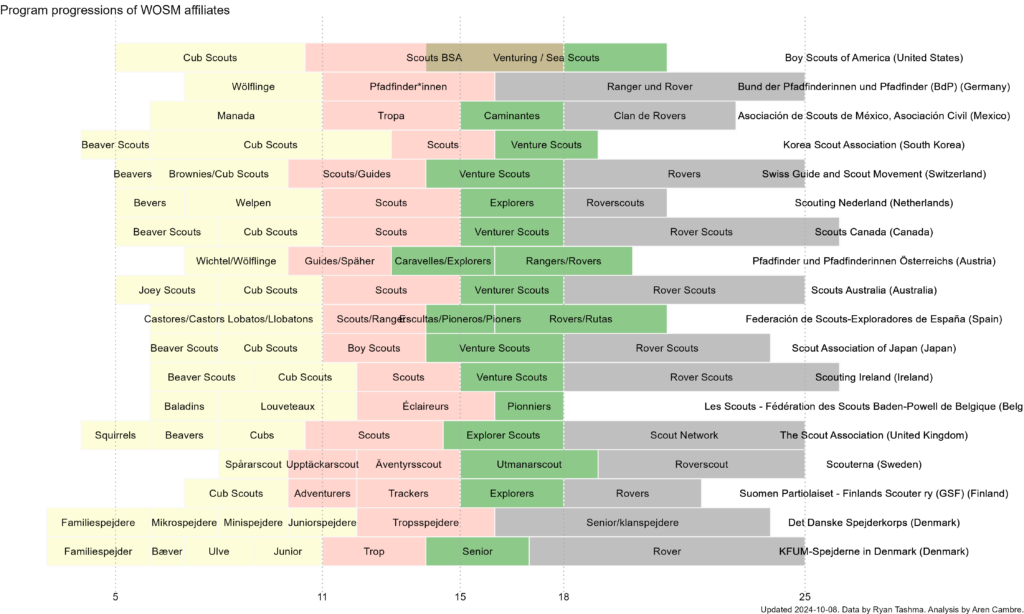
Scouting’s founder, Robert Baden-Powell, also saw this in the UK. To improve, he called for a separate program for older youth. All of SA’s international peers have met this vision.
SA’s answer has instead been to make high schoolers staff the middle-school program, with a predictable outcome: few high schoolers remain active.
High schoolers who graduate to Venturing are still in Scouting, in a program built for their age. That is Scouting tradition.
MYTH: “An older-Scout patrol gives high schoolers their own program.”
An older-Scout patrol is still part of a middle-school program.
Its members attend the same troop meetings, share the same expectations, still must pretend to be peers to 11-year-olds, and are still pulled toward instructing and supervising younger Scouts. SA’s own troop guidebook recognizes how this structural mismatch leads to frustration, calling an older-youth patrol a “safety valve”.2 That wording is SA’s admission: a safety valve is supposed to be a last resort to prevent catastrophe. When a safety valve becomes the norm, that reveals a problem is being ignored.
MYTH: “If a high schooler is happy in the troop, there is no reason to move.”
Enjoying the troop does not make it a high-school program. Even if some high schoolers like being the most experienced Scouts in the room, they are better served by a program built around their own age.
Many times, this preference is because a family misunderstands Venturing. Elevate this from fear of the unknown: participate in a crew adventure, allowing a choice between two real programs.
High schoolers benefit from a high-school program for many reasons, starting with the plainest: They’re in high school. A program built for middle schoolers, however well it’s run, treats high schoolers as younger than they are, and that’s easy to miss when the troop is what we know best.
MYTH: “Supervising middle schoolers prepares high schoolers to mentor in adulthood.”
Teaching younger Scouts can provide useful experience. That does not show that teenagers remaining in a younger age group’s program prepares them for adult mentoring.
Troop roles held by high schoolers mostly involve instruction and supervision, yet they are commonly called leadership, which is different, and often romanticized as mentoring. Instruction teaches a skill. Supervision keeps people in line. Leadership is mutual influence around a shared vision.
Mentoring is where one person helps another person pursue that other person’s own goals. Mentoring requires listening, respecting choices, and helping without taking over. This is a peer experience: the mentor may know more, but the mentee is an equal whose goals and decisions remain their own. Instructing or supervising younger children does not supply that.
MYTH: “High schoolers should wait for their younger friends before moving on.”
A high schooler should not delay graduation. Friends can stay close while spending a year in different programs, just as they do when entering high school in different years. They can spend time together outside Scouting, and the younger friend can join the crew when eligible.
If same-age friends are staying in the troop, invite them to graduate together.
MYTH: “If high schoolers lose interest, troop adults need to do better.”
Troop adults cannot fix the mismatch between high schoolers’ needs and a middle-school program. This Sisyphean quest has been a expectation of adult leaders throughout scouting history, and it’s an unrealistic expectation placed on them by the national organization.
I call the demand that local adults overcome national’s program-design fault “blame the volunteers”. This blame shifting is unfair to volunteers.
Encouraging a high schooler to graduate to Venturing is not blaming troop leaders. It frees that youth from a structural mismatch these leaders did not choose and cannot fix. A troop that entirely consist of middle schoolers would be a wonderful gift to adult leaders, as it allows them to focus on mentoring patrols while implementing traditional scouting.
MYTH: “The troop gives high schoolers the program and leadership experience they need.”
Older youths’ role in troops is staffing the middle schoolers’ program: teaching familiar skills, running meetings, and supervising younger Scouts. Those duties can teach responsibility, but they should not be a teenager’s main Scouting experience.
Venturing gives teenagers more room to choose what they want to attempt and persuade peers who can disagree. An office title or age advantage does not secure their cooperation. That tests skills greater than keeping the 11-year-olds in line.
MYTH: “Occasional older-Scout adventures solve the problem.”
An occasional trip leaves the rest of the program unchanged. Teenagers return to the same middle-school meetings, same age mismatches, and same expectations.
Meeting high schoolers’ needs requires a continuing peer group with its own decisions and adventures, with no falling back to a middle-school program.
MYTH: “A youth should earn Eagle in a troop before being allowed to join Venturing.”
Eagle is not an entry requirement for Venturing. Youth should join no later than the last day of eighth grade, regardless of rank.
Age-appropriate programming is essential, not a reward for earning a patch. Youth should have be in an age-level program while pursuing the awards they choose.
MYTH: “Leaving the troop means giving up Eagle.”
Youth can complete Star, Life, and Eagle through Venturing. No troop participation is required. The usual requirements and deadlines apply.3 Crew offices count toward requirements for positions of responsibility. Crew adults can help with advancement in the same way troop adults do.
MYTH: “Venturing has no advancement program.”
In addition to supporting the path to Eagle, Venturing has its own ranks: Venturing, Discovery, Pathfinder, and Summit. They include adventure, leadership, personal growth, and service.
The Venturing ranks are available to any Venturer, even those whose first Scouting program is Venturing.
MYTH: “A serious Scout must keep earning ranks.”
Venturing implements traditional Scouting: advancement is a method of Scouting, not the focus.
Advancement is optional. Youth who want adventures and friendships without working on badges are full members. Most of the value of Scouting and the cherished memories come through regular participation, not formal recognition.
MYTH: “You must already be an experienced Scout to join.”
No previous Scouting experience or rank is required to join Venturing.
MYTH: “Ninth graders are too young for Venturing.”
Venturing is intended to begin when eighth grade ends.4 Youth can join Venturing at 14 or at 13 after completing eighth grade. High school is when teenagers need an age-level program of their own, which is Venturing’s focus.5
MYTH: “A crew must specialize or focus entirely on demanding outdoor expeditions.”
Few crews have a topical focus. Typical crews offer a varied program chosen by their members, which is traditional Scouting delivered in an age-level manner for high schoolers.
MYTH: “Venturing is a career program.”
Career exploration is in Exploring, a separate program operated by an SA subsidiary.
MYTH: “Fewer meetings mean a weaker program.”
Meeting frequency does not measure program quality. Crews typically meet once or twice a month and also have outings.
With fewer routine meetings, Venturing better fits the lives of high schoolers. This leaves room for schoolwork, sports, jobs, and other friendships.
Judge the program by the worthwhile activities youth plan and carry out.
MYTH: “Graduating to Venturing abandons traditional Scouting.”
Graduating to an older-youth program is Scouting’s tradition.
Over a century ago, Baden-Powell recognized that older youth were leaving because they were tired of repeating younger Scouts’ tests and games. He envisioned a separate program suited to them.
All of Scouting America’s international peers separate younger and older adolescents into distinct programs and expect them to move on. Venturing offers that progression within SA.
MYTH: “Venturing is a social club, not real Scouting.”
Fun with friends is core to Scouting. Baden-Powell called it “a jolly game” that is also “educative”.6 Also, social experiences are an appropriate support for a high schooler’s development.
When high schoolers plan their own activity, take responsibility, and learn from what happens, a movie night serves Scouting’s purpose alongside a trip to Philmont.
MYTH: “Difficulty sustaining crew activities proves the crew is inadequate.”
When troop events repeatedly take priority, the crew is starved of participants and parent help needed to deliver adventures.
Ask why the activity fell through: was the plan unappealing or poorly organized, or did families steer commitments elsewhere? Families need to keep crew dates on the calendar for worthwhile plans to happen.
MYTH: “Venturing is small, so it must not work.”
Membership totals show how many youth a program reaches; they do not show what it offers its members. Treating the troop as the normal path for high schoolers limits how many youth consider Venturing. To assess a crew, look at what its members plan, do, and gain from participating.
MYTH: “There is no crew nearby, so the troop is the only option.”
A crew can be started. The troop’s own chartered organization can also charter a crew.7
BONUS MYTH: “Order of the Arrow is the fix.”
Order of the Arrow is a council-operated children’s prestige club that celebrates White supremacy and that I suspect has a perversion problem.
This prestige club’s main distinctions from ordinary Scouting are its redface minstrel shows and how it tries to convince high schoolers to remain in SA’s middle-school program.8
This prestige club is not Scouting. Instead, it cannibalizes Scouting, especially Venturing, while falsely claiming to support Scouting.
Finally, just like older-Scout adventures, once the prestige club’s activity is done, the youth returns to the same meetings, same age mismatches, and same expectations.
- For bureaucratic reasons, unlike a Den Chief, the Troop Guide will need to maintain dual registration with a troop. This should be a free, “multiple” registration for the youth. Just as a pack should never expect a Den Chief to pay unit-level dues, the troop should never expect a Troop Guide to pay dues. ↩︎
- Troop Leader Guidebook, Volume 1, Boy Scouts of America, 2018, p. 17. ↩︎
- First Class may only be earned through Scouts BSA. Youth who want Eagle and have not earned First Class can still join a crew and remain simultaneously registered in a troop while completing the remaining First Class requirements. Their troop participation has no need to go beyond the minimum necessary to cover those requirements. Once First Class is complete, the youth may choose to continue exclusively through the crew. That said, First Class is a middle-school badge. Venturers who have not earned First Class should seriously consider Venturing’s rank system, which is superior to the path to Eagle. ↩︎
- Bryan Wendell, BSA alters age and grade eligibility requirements for Venturing, On Scouting, February 26, 2010. The article supports the ethos of the text the footnote applies to. By opening an option of 13-year-olds who have completed 8th grade, in addition to the standing minimum age of 14, SA is correcting an exclusion of some 8th-grade graduates. This strongly suggests that SA intends for Venturing to start after 8th grade, even though 14-year-old 8th graders can be members. ↩︎
- While Venturing membership goes until age 21, this age range is another faulty program design. Beyond the summer after high-school graduation, young adults need to move on. They do not benefit from acting as peers to considerably younger youth, and the younger youth do not depend on their presence. While Rovers is the worldwide Scouting home for young adults, SA killed it in the 1950s. ↩︎
- Robert Baden-Powell, Aids to Scoutmastership, 1919, p. vii. ↩︎
- Do not allow the crew to exist only in a space allowed by a troop. This undermines high schoolers, conveying that a middle-school program may clobber their interests. Just as packs and troops are seen as independent, the same goes for crews and troops. If a troop has as campout the same weekend as a crew, the crew must not cancel its event because the troop wants high-school supervisors. The middle schoolers will do fine when adults support them in owning their own patrol programs. ↩︎
- Several sources attest to that retention of older youth in the middle-school program is among OA’s self-styled distinctions. The clincher is that this retention gambit and its redface minstrel shows are the only parts of OA that are meaningfully distinct from ordinary Scouting. ↩︎

Leave a Reply