
We can grow Scouting while doing it much better! To get there, we improve delivery with simplification and better focus. This comes largely by leaning in on Scouting tradition and international Scouting norms.
This plan prescribes traditional Scouting that is more relevant to youth. It refocuses on Scouting’s main distinction, the patrol method: team-based adventures that elevate youth to maximal ownership of their experience. Younger kids try more for themselves, middle schoolers own their patrols, high schoolers have adventures of their own, and young adults seek new opportunities.
The mechanics
Scouting America’s (why this is a terrible brand) program designs are obsolete, they are not Scouting tradition, they are out of step with worldwide Scouting norms, and they are misaligned with American societal norms.
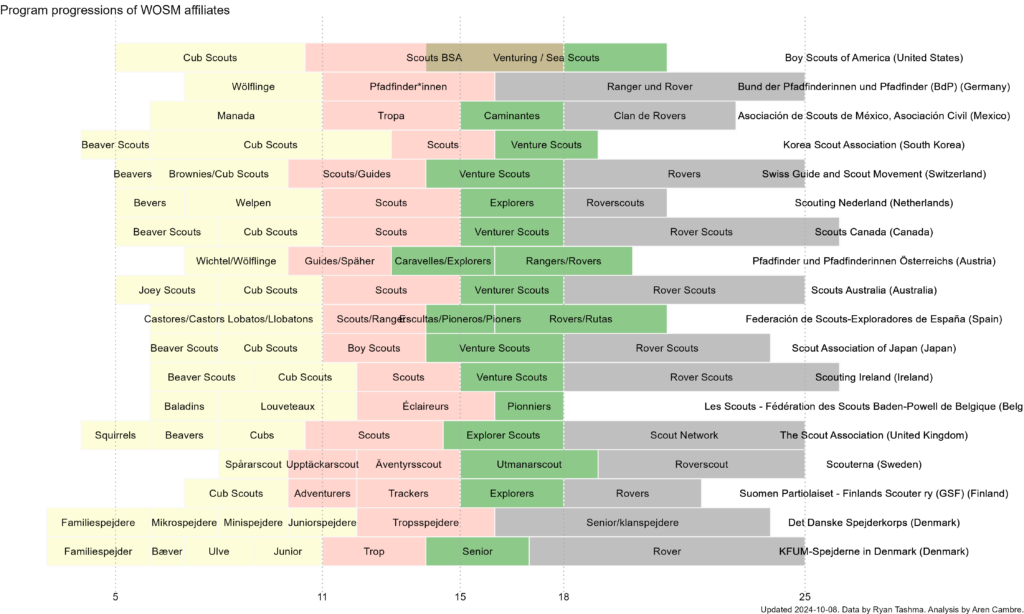
This plan approximates the linear progression of programs that SA should support. SA does not organize in a sensible way because its gold loopers2 systematically avoid addressing their faulty designs.

SA’s eligibility, safeguarding, and badge requirements still apply, and this plan works within them.
This improvement plan is constrained as it must comply with SA’s rules. Further institutional improvement is needed nationwide to sustain better Scouting. It is laid out at Move Forward: Save Scouting.
Cub Scouts, the Right Way
The problems with by-the-books Cub Scouts that this guide solves:
- The program has too many ages, which makes it unfocused and infantilizes older ages.
- The advancement system is weak, mostly focused on activities that are unadventurous or redundant with what children get in everyday life.
We solve this by operating two programs within one Cub Scout pack: one for grades K–2 and one for grades 3–5. Give each age band its own program and its own Cubmaster; both share a committee.
Grades K–2: adventure first
Run grades K–2 mostly under the current program. Do as many adventures as you can stand. Target four major pack-level adventures a year, preferably campouts. Do more if your families can swing it. Get the kids outside and moving. Keep selling the next adventure!
At the end of 2nd grade, mark the transition to the grades 3-5 program with a celebration.
Grades 3–5: more independence
Give grades 3–5 as much of a troop’s adventure program as they can handle. Target at least six campouts a year, more if your families can swing it.
On 4th and 5th grade overnights, parents are not required to attend. Where appropriate, this could be an opportunity for the child to show more independence.
Make older dens patrol-like
Run these dens as much like patrols as possible. The Den Leader is still an adult. Have each Denner serve for at least a month, with a real assignment or two at each meeting. Help the kids succeed, then let them do the job!
Independent den meetings
Dens should meet independently at least twice a month. This gives the kids time to be a den.
When a grade doesn’t have enough members to meet on its own, it may be necessary for multiple grades to meet at once. Always assure all kids still get activities appropriate for their age.
Pack meetings worth attending
Aim for monthly pack meetings with something worth coming for: a campout, pinewood derby, or party. Don’t call a meeting just because another month has passed.
The K–2 and 3–5 sides should usually hold independent pack meetings. A joint event can work if each age group has appropriate things to do throughout it. Both halves might visit Tyler State Park together, for example, but since what appropriately challenges a kindergartner will bore a fifth-grader, each side of the pack should run its own program. As much as possible, dens are given opportunities to do their own thing.
Give each group plenty of independence.
Keep advancement optional
Advancement is optional, a longstanding Scouting norm. Treat advancement as a “choose your own adventure” book. Do requirements that make sense, are fun, or help you get to an adventure.
It’s fine if a kid doesn’t earn the annual badge. Celebrate what they kids accomplish. Some will want every badge; others won’t care. Both should have a great time, both have experiences worth celebrating. Years down the road, the kids will remember their adventures, not badges.
Focus den and pack time on adventures. That may squeeze out badge requirement that are less adventurous, like academic stuff or arts and crafts. The Lion and Tiger hand-washing requirements are an example. Families who want every badge can handle boring requirements at home.
Arrow of Light exception
Today, the transition between Cub Scouts and Scouts BSA is rough because of SA’s faulty program design. Following this plan will smooth the bump, making it more of an ordinary transition. It amps up the grades 3-5 experience in Cub Scouts, making them more capable of next-level adventure, and it refocuses Scouts BSA on Scouting tradition, focusing on grades 6-8 (next section).
Due to these changes, there is no longer a need to treat 5th grade as a transition year. However, Arrow of Light is one of those “forever” badges. It is worn on the uniform for the rest of youth and as a square knot for adults. Give Arrow of Light a little more attention while keeping adventure first.
I recommend crossover in March or later, even if the kids earn Arrow of Light sooner. Fifth-graders can still move to Scouts BSA after March 1 without earning it. Give them some time that spring to get to know their new troop-mates before a summer trip. Treat crossover as their graduation from Cub Scouts.
Scouts BSA, the Right Way
The problems with by-the-books Scouts BSA that this guide solves:
- The program has too many ages, which makes it unfocused and infantilizes older ages.
- Middle schoolers can’t own their own program, instead forced to be of babysitting so that high schoolers can earn badges.
- Boring, obsolete summer camps that glorify a children’s prestige club that celebrates White supremacy (OA) (and that may have a perversion problem!) while thieving core program elements from troops.
- The program focuses on bureaucratic offices, which mostly kills leadership development and diminishes the patrol method.
- Adults are encouraged to withhold mentorship to alleviate high-school boredom.
- Per SA’s own findings, increasing age ranges place youth at greater risk of SA (sexual assault).3
We solve this by focusing Scouts BSA on what it is: a middle-school program. In other words, we improve this program by realigning it to Scouting tradition and the worldwide Scouting norm. Build the program around these kids and what they can learn to do for themselves.
Build same-grade patrols
Use Scouting tradition: Build patrols from Scouts in the same grade. Friends in the same grade stay together. The patrol can take on challenges suited to its members, and everyone gets a say.
Use a mixed-age patrol only when a grade lacks the critical mass to form its own.
Use advancement to plan adventures
Let Trail to First Class requirements guide patrol adventures. Build a rolling two-year program, with each month or two organized around a handful of related requirements. Use those themes to guide patrols to meaningful meetings and outings.
Scouts discover how to do things while having adventures, and advancement follows. This means that active participation in a patrol’s adventure program should satisfy almost all rank requirements through First Class.
The requirements cover a lot of ground. To make the two-year program work:
- Group together related requirements, regardless of which rank they apply to.
- Watch the timing. Tenderfoot and Second Class each have 30-day requirements, and some steps must happen in order.
- Cover every requirement over the two years. Use the ordinary troop program for as many as possible; leave individual work for requirements that don’t fit a group adventure or are academic or redundant.
Leave room for fun that has nothing to do with rank requirements. Go to a movie, take a swim, or get dinner together. If you have time for a bigger adventure, take it. Go to Italy!
Make summer an adventure
Choose a camp for its adventures and the quality of its staff.
Never enroll Scouts in camp-based Trail to First Class courses. This robs your troop of program elements for your year-round program. Focus summer-camp on adventures the patrols don’t get to do at home.
At a traditional camp, choose fun merit badges and activities. Better still, reconsider traditional summer camps. Do you really need them? Create your own adventure! Tour some national parks or take another trip the patrol wants to do.
Let merit badges follow adventure
Use adventure-centered merit badges to shape patrol activities, and keep badge completion optional. For example, use the Cycling merit badge to plan 2-3 months of bike trips.
Scouting’s point is not to be a credentialing engine. Whether the Scouts finish all the requirements or only some, judge success by the main criteria: Did they have enriching, fun adventures? If yes, the program was successful, even if a patch wasn’t earned.
Scouts who wish to work on academic merit badges may work directly with a merit-badge counselor, outside of patrol activities.
No mad dash to First Class
Aim for First Class completion during the first half of eighth grade, then celebrate it as the capstone of the middle-school program. That’s a target for planning the program. Don’t withhold advancement from a Scout who has met the requirements.
Don’t push kids to race through advancement. It takes the discovery out of the normal program. Repeating requirements they have already done is boring. Scouts with advanced skills may be ready for special projects or a harder part of the patrol’s adventure.
Scouts should be discouraged from continuing beyond First Class while in a troop. But if you have a Scout interested, provide the required individual advancement support without reorganizing the patrol program around post-First-Class ranks.
Put patrols at the center
In the traditional patrol method, patrols own their adventures. The troop is mostly a shell that supports patrols, with adults mentoring Patrol Leaders directly and getting patrols the resources they need.
Keep the standing youth roles in the patrol: a Patrol Leader, usually serving for six months, and an Assistant Patrol Leader if useful. Don’t build a layer of troop offices above them. Those offices cannibalize matters that should belong to the patrols.
Patrols determine their own programs. Adults can offer the two-year plan to help them, but it isn’t a syllabus imposed on every patrol. Let patrols choose, as much as feasible, which adventures they’ll use to learn the skills. Adults arrange the mentoring and support.
Use the PLC and service patrol to coordinate
The Patrol Leaders’ Council (PLC) returns to Scouting tradition, a council of Patrol Leaders whose authority rises from their patrols. It coordinates between patrols rather than determining their programs. This will feel completely different from the current program which undermines patrols, where the PLC sets the troop’s agenda, and patrols are reduced to labor pools that act at the behest of the PLC.
Say three patrols want to camp together. Each chooses its activities and plans its meals, checks its equipment, and divides the cooking and cleanup. The PLs meet with the Scoutmaster to agree on the campsite, shared facilities, and any joint activities. They pick one PL to chair that meeting and another to take notes, then report back to their patrols. Adults handle permissions, transportation, shared equipment, supervision, and any specialist help. They also help patrols work through problems.
At the troop meeting before the trip, a service patrol sets up, handles the opening, and helps clean up. Its members divide the jobs; another patrol takes the next turn. A Scout who knows a useful skill can lead an activity. Nobody leaves their patrol for a troop staff position.
Move to Venturing near the end of eighth grade
Graduate Scouts to a Venturing crew near the end of eighth grade. They should start high school in a high-school program.
A youth becomes eligible to join Venturing at 14, or at 13 after completing eighth grade.4 While turning 14 earlier makes the move possible, I still recommend keeping the youth with their eighth-grade peers until near the end of the school year, then they graduate together.
Introduce the eighth-graders to the crew in the spring. Give them time to get to know its members and prepare for the summer adventure. Those who aren’t yet eligible can make introductory visits as prospective members, within the activity and safeguarding rules for their age. They can register when eligible.
Venturing, the Right Way
The problems with by-the-books Scouts BSA and Venturing that this guide solves:
- Nearly all of SA’s high schoolers are denied an age-level program. Instead, they are forced to linger in the middle-school program (that is not traditional Scouting!), pretending to be peers to the middle schoolers while being made to staff this middle-school program.
- Scouts BSA has too many ages, which makes it unfocused and infantilizes high schoolers.
- Venturing has too many ages, which infantilizes young adults and endangers the youngest Venturers.
- Middle schoolers can’t own their own program, instead forced to be objects of babysitting so that high schoolers can earn badges.
- The Scouts BSA program does not train leaders or support teams, instead focusing on bureaucratic, troop-wide offices.
In BSA, Venturing5 is the high-school program. This video explains why:
It may be good to also review 25 myths obstructing Venturing participating today.
Complete the transition from the troop
Once youth join the crew, finish the move. Register them only in the crew. Don’t delay the move over First Class. Those who didn’t earn it by the end of 8th grade may do Venturing’s advancement system, which is better than Eagle.6 There’s one narrow exception to crew-only registration, for voluntary service, explained below.
Build a high-school adventure program
Trust crew members to choose and plan their own program. Give them real jobs in planning and running adventures, and help them take turns. Adults advise, look after safety, and provide the resources.
Aim for an adventure every month. Get outdoors as much as possible, though other adventures can work. For summer or lengthy breaks, let the crew plan a longer trip, visit a high-adventure base, or choose another adventure appropriate for high schoolers.
SA’s options include Philmont, Sea Base, and Northern Tier7, along with council-run programs. Some, like Swamp Base, operate independently of summer camps. Others, like Camp Alexander’s Outback Adventure or BTSR’s Cavalcade, run alongside traditional summer camp but have almost entirely separate programs.8
Never do a traditional summer camp. Those are middle-school programs.
Let Venturers choose their advancement
Those who earned First Class while registered in Scouts BSA can still work toward Star, Life, and Eagle. Provide the required advancement help in the crew, while keeping its adventure program first.
Venturing’s Summit and Ranger tracks are open to all Venturers, including those who never earned First Class. Summit combines adventure, leadership, personal growth, and service. Ranger builds the outdoor skills needed for outstanding adventures.
While Eagle should be supported, Summit and Ranger are better than Eagle and more relevant to high schoolers.
The crew may complete some merit-badge requirements while working on Ranger or using a merit badge to plan an adventure. Let the youth make that choice. Adults advise and help.
Keep the high-school program independent
The crew and troop are for different ages. Do not turn the crew into a subsidiary of the troop. Do not use crew members as troop staff. The crew has its own calendar, adventures, leaders, resources, and identity.
Just as it would be absurd for the perceived needs of a pack to veto troop activities, the same goes for troops and crews. There is a tendency for crews to live in the shadow of a troop, and this must be firmly rejected.
Never single out high-school seniors
Don’t single out an 18-year-old high-school senior for different treatment beyond the bare minimum required by the Barriers to Abuse.9 That student is still in high school, among high-school peers. Nowhere else in life is that young adult singled out for differential treatment.
Keep service to younger programs optional and limited
Before discussing service to another unit, get the crew’s own program running well. The youth’s own program must come first.
Crew activities should be for high schoolers. Keep join activities with younger youth occasional and with a clear justification, such as to help with crossing over, recruitment, or service that crew members choose to do.
Service to younger programs must be voluntary. Offer it to youth who want to do it. If nobody volunteers, that’s fine. The presence of older youth is not essential to any younger Scout’s experience.
For older youth, who choose to help, they serve as guides. They aren’t supervisors or participants in the younger program, and their help doesn’t replace adult mentorship. Use these roles:
- Those wishing to serve Cub Scouts can serve as Den Chiefs.
- Those wishing to serve Scouts BSA members can use the Troop Guide position as a model. For Star, Life, and Eagle paperwork, if the role cannot be listed while the youth is registered solely as a Venturer, use free dual registration only for that purpose. This extra registration is just to satisfy SA’s obsolete bureaucratic requirements. The youth is still a crew member and wears the crew’s uniform when serving.
Move on after high school
Venturing is built around the high-school experience, and it’s weird for a college junior to pretend to be a peer to a 14-year-old 8th grader. After high school, it’s time to move on from the crew’s youth program.
SA should have a Rovers program for this age range. It is the traditional, worldwide program for young adults. But SA declines to, so there is no appropriate SA program for young adults where they are simply a member.
That is not necessarily bad. Rovers treats young adults like adults, so the value of Rovers can still be met simply when young adults plan and execute their own adventures, seeking help of more experienced adults as appropriate. This does not require formal Scouting affiliation.
That said, Rovers is a worldwide norm, and it’s beneficial to maintain formal connections. Therefore, I call on SA to restore Rovers, which it killed in the 1950s.
High-school graduates who stay in SA can be an adult leader in any program.
If they select Venturing and are between ages 18 and 20, they should be treated like an Associate Advisor or Committee Member in all respects that aren’t forbidden. They will have to register as adult program participants, rather than in those formal adult-leader positions. Adult safeguarding rules apply. They cannot satisfy selected requirements reserved for adults age 21 or older; for example, two-deep leadership requires two registered adult leaders age 21 or older.
Give youth the help they need
As they learn and grow, youth can take on more responsibility. But there will always be a limit to what youth can do.
Our responsibility as adults is to understand this limit, support the youth in taking next step or two, then handling the rest ourselves. That is our proper role in Scouting.
The right amount of youth ownership will vary from activity to activity. Sometimes even with older youth, adults may need to do more than expected for an activity to succeed. That’s fine when necessary as long as ownership is handed back to the youth as soon as they’re ready.
Importantly, “handling the rest ourselves” is an adult responsibility. That is part of the adult-association method of Scouting.
A widespread misunderstanding is something magical happens for middle schoolers when high schoolers take on this role. Nope. This is just a decades-old ploy to keep high schoolers entertained while they linger in a middle-school program. All it really does is undermine middle schoolers by reducing them to objects of supervision by high schoolers while depriving middler schoolers of mentoring by more capable adults.
Use the group and section model
BSA’s international peers generally use the group-and-section model. A community has one Scout group, with a separate section for each age-level program. Each section has its own program leader. One group leader and one committee support them all.
We can get close to this when several units share one chartered organization (CO). Having the same CO matters: each unit acts in its CO’s name. It is not appropriate to seek a group and section model for units that have different COs
One committee, separate registrations
Use one committee team to support all the units, with its members registered in each unit as required.
Some adults will need multiple registrations. At a minimum, the Committee Chair must be registered in every unit. Choose one unit as the anchor for adult registrations and use free “multiple” memberships for the others. Adult registrations and units still need their separate annual renewals. One committee member can handle this for all the units.
Share leaders and resources
Sharing leaders helps the units develop a common culture. Each unit still needs a lead focused on its program—Cubmasters10, Scoutmaster, and Advisor. Other leaders can serve more than one unit.
Share equipment and other assets. Treat them as CO property available to all its units. One unit shouldn’t treat them as its exclusive property.
BSA has no equivalent to a group leader, but the committee can appoint someone to do that job. Working with the Committee Chair, this person helps the units get adventures off the ground and directly supports their program leaders.
Protect the culture
Say no to Order of the Arrow in every form
Order of the Arrow is just a council-run children’s prestige club. It is not Scouting11, it celebrates White supremacy, it cannibalizes the actual Scouting programs12, and its claim to be an honor society is a fraud13. I think it is attractive to perverts. This club’s main point is to trick high schoolers to stay in the middle-school program.
By competing with your units and sending high schoolers the wrong way, OA directly undermines the superior youth programming you’ve invested in.
Units must reject Order of the Arrow in every form. They must actively discourage any OA involvement by their youth and adult members. Do not host OA elections, appoint OA representatives, promote or facilitate OA membership or activities, recognize any OA activity, or permit OA ceremonies, recruitment, regalia, sashes, or recognition at unit events.
Social events, leadership development, service opportunities, and recognition don’t need a children’s prestige club. All these belong in your units or in support structures that support your units, like the Venturing Officers Association.
Keep Scouting fun and simple
- Be a partner. Give kids room to make choices and get things wrong. As Robert Baden-Powell envisioned, adults should act more like older siblings. Be excited about the adventure with them. Exercise authority when safety or the situation requires it.
- Keep rules short. Don’t bury families in lengthy unit bylaws and parent manuals. SA already has plenty of rules, and respectful conduct takes care of nearly all the rest. A perceived need for bylaws and parent manuals is an admission of too much complexity or bad culture.
- Keep youth events about youth. Do adult recognition separately. Save lengthy adult presentations for adult meetings.
- Reconsider Wood Badge. Wood Badge is designed around the obsolete designs and culture we need to leave behind. This training system lost its way in 1972, becoming a bureaucrat-polishing school that does not teach the patrol method or traditional Scouting, and it does not focus on genuine leadership. Instead, Wood Badge doubles down on the leadership-killing Scouts BSA corporate-bureaucracy simulation. This is a natural result of organizational capture by the bureaucrats, whose career system rewards fecklessness.
Go have an adventure
The point of all this is simple: give each age group a program they want to be part of. Share the adults and resources needed to make it happen. Then go have an adventure!
- Robert Baden-Powell’s first Scouting activity was the Brownsea Island experiment, which included youth aged 10-17. Within the next 11 years, Baden-Powell came to understand why combining too many ages in one program is a poor design. He evolved, advocating for program separation. He saw that younger kids’ presence at Scout meetings was disruptive, and he recommended what evolved into Cub Scouts. He also saw the attrition of older youth. He correctly diagnosed it as boredom with a program optimized for younger ages, and he recommended splitting them off into their own program. Compared to its international peers, SA is the sole organization to cling to the prototype model that Scouting’s founder later rejected. ↩︎
- Gold loopers are volunteers and professionals associated with SA’s national organization. Entrusted with stewarding the organization and movement, gold loopers have been repetitive failures, constantly screwing up and showing little interest in the Scouting movement. The root cause is organizational capture by the commissioned bureaucrats’ patronage system, which harms the organization by incentivizing loyalty to the commissioned bureaucrats above all else. ↩︎
- This is detailed in the “A sixth grader and a college junior in one “youth” category” section of Why I believe OA is attractive to perverts. ↩︎
- An unusual exception is a 12-year-old eighth-grader who turns 13 over the summer, as may happen with a youth who is a year ahead of their peers. After completing eighth grade, that youth becomes eligible to register upon turning 13. ↩︎
- Venturing crews may choose any specialty, but a crew that wants to focus exclusively on nautical activities can instead become a Sea Scout ship. Whenever this article refers to Venturing, you can substitute Sea Scouts and get the same outcome. In general, use Venturing as the default and charter a separate ship only when a critical mass wants to focus on nautical activities. ↩︎
- Venturing’s advancement system is superior to Eagle. Not only are none of these middle-school badges–since 11-year- olds can earn Eagle, it’s definitionally a middle-school badge–its requirements focus on the high-school life stage. When SA modernizes its programs, it should retire Star, Life, and Eagle, and it should rename Summit to Eagle. This is an 85% solution to a better, more relevant Eagle that is decoupled from a middle-school badge ladder. ↩︎
- At Summit Bechtel Reserve, choose an itinerary that uses the New River Gorge and surrounding areas for its high-adventure experience. A separate article explains why programs confined to SBR itself are not included here. ↩︎
- The BTSR and Camp Alexander programs can be great choices when logistical constraints make it difficult to support separate summer adventures for a troop and a crew. ↩︎
- Among the Barriers to Abuse’s defects is it treats 18-year-old high-school students as adults. While it should be a non-issue for that high-school senior to tent with a 17-year-old high-school-senior friend, SA’s rules force separation and even allow that senior to tent with a 40-year-old adult! ↩︎
- Because you’re essentially running two age bands within one pack, you’ll need two Cubmasters. On paper, one can be registered as an Assistant Cubmaster. On the uniform, both must wear the Cubmaster patch. ↩︎
- Why OA is not Scouting is detailed in the “Why add more risk?” section of Why I believe OA is attractive to perverts. ↩︎
- The cannibalization comes from how OA, which is not a Scouting program, sucks youth and volunteer time and energy and other resources out of the Scout units. Also, all of OA’s worthwhile activities are things that should be done within the units or structures that support the actual Scouting programs. OA cannibalizes to serve its own prestige. ↩︎
- This is detailed in the “Honor-society fraud” section of Why I believe OA is attractive to perverts. ↩︎