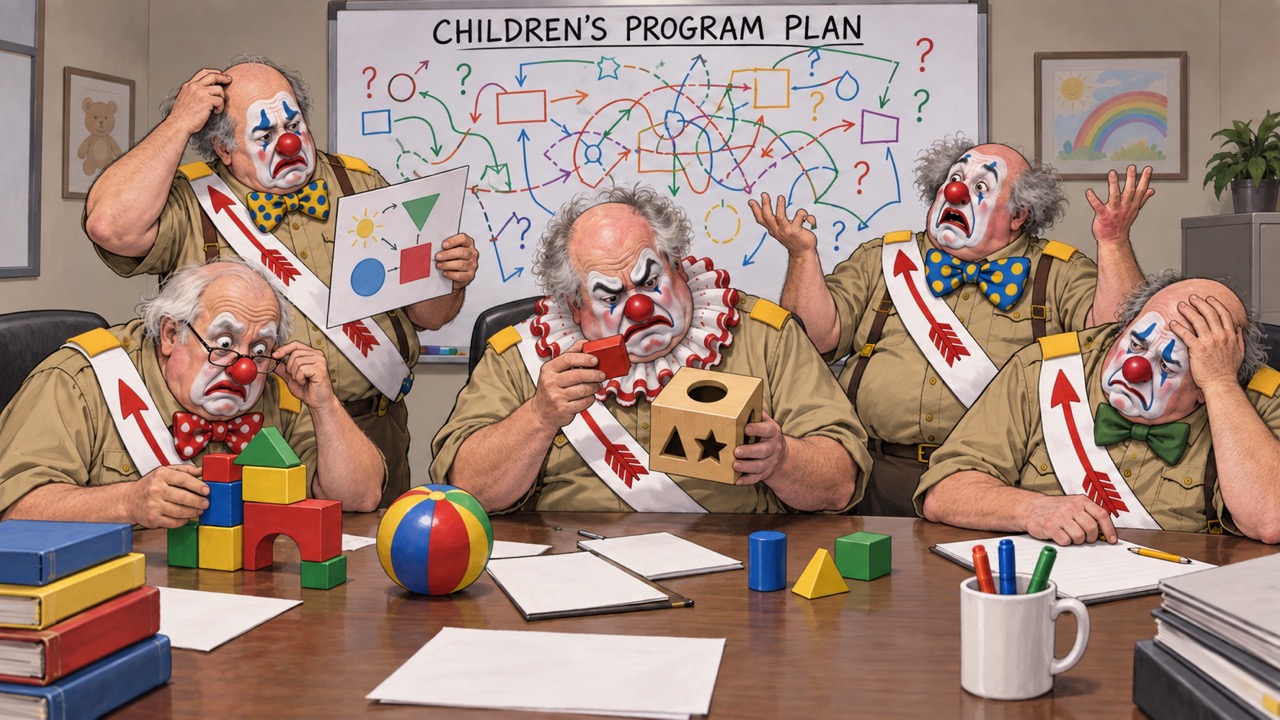
Order of the Arrow (OA), the self-anointed honor society within Scouting America (SA), is a risky children’s prestige club.
I am concerned that OA’s design and culture create opportunities that perverts can exploit. Historically, this prestige club’s Indigenous fraud and a fake legend put youth in states of undress. Additional sexual assault (SA1) risks include a sprawling participant age range, blurred adult–youth boundaries, secrecy, obstacles to parental observation, and a culture that is averse to criticism.
All these amplify SA risk. A 2024 study of a random sample of SA’s perversion files identified six “characteristics that allowed motivated adult leaders to molest their victims”. Three of them, “volunteer imbalance”, “reasons for separation from protective adults”, and “social status as a prophylactic defense”, are among OA’s risks that this article reviews.2
I believe that these are avoidable safeguarding burdens, and SA bears them merely to sustain a prestige club that undermines the actual Scouting movement.
Why add more risk?
Kenneth Lanning, a retired FBI supervisory special agent, warns that “certain youth organizations inadvertently provide the child molester with almost everything necessary to operate a child sex ring.” His example is scouting, which offers access to children of a specific age, “opportunities to spend the night with a victim or have a victim change clothing”, and “a system of rewards and recognition, and indoctrination through oaths and rituals.”3
Scouting already carries SA risk. Why does SA still maintain a children’s prestige club that adds considerable SA risks when this club undermines the Scouting movement and is not essential?
The OA prestige club is not Scouting. It is not a Scouting program: SA’s Rules and Regulations list the programs, and OA is not among them.4 Also, the prestige club’s relationship to customary notions of Scouting is missing5 or fractured6. No other international Scouting organization has a prestige club. Even worse, this prestige club cannibalizes the actual Scouting programs, devouring time and resources to serve the club’s own interests. Worst of all, the prestige club’s main practical point is to undermine youth by perpetuating a bad program design.
Before I go on, I need to be clear: I believe the vast majority of the prestige club’s adults care about young people, and they support the prestige club for altruistic reasons. However, caring adults can unknowingly inherit and defend practices that make youth safeguarding much harder. These adults’ good intentions do not make an unnecessary risk necessary.
Explainers: OA children’s prestige clubs are mainly activities run by local councils, using a brand controlled by the SA national organization. Each council’s prestige-club operation is called a lodge, and councils typically subdivide their prestige clubs into chapters.
In various places, I refer to the organization and to the movement. The Scouting movement is the activities done by Scout units–packs, troops, and crews. Everything else is the organization, which includes SA’s bloated council and national bureaucracies and everything they do, including the OA prestige club.
In addition to reasons stated above, OA is not part of the Scouting movement because it is not an activity of Scout units. OA is a children’s prestige club run by the organization that pulls youth, adults, and resources away from the Scouting movement. OA engages adults and youth in activities that serve the prestige club’s own interests while undermining the Scouting movement.
Undress presented as tradition
The OA prestige club’s history includes generations of youth performing redface minstrel shows, often while partly clothed. This is not prudishness. The concern, explained below, is undress that OA’s culture expects, not what a Scout chooses for comfort or function.
These redface minstrel shows fall in two categories. The main shows are pageants where Scouts dress up as stereotyped Indigenous characters as they Tonto-talk through children’s fantasy fiction.7 The other shows are allegedly authentic Indigenous acts that, historically, no tribe has ever authorized OA to use nationally.8 In both cases, OA freely steals Native identity so that it can create theatrical scenery. This is the core of OA’s Indigenous fraud.
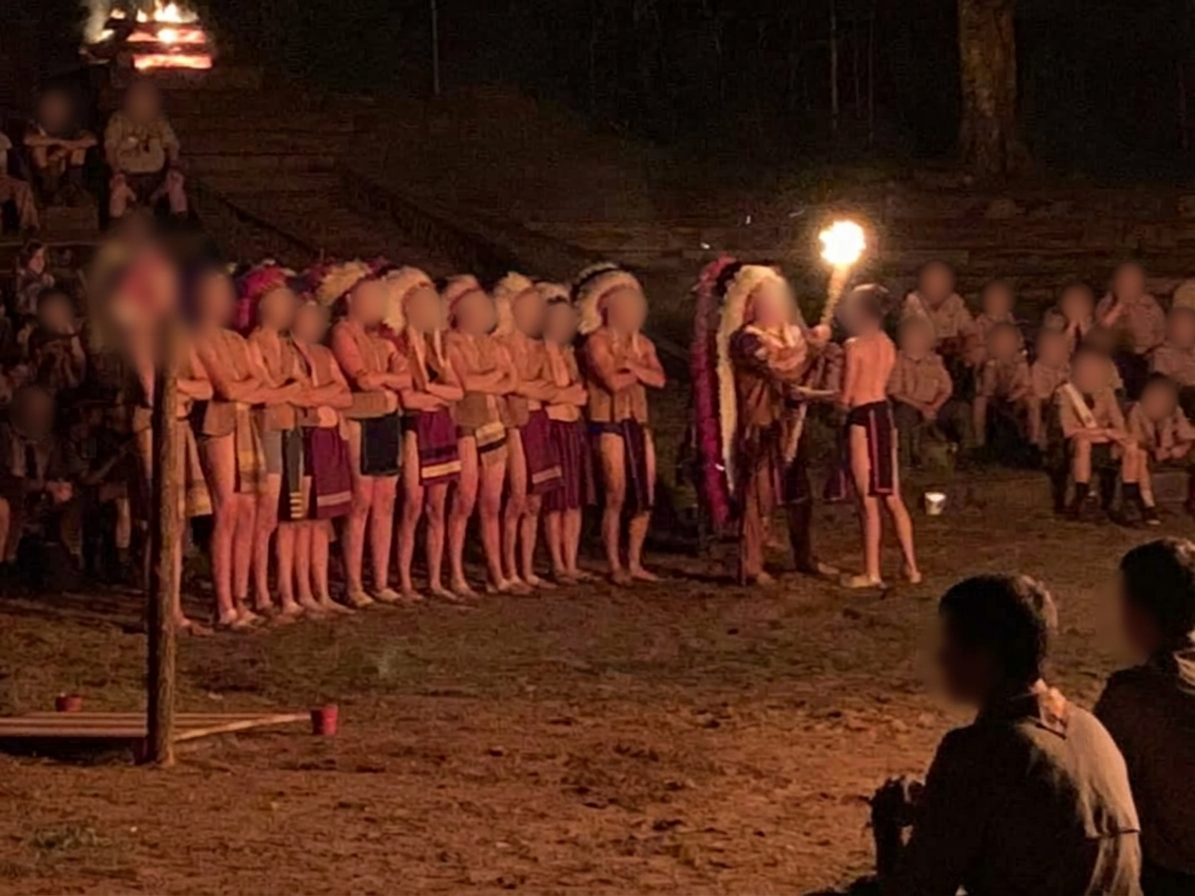
OA’s own account of its first redface minstrel show, in 1915, records Indigenous-derived names from the start: Carroll Edson served as “Sachem”, and the society called itself the “Wimachtendienk”.10 That kicked off a tradition where adults could use “playing Indian” as an excuse to make partial undress seem like an ordinary expectation of belonging.
As a teenager at El Rancho Cima‘s River Camp in the Sam Houston Area Council, I remember the redface minstrel shows where youth entered the audience to grab new OA candidates. These grabbers appeared to wear nothing but loincloths, similar to some youth in the above video.11
That horrified me. Adolescence was already confusing enough. Now I feared that I might have to perform mostly nude before the whole camp. Fortunately, I managed a path through OA that avoided performing in any redface minstrel shows. That I could avoid it does not make it harmless. The youth who performed were doing what OA’s adults asked of them, in front of the whole camp, in a role OA treated as an honor.
Others share the same concern. For example:
Comment
by u/Logen-Grimlock from discussion
in BSA
We see this in other councils’ OA operations, like:
- A researcher noting a shirtless handicraft counselor at an OA redface minstrel show.12
- A mom noting that candidates had to remove shirts during an OA redface minstrel show.13
- A recollection of an OA redface minstrel show participant “with a loincloth and a faux Indian headdress”.14
An earlier example appears in the 1944 footage below, around a decade after SA’s gold loopers15 formally declared OA as an authorized activity, showing teens in partial undress during a redface minstrel show:
A 2019 Indian Country Today article described “bare-chested and barefooted” youth dancing in an indoor redface minstrel show.16 In 2015, OA’s national chairman defended shirtlessness during redface minstrel shows by comparing them to swimming activities.17
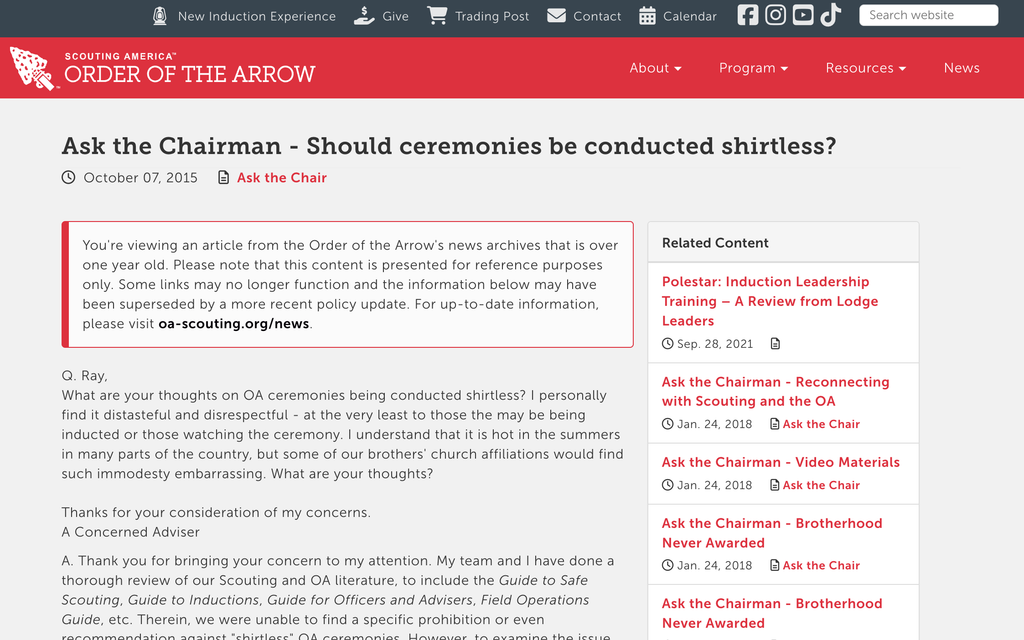
That chairman’s comparison misses the point. The concern is undress induced by OA’s culture, where stripping has never served a legitimate function, instead presented as part of belonging to a group. That puts pressure on youth, including youth who are uncomfortable, and that pressure creates an opportunity for perverts.
I suspect that OA’s apologists may rely on three main points.
The first apology is that OA is moving away from Indigenous fraud. OA is not getting rid of Indigenous fraud; it’s just adjusting its approach. Redface minstrel shows will continue, and I write more about that below. As long as Indigenous fraud exists in OA, it preserves a vector that perverts may use to induce various states of partial dress.
Even OA’s current guidance is contradictory. While this club is transitioning some redface minstrel shows to newer versions that have “no American Indian costuming”18, it also supplies attire guidance for redface minstrel shows that has “American Indian attire” as first in a list, with no robust qualification. As this attire is quite often based on stereotypes, defective reads of history, or selective choices of Indigenous attire, OA’s guide perpetuates the mechanism that encourages various states of undress.19
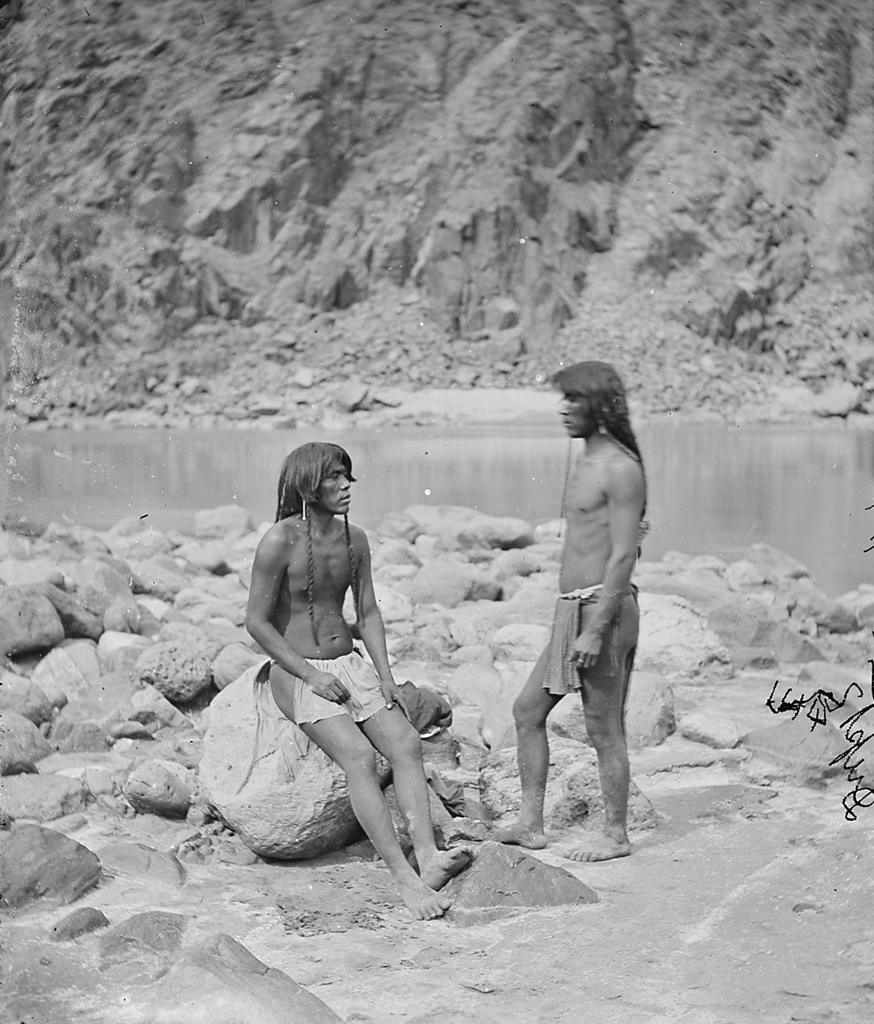
Some will take umbrage, saying that the guidance cited in the last paragraph is obsolete. It is not. OA’s October 2026 manual for prestige-club administrators states, “All principals who conduct [OA’s redface minstrel shows] should wear ceremonial attire that is appropriate and respectful of the American Indian cultures”, offering Scout uniforms or black shirts and pants only as alternatives.20
A second apology is that introducing girls makes this level of undress harder to continue. Perhaps, but that is circumstance, not policy, and nothing in OA’s guidance prevents a return to it.
A third apology will be a claim that states of undress are unusual. Even if true, rarity would not answer that concern. The question is what OA asks a young person to accept.
The future is clear: outside OA’s new induction pageants, the dancing and costuming that have put youth in loincloths can continue wherever a council holds a tribal agreement that allows them.
Even worse, OA has no required replacement for its most commonly performed pageant, the callout. Each council writes its own callout, and the callout principles in OA’s handbook say nothing about clothing.21 Even though OA alleges that tribal agreements are needed for continued use of Native culture, I have received several reports of continued employment of this culture in councils with no agreement. Also, all existing tribal agreements are so loose, they cannot be differentiated from permissions slips to continue redface minstrel shows.
We can look at the induction ceremony of the phony Tribe of Mic-O-Say, a different children’s prestige club run by two SA councils22, as a cautionary example.
While Mic-O-Say is not OA, it illustrates where OA could go. Just create a new story, dress it up with new Indigenous fraud, and once again we get youth dancing half-naked in front of the entire camp. (Did you know that the Northern Arapaho Tribe told Mic-O-Say to knock it off?23)
It’s not a stretch to suspect that perverts prefer youth who wear less clothing.24 SA’s perversion files have an example of someone who allegedly SAed an OA youth who was changing (was in a partial state of undress) to prepare for a redface minstrel show. Another perversion file conveys that an ejected adult asked to remain involved with the specific part of OA where youth would change clothes and often be partly undressed (SA rejected the request; the request itself is what is notable). Another file tells of a man, known for heavy involvement in an OA dance team, who was convicted of SAing several youth. (Incidentally, when perverts maneuver children into changing clothes, they “almost always succeed in seducing them”.25)
NOTE ON THE PERVERSION FILES: The SA perversion files concerning adults, which became public through litigation, are an incomplete and difficult-to-interpret historical record.26 They contain allegations, administrative decisions, and, in some cases, accounts of admissions or criminal proceedings.
They are widely called “perversion files” because SA’s own bankruptcy brief says that files about sexual misconduct were originally designated “P” files, for “perversion”.27
A file’s existence is not a finding of guilt. Some files concern multiple people. The examples here illustrate particular incidents and institutional responses; they do not measure the prevalence of SA in OA or establish its rate relative to other SA activities.
Also, the public adult files cannot characterize youth-on-youth SA. A national U.S. study found that juveniles committed most of the SA reported against youth in its sample.28 (That study is also cited in a Time magazine article.29) That finding concerns the broader population and is not an SA- or OA-specific estimate. Surprisingly, only around one in eight of SA’s perversion files cover youth-on-youth incidents.30 It is not possible to discern why SA’s ratio of these files wildly contrasts the study.
A sixth grader and a college junior in one “youth” category
SA’s training identifies age differences as a concern in youth-on-youth SA:31
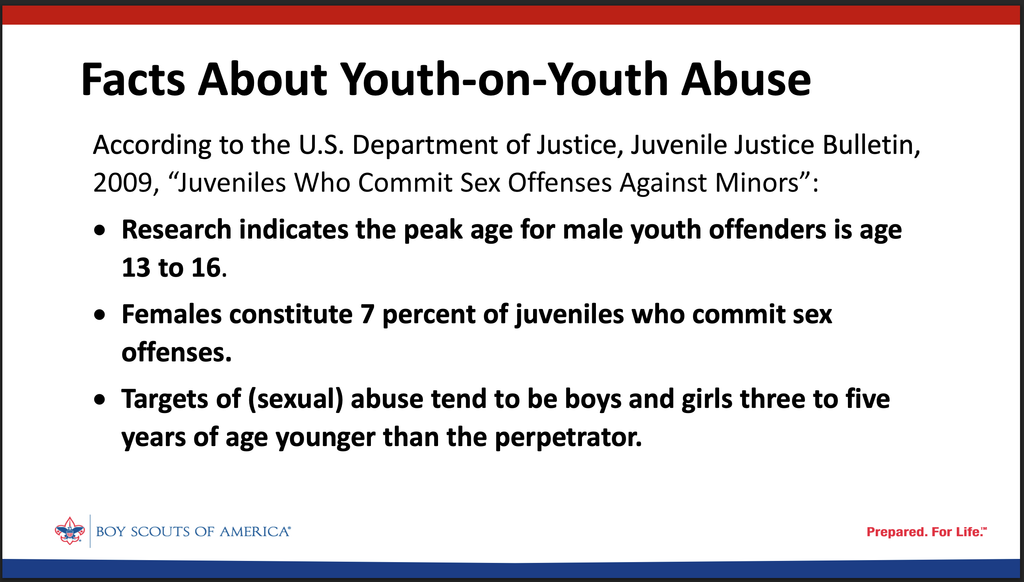
The concern makes sense. Differences in age, maturity, experience, and power can leave a younger child vulnerable to an older participant. As large age gaps amplify this risk, an organization should have a compelling reason to build large age gaps into its ordinary activities. SA does not.
It is unusual to discover youth organizations that don’t use narrower age bands. Girl Scouts has grade-based levels32, and non-school youth sports commonly divide participants by grade or age33. Middle schools commonly cover grades 6–8 and high schools grades 9–12.34 Clubs and well-run church activities are typically split like schools.
SA’s international Scouting peers have programs that average to about three years each:
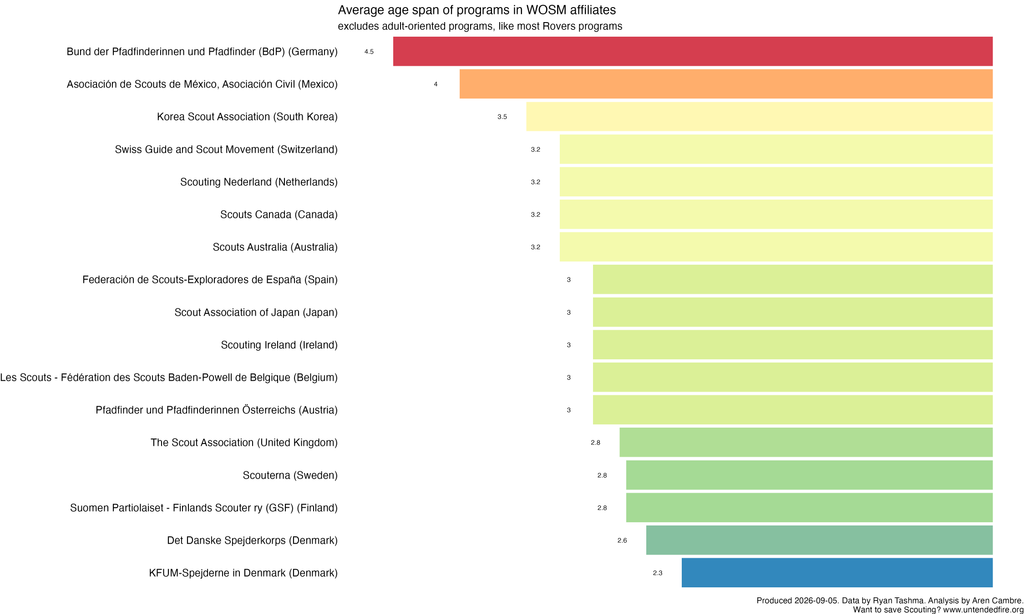
This is sound. It’s not just about reducing SA risk. As I explain in Scouts BSA: a middle-school program unsuitable for high schoolers, narrower age bands also let a program focus on a recognizable developmental stage, and they honor the vision of Scouting’s founder.
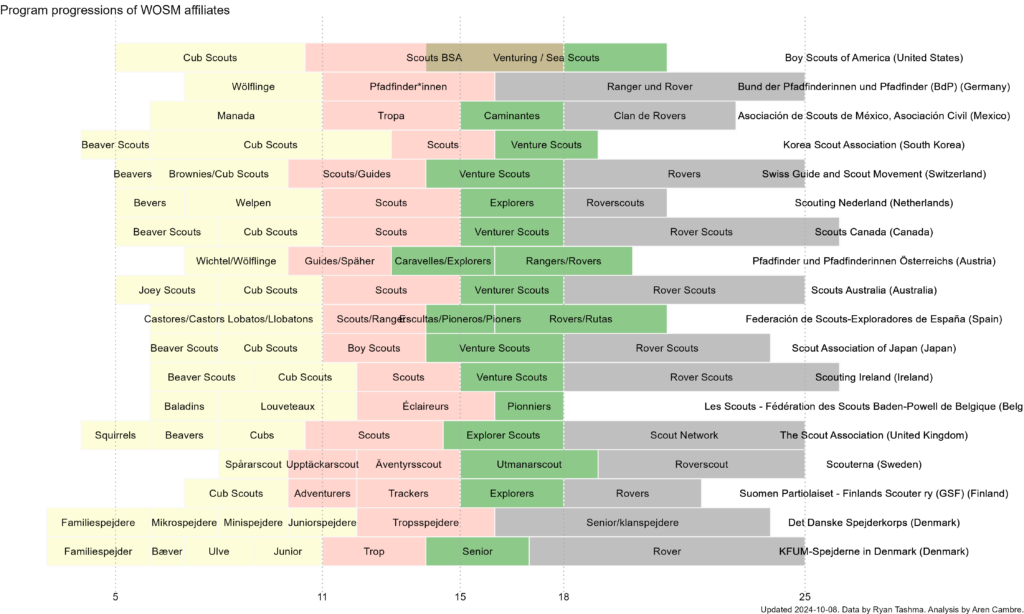
With its weirdly wide programs, SA departs from customary wisdom. Scouts BSA’s 8-year age range packs 10-year-olds through 17-year-olds in the same program. Venturing (and Sea Scouts35) includes 7 years, extending from 14 through 20.36

OA is worse: it places 11-year-olds and 20-year-olds in the same “youth” category!
OA’S WEIRD DEFINITION OF “YOUTH”: OA treats participants under 21 as “youth” for its activities.37 An 11-year-old38 sixth grader is in the same participant category as a 20-year-old college junior, a 10-year range spanning three development phases! Calling this range “youth” neither makes them developmental peers nor promotes safeguarding.
To its credit, OA’s own age-policy page explicitly says that SA’s youth-safeguarding adult rules apply to OA’s “youth” members starting at age 18.39 But the problem remains: SA’s own rules require tent-mates to be no more than two years apart and recommend buddies no more than three years apart40, and its training warns that youth offenders tend to target children three to five years younger. SA believes modest age differentials are an abuse risk, yet it allows an unnecessary children’s prestige club to define a 10-year range as peers! While the Barriers to Abuse can be enforced around that mismatch, it is asking a lot of that complicated, unfocused ruleset to compensate for an unnecessary, weirdly wide activity design. I consider that dangerous.
SA’s perversion files describe cases where perverts are alleged to have taken advantage of OA’s weirdly wide age range. In one file, a mother alleges that a 19-year-old OA Chapter Chief, whom her 15-year-old son met through an OA lodge, groomed the boy and then turned his attention to the boy’s 12-year-old brother.41 It is not normal for a 19-year-old to be close friends with a 15-year-old. The parents wrote that the friendship had seemed unusually intense, but they had put it down to shared activities, including the man’s OA office.
When adults are like peers
OA blurs another boundary: all members, regardless of age, share much of the same membership journey.
OA’S PRESTIGE LADDER: Entry into OA’s prestige ladder starts when a youth or adult–yes, both 11-year-olds and 50-year-olds–are selected in a popularity contest.42 They are both publicly announced in the same callout, a redface minstrel show recognizing selected candidates.43 Both complete the ordeal, a hazing ritual involving silence, limited food, work, and sleeping apart from other campers44. (Note: A newer hazing ritual that is allegedly softer is now rolling out45, but OA’s manual for prestige-club administrators celebrates “exhilarating fatigue that comes from working hard with very little food” on the same page where it prohibits hazing46.) After adults and youth complete the hazing ritual, both wear the same white sash bearing a red arrow47. That sash indicates one’s level on OA’s prestige ladder, where youth and adults both progress through the prestige ladder’s Ordeal48, Brotherhood, and Vigil rungs.49
While OA formally assigns adults advisory responsibilities, in my experience, its shared rituals and language of “brothers” create an unusual sense of adult–youth equality. As a boy, I felt the weirdness without understanding why it deserved questioning. People today report the same dynamic to me.
The safeguarding issue is whether that culture makes an adult’s responsibilities unmistakable. Soccer coaches neither become team captains nor play alongside their youth team members. Teachers do not earn classroom grades alongside their students. The lines are clear in those settings. As OA’s adults participate in the same prestige ladder as children, OA blurs lines between adults and youth.
Research gives us reason to question that arrangement. The Independent Inquiry into Child Sexual Abuse in England and Wales found that institutional cultures normalizing over-familiar adult–child relationships could allow SA to develop without raising suspicion.50
Sandy K. Wurtele’s paper, Preventing the sexual exploitation of minors in youth-serving organizations, explains that adult–youth relationships carry an unequal distribution of power and responsibility. Adults must maintain boundaries and avoid using youth to satisfy their own emotional needs. She also identifies treating a minor as an adult or equal as a possible boundary violation.51
Wurtele’s examples of boundary violations are clear misconduct, such as supplying alcohol, so sharing a prestige-club pageant is not equivalent. But applying her principles to OA nevertheless raises pointed questions:
- What is the boundary? Within this shared system, where is the adult’s distinct duty made unmistakable? When participants of all ages wear the same sash, call each other “brothers”, and go through the same prestige ladder and associated pageantry, the boundary between adult and youth roles is blurred.
- Whose needs does the activity serve? It is fine for Scouting adults to experience adult friendships, adventure, and the satisfaction of mentoring youth. But an adult’s desire for status or belonging must never compete with a child’s needs. Why build that into the design, by allowing adults to do the same rituals and prestige ladder?
- What makes troubling closeness stand out? Grooming often develops through apparently ordinary interactions.52 When shared experience and unusual familiarity are normalized, adults and youth may lack clear grounds for recognizing and challenging a boundary crossing.
The age-policy distinction already illustrated why a written safeguard is only part of the answer. Culture determines how people apply it. Australia’s Royal Commission into Institutional Responses to Child Sexual Abuse put institutional leadership, governance, and culture at the center of its first child-safe standard.53 Citing SA’s youth-safeguarding rules does not answer the concern of how OA’s everyday culture wears them down.
The alternative is a warm relationship with an unmistakable adult duty. Scouting’s founder, Robert Baden-Powell, described the adult leader as an older sibling who sees the younger child’s point of view while carrying a distinct responsibility to guide and, when necessary, be firm:54
…the Scoutmaster has to be neither schoolmaster nor commanding officer, nor pastor, nor instructor. All that is needed is the capacity to enjoy the out-of-doors, to enter into the boys’ ambitions, and to find other men who will give them instruction in the desired directions, whether it be signalling or drawing, nature study or pioneering.
He has got to put himself on the level of the older brother, that is, to see things from the boy’s point of view, and to lead and guide and give enthusiasm in the right direction. Like the true older brother he has to realise the traditions of the family and see that they are preserved, even if considerable firmness is required. That is all. The Movement is a jolly fraternity, all the jollier because in the game of Scouting you are doing a big thing for others, you are combating the breeding of selfishness.
Note the word older. This distinguishes the roles. While Scouting’s founder prescribes a meaningful, warm relationship, he also conveys a clear adult duty.
That older-brother standard is the distinction OA muddies. Shared experiences and honors obscure the adult’s different responsibility.
The perversion files give an example where a youth, who wrote that he was SAed multiple times by an adult, wrote how one time he was SAed at a place relevant to the Vigil rung of OA’s prestige ladder, not long before the youth was to ascend to the same prestige-ladder rung. In another case, a man in his mid-50s, who was employed by a council, admitted to a sexual encounter with a youth during an OA overnight activity, and the file describes him abusing at least two youth at OA events, including section conclaves. That adult later pled guilty to SAing a child.
Fraudulent prestige discourages hard questions
OA’s false claims to be sacred, authentic, and honorable do more than flatter its members. They can make scrutiny itself seem offensive. Two forms of fraud sustain that prestige.
Indigenous fraud
The Indigenous imagery described earlier does more than furnish costumes. It lets OA stake a fraudulent claim to authenticity and virtue.
The stolen imagery invokes the “noble savage” stereotype: Indigenous people imagined as inherently virtuous and close to nature.55 OA appropriates that virtue for its own profit, a form of stolen valor. With little exception, it’s an enduring fraud.
OA’s published policy sets deadlines for revised rituals that are based on new children’s fantasy fiction that avoid Indigenous themes. But cleaning up some redface minstrel shows does not address how OA’s culture was formed by 111 years of cultural theft. And OA makes clear that this culture will be continued. Nearly every council’s OA lodge and chapters tie themselves to fraudulent Indigenous identity by naming themselves with stolen Indigenous words,56 and OA expressly permits councils to continue this form of Indigenous fraud.57
While OA now requires councils to obtain tribal agreements for some uses of Indigenous culture, such as live performances, my review of OA’s tribal agreements explains how the arrangements can preserve the redface minstrel shows. National oversight is part of the problem, as discussed later.
Those continuing names and redface minstrel shows preserve the stolen valor that OA’s new children’s fantasy fiction was supposed to leave behind.
Honor-society fraud
Personal honor is already fundamental to Scouting. Consider the first point of Baden-Powell’s original Scout Law58:
1. A Scout’s Honour is to be Trusted.
If a scout says “On my honour it is so,” that means that it is so, just as if he had taken a most solemn oath.
Similarly, if a scout officer says to a scout, “I trust you on your honour to do this,” the scout is bound to carry out the order to the very best of his ability, and to let nothing interfere with his doing so.
If a scout were to break his honour by telling a lie, or by not carrying out an order exactly when trusted on his honour to do so, he would cease to be a scout, and must hand over his scout badge, and never be allowed to wear it again—he loses his life.
First point of the original Scout Law, from the 1908 edition of Scouting for Boys, by Robert Baden-Powell, showing how the concept of honor is core to Scouting identity.
Scouting itself is an honor society! Honor is the starting obligation of every Scout, not an exclusive status conferred by an internal prestige club. (Important note: I do not stand behind Baden-Powell’s words on obedience. They show unresolved tension between developing independent character and demanding deference to authority.)
OA’s branding as an honor society59 encourages an unjustified distinction between ordinary Scouting and a supposedly more honorable inner circle. This is snobbery and elitism, which Scouting’s founder opposed. For example60:
4. A Scout is a Friend to All, and a Brother to Every Other Scout, no matter to what Social Class the Other belongs.
Thus if a scout meets another scout, even though a stranger to him, he must speak to him, and help him in any way that he can, either to carry out the duty he is then doing, or by giving him food, or, as far as possible, anything that he may be in want of. A scout must never be a SNOB. A snob is one who looks down upon another because he is poorer, or who is poor and resents another because he is rich. A scout accepts the other man as he finds him, and makes the best of him.
“Kim,” the boy scout, was called by the Indians “Little friend of all the world,” and that is the name that every scout should earn for himself.
Fourth Scout Law, by Robert Baden-Powell
In other writings, Scouting’s founder repeatedly rejects snobbery and treats fellowship as something shared by every Scout. Separating oneself into a prestige club that’s gated by a popularity contest and that falsely claims generic Scouting values as its special domain opposes a key ethic Scouting’s founder expected of us.
Return to the selection process described earlier, this time asking what it establishes about personal honor. Meeting eligibility requirements and winning a popularity contest are not the same as possessing exceptional moral character.
This popularity contest, formally called an “election”, is almost always conducted in SA’s middle-school program. The middle-school ages are where children start to learn how to navigate status and social interactions. In that life stage, popularity and peer conformance have outsized value. While that is normal in their developmental stage, it reduces this election to a middle-school popularity contest.
People from my father’s generation have shared stories of this popularity contest neglecting deserving Scouts. I have my own from my youth. I have seen it in my sons’ cohorts, and it has been repeatedly shared with me and in social-media forums. In those experiences, the middle-school popularity contests function as expected.
Prestige becomes protection from scrutiny
OA’s Indigenous links and claims to honor can turn criticism of a practice into an accusation of disloyalty.
In 2023, I published a leaked, secret letter from twenty-five recent national and regional youth officers calling for an end to Indigenous-themed activities. That the letter reached the public only through a leak illustrates the climate I am criticizing. In OA-enthusiast communities, including but not limited to the Save the OA group on Facebook, I have repeatedly seen reform advocates castigated as disloyal.
That reflex matters for safeguarding because the loyalty that shouts down critics of the institution can also discourage questions about its members. Lanning’s analysis, quoted earlier on access and ritual, also identifies loyalty to the leader and group as a means of manipulation. They are among the features of Scouting’s bonding mechanism that “can all be used to control, manipulate, and motivate victims.”61 OA concentrates those features.
That raises a practical question: what happens when an apparently worthwhile activity discourages closer scrutiny? In one of SA’s perversion files, a parent alleged that a man used OA work as an excuse to lure youth to his home, where SA and alcohol use were alleged to have taken place. The adult was “known to [a reporter] to be frequently inviting Scouts to spend the weekend”. Why did that go on for so long without questioning? (Per a letter from a county official, the adult “will receive treatment for his problem while being restricted from working with children.”)
Even the trappings of OA’s Indigenous fraud are valuable to perverts. For example, one of SA’s perversion files conveys that an adult, who was known for improper conduct in OA, allegedly lured youth to his home partly by constructing a phony Indigenous sweat lodge.
Secrecy is part of the culture
OA’s secret-society mystique has deep roots. Its connections to Freemasonry help explain some of OA’s pageantry.62 To be clear, this is not a criticism of Freemasonry. Adults are free to join private societies, and I reject extremist, conspiratorial views of Freemasonry. However, importing that mystique into a children’s organization raises different questions.
OA’s own history records a 1921 committee report saying the ritual had been revised because “meddlesome outsiders” had gained access to it, and urging that copies be limited to three, with all others destroyed.63 Its membership pledge, called the Obligation, referred to secret rites and symbols until a 1935 revision.64 Historical redface minstrel show booklets also document restrictions on access decades later.65 As a youth, my peers and I experienced the result of OA’s pervasive secrecy: due to information embargoes, we had little understanding of OA’s activities or meaning before induction.
The secrecy is not merely historical:
- OA’s redface minstrel show scripts remain password-protected. The access instructions rely on insider knowledge.66
- OA’s October 2026 manual for prestige-club administrators prohibits photographs and video recordings of induction, Brotherhood, and Vigil pageants. Its justification of continued secrecy is thin, claiming it protects the participants’ concentration and the pageants’ atmosphere.67 Combined with OA’s barriers to parental observation (more below), this ban obstructs outside knowledge of OA’s pageants.
- Outside observers still encounter the secret-society identity. For example, the 2019 Indian Country Today report cited above put that characterization in its headline.68
- Extreme secrecy has made reform hard to follow. Reform information followed the pattern of the 2023 letter: an induction document leaked in 2025 and participant reports from a 2025 meeting were the first credible sources of information about the revision of OA’s redface minstrel shows, many years after the process allegedly began69.
A culture of secrecy creates numerous risks. An example risk is that a purported secret rite can borrow credibility from the surrounding culture. A perversion file describes such a ruse, where someone, who later pled guilty to SAing youth, presented sexual acts as entry into a supposed hidden OA group. While this pervert’s act was probably not related to an OA redface minstrel show, it illustrates how a pervert could exploit a child’s expectation that OA has secrets.
Parents need permission to observe
SA’s Barriers to Abuse states a straightforward rule:70
All aspects of the Scouting program are open to observation by parents and leaders.
“Barriers to Abuse Within Scouting” section of Guide to Safe Scouting, Boy Scouts of America, 2003. The same language appears in the current Guide to Safe Scouting.
Curiously, the next item on that page prohibits “secret organizations”.71 These are requirements, and they have no further qualification. (OA’s own handbook mentions the Guide to Safe Scouting as “a mandatory source for all OA activities and meetings”.72)
OA nevertheless tells parents to expect barriers to observation. In 2014 and 2018 articles, its national chairman disallowed parents from attending, conveying that nonmembers must not observe OA’s redface minstrel shows beyond the public callout. Parents with concerns were directed to the lodge adviser (the top volunteer bureaucrat over a council’s OA operation), then were directed to access a script and training video. After all that, parents could seek an exception from the Scout Executive, the council’s CEO and most senior commissioned bureaucrat.73
The dates make that rules-versus-practice problem concrete: the 2018 response came at least 15 years after the parent-observation rule!74 This reveals that OA’s cultural dynamics let it openly flout the Guide to Safe Scouting‘s Barriers to Abuse! The Independent Inquiry into Child Sexual Abuse, cited earlier, found the same gap in other institutions: “contradictions between safeguarding policies, which made certain conduct or behaviour unacceptable, and institutional norms and practices which tolerated the behaviour”.
The same secrecy-first framing appeared in Cradle of Liberty Council’s parent guidance as of September 2026, which defended the “Experience”75 and directed concerns to the lodge adviser.76 That contradicts the plain and unqualified language of the Guide to Safe Scouting. Cradle of Liberty Council’s isn’t just any old council. Its lodge is OA’s founding club. Similar language appears on pages for Natchez Trace Council77 and Greater Tampa Bay Area Council78.
While the above-mentioned 2014 and 2018 articles are disclaimed as archives, I cannot locate any newer articles by OA that change this guidance. In fact, in its latest manual for prestige-club administrators, OA advises that attendance at the Brotherhood redface minstrel show is limited to those on the Brotherhood and Vigil rungs of OA’s prestige ladder79, which likely excludes most parents.
This contrasts mightily with the middle-school program’s guidance on parental presence, which asks a parent who wants to watch a troop meeting only to tell the Scoutmaster in advance so the visit can be arranged.80
Effective barriers to abuse are crucial to SA’s survival. OA acts differently.
Separation from the home unit means parents cannot assume that the familiar friends and trained adults from their child’s Scouting community will be present.
An example of plucking youth from their support networks is the members-only culture of my own council’s winter-camp staff, which is run by my council’s OA operation. Because staffing required OA membership, a Scout’s friends who were not in OA could not staff alongside him. In the 7 years I staffed this camp (2018-2024), council volunteers obsessed over winter-camp staffers being current on OA dues81, and they withheld crucial information from staffers whose OA dues had lapsed. All this even though winter camp is a council program for all Scouts, not an OA activity.
These examples raise access concerns: procedural hurdles for parents and membership conditions that can separate youth from familiar peers. Perverts benefit when fewer informed adults are watching and when children are separated from their friends.
One of SA’s perversion files tell the story of an adult who allegedly selected a youth for special treatment at an area OA event82. The file alleges that this resulted in the youth receiving explicit instructions on S&M acts. If parents could have observed, could that have happened? The chapter-chief case discussed earlier adds a related warning: the mother initially understood the unusually close relationship through the participants’ shared OA roles. Another perversion file, about a man later convicted of forcible SA, alleges a youth was pulled into a room alone at an OA event, then SAed. Had parents been able to be present, would this have happened? And in yet another alleged SA incident, a file conveys that an OA ordeal provided cover for an adult to remove two kids from the event, ply them with beer, and then SA one of them throughout the night. (After evicting the man they believed to be a pervert from an event, the event’s officials asked him to come back to transport his victims home. While this is hard to believe, I don’t think it is SA’s current practice.)
A national committee that will not confront its own failures
OA’s national committee should be the place where these contradictions are resolved. Instead, its terrible record gives little reason for confidence.
The history already described leaves national administration with a question: why were these practices allowed to continue for so long? OA has engaged in redface minstrel shows since its earliest years. In the 1910s, its original redface minstrel shows would likely not have been understood to be harmful. However, the federal government formally ended its centuries-long, White-supremacist, tribal-destruction campaign in the 1970s83, switching to tribal self-determination. OA ignored this pivot, and over five decades later, OA still celebrates White supremacy by perpetuating its Indigenous fraud. That long history makes national administration’s delay harder to excuse.
The delays continued after formal reform began. The pageant revision discussed earlier is also a test of the committee’s ability to carry an announced change through to completion. Revising OA’s children’s fantasy fiction should just take a few months, but this committee instead has dragged this revision through 5-6 years, with very little transparency until a “ta da” moment. Even worse, it’s not done. More revised children’s fantasy fiction is forthcoming.
The tribal-agreement problem becomes an oversight problem here: how does the national committee check what councils have actually obtained permission to do? Despite being richly staffed84, and despite only four councils having tribal agreements85, this committee neither reviews tribal agreements nor requires their disclosure, simply relying on council attestations that an agreement exists.86 This “trust me, bro” approach has a predictable outcome: all tribal agreements so far are just open-ended permission slips for councils to continue redface minstrel shows.
A large national committee should be capable of examining the substance of such an essential reform. Why settle for mere assurances from council activities whose longstanding pattern of behavior demands oversight?
This is unserious administration. As an example, OA’s AIA Policy page can’t even get history right, claiming that the 1830 Indian Removal Act is from 1810.87 And it offers different dates for retiring of the current redface minstrel shows: first quarter 2025; June 1, 2026; and July 1, 2026.88 In fact, as of press time, the redface minstrel shows may continue through mid-2027, with that deadline softened as “likely”.89
Prestige plays and rewards for loyalty–the norms for gold-looper volunteer appointments in a captured organization90–impact willingness to challenge defective practices. If this children’s prestige club’s national administration is too lazy to review four tribal agreements, how can it be trusted to assure youth safeguarding?
OA cannibalizes Scouting
OA is not Scouting. It is not young people practicing the Scout method through their own units. It is a separate prestige club within SA, with its own honors, pageants, and events.
OA’s core is its council-run activities, which do not replace the continuing experience of Scouts planning, undertaking, and learning from unit-level adventures together through the patrol method. Being an activity of the organization does not make OA part of or a substitute for the Scouting movement.
Even some adults removed from Scouting treated OA as separate from it: One person asked to remain in OA after removal; another’s lawyer sought permission for OA publication work during his suspension; and another appeared at an OA Ordeal after an earlier exclusion.
Beyond those safeguarding concerns, OA cannibalizes the Scouting programs it claims to support. Its activities compete for young people’s time, adults’ effort, and resources that could strengthen troops and Venturing crews.
OA’s retention strategy creates a deeper conflict. OA’s 2024 mission announcement identified a “specific commitment to retention” in SA’s middle-school program.91 But who is being retained? High schoolers. OA believes it may be “the only place where a 14 or 15 year old has the opportunity to lead his or her peers as opposed to younger Scouts”.92 OA’s 2025–2027 business plan goes further, seeking to make OA the “retention driver for all older youth” in SA.93
That is an admission of a program-design problem. As I argue in my examination of Scouts BSA, that program is a middle-school program despite its age eligibility extending through 17. High schoolers need a continuing experience built around their own interests, growing independence, and relationships with peers. Occasional OA events do not repair the everyday mismatch of lingering in a middle-school program.
SA already has an older-youth program: Venturing. It provides homes in which high schoolers can pursue adventure, service, and leadership alongside peers. Those experiences should be central to their Scouting lives.
Instead, OA offers an additional social circle and older-youth activities while encouraging continued participation in Scouts BSA. Where that combination satisfies a teenager’s desire for a peer community, it weakens a central incentive to join a Venturing crew. OA squats in the space that SA’s actual high-school programs need to attract members and sustain active units.
That is the cannibalization: OA competes with troops for participation while helping preserve their dependence on high schoolers. At the same time, it draws demand away from the programs that could give those high schoolers an experience of their own. SA can point to OA as its answer to the older-youth problem, enabling it to never address the obsolete, dangerous design it imposes on its Scouting programs.
What does OA provide in return that requires maintaining this separate institution?
Central claims seem to be camp service, peer friendships, and leadership opportunities. Those benefits deserve to survive. But councils don’t need the OA brand to organize camp service opportunities. Crews can provide age-level friendship, adventure, and leadership experience to high schoolers. None of this needs a children’s prestige club to claim them as its special territory.
Even the service defense needs scrutiny. In my experience, OA’s main camp-service contribution is labor performed during the hazing ritual.94 How much of that work is useful is unclear. Some is certainly work of minimal value or make-work concocted to give the ritual a purpose.
I have heard several accounts of work being withheld from equipment operators so that initiates would have something to do, and of holes dug only to be filled again. During my own time as an elangomat (a guide during the hazing ritual), I supervised adults spending hours on manual work. The camp tractor could have done some of it in minutes; other tasks were low-value work, and some of that effort could instead have provided meaningful service opportunities for Scout units.
Comment
by u/openwheelr from discussion
in BSA
Another account is where hazing-ritual participants “took tents down that then were decided to be too wet and had to put them back up to dry and without other things to do”, with “fourteen year olds .. [who were] very hungry sitting in silence”. Yet another account is of a council-level volunteer bureaucrat, who observed “service projects [that] were meaningless” at some hazing rituals.
The institutional problem is clear: the prestige club’s ritual needs work to do. This incentivizes concocting labor to give the hazing ritual purpose, then SA cites that labor as a reason to preserve the prestige club. This is circular. Hours worked are no substitute for useful results.
A council’s insistence that its camps need OA-branded service raises a separate question: are those camps economically viable? Volunteer labor can be a legitimate part of a sustainable camp, but a claim that the camp cannot survive without a children’s prestige club is a warning sign about the camp’s operating model. Councils should be able to explain how attendance, fees, donations, staffing, maintenance, and eventual replacement of facilities fit together, and why useful service cannot be organized through regular Scout units or other volunteers.
SA’s own camp accreditation framework calls for assessments of camps’ contributions to council financial sustainability and plans addressing programs, staffing, attendance, finances, and facilities. If child labor is being used to prop up a camp whose needs exceed the resources the council can reliably sustain, preserving a children’s prestige club merely papers over that problem. The council still needs to fix the camp’s finances. A need for camp labor does not establish a need for a children’s prestige club.
The bargain is perverse. SA accepts the additional safeguarding burdens described above, devotes resources to a prestige club that distracts from the mission, and then uses that club to compensate for a program design it should repair. In my assessment, OA helps sustain the very mismatch that its older-youth activities promise to relieve.
OA’s worthwhile activities do not require OA. SA should put those opportunities into the regular programs, where they can strengthen the Scouting movement instead of cannibalizing it.
Retire OA and fix the programs
OA has no indispensable purpose that justifies its bargain. It forces SA to accept unnecessary safeguarding burdens while diverting attention from a better, safer program progression.
The prestige problem also has a parallel in SA’s own training. Years ago, youth-protection training warned about perverts who sign off on advancement a child had not earned: unearned approval could be used to gain trust and weaken resistance. SA should recognize its own institutional parallel. It keeps “signing off” on OA’s fake claims–honorable, sacred, traditional, essential–the very claims that make OA harder to question.
But questioning OA is what we must do. A prominent OA gold looper was taken into custody by police during a predator-vigilante sting, though the district attorney later declined to prosecute.95 In response, someone who had also recently been an OA gold looper made a stunning observation about OA’s culture and seriousness:
SA must stop apologizing for its children’s prestige club and start solving problems with these steps:
- Publicly apologize for OA’s 111 years of celebrating White supremacy. With its Indigenous fraud, OA’s entire history is premised on the success of the USA’s multi-century, White-supremacist, tribal-eradication campaign. As mentioned above, the federal government grew a moral backbone in the 1970s, so this apology is over five decades late. SA must publicly apologize for the racist sins of its children’s prestige club. It must apologize for undermining tribal soverignty.
- Kill the OA zombie. Liberate this prestige club’s worthwhile activities to Venturing, an actual Scouting program, and let councils continue camp service without the OA brand, without cannibalizing the very Scouting programs councils are chartered to support.
- End dangerously wide program age ranges. Make Scouts BSA a middle-school program for grades 6–8. Move high schoolers into Venturing, and refocus that program on grades 9–12. Create a Rovers program for young adults, giving them an experience of their own, where they are finally treated like adults.
- Stop using cross-age interaction to excuse a bad design. Keeping high schoolers in a younger program is not essential to Scouting, is not a historically grounded model, and is not conducive to youth leadership development. That said, an age progression need not end older youths’ contribution to younger Scouts. We can offer voluntary, cross-age-service roles such as the Guide role I propose.
SA’s obligation is to deliver high-quality Scouting to the young people it serves. The survival of a children’s prestige club does not belong ahead of this.
Footnotes
- SA means both Scouting America and sexual assault. It is mind-boggling that SA’s national organization chose a new corporate brand in 2024 that initializes to SA, right after concluding a record-setting, SA-related bankruptcy. ↩︎
- Mitchell B. Mackinem, Deborah Laufersweiler-Dwyer, “A Deeper Look at the Boy Scouts of America ‘Perversion’ Files: Structural Factors Related to Access and Abuse“, Journal of Interpersonal Violence, August 2024. ↩︎
- Kenneth V. Lanning, Child Molesters: A Behavioral Analysis for Professionals Investigating the Sexual Exploitation of Children, 5th ed., National Center for Missing & Exploited Children, 2010, p. 76. ↩︎
- In SA’s Rules and Regulations (Oct. 28, 2025), the Scouting programs are identified at the top of section VII: “Cub Scouts, Scouts BSA, Venturing, Sea Scouts, and Lone Scout”. Notably, Order of the Arrow is mentioned nowhere in this document. ↩︎
- A key example, but far from the only one, is that the patrol method, which OA lacks, is the “one essential feature in which Scout training differs from that of all other organizations”, according to Scouting’s founder, Robert Baden-Powell (this quote appears in various editions of his Aids to Scoutmastership book). ↩︎
- An example, but far from the only one, is the lack of any personal progression in OA, which is an essential part of Scouting. While OA has a prestige ladder–Ordeal, Brotherhood, and Vigil–the first and third steps are just popularity contests, and the middle step is built on mumbo jumbo. ↩︎
- OA is currently transitioning to new ceremonies that resemble Dr. Seuss-inspired mindfulness workshops. While writing new children’s fantasy fiction should take a few months, it has been going on for 5-6 years and remains incomplete as of publishing of this article. ↩︎
- This refers to OA nationwide. In response to recent OA rules, some local tribal agreements are known to exist, but they are all flawed. ↩︎
- From a Facebook post titled “Order of the Arrow Tap Out Ceremony”. ↩︎
- First Ceremony, Order of the Arrow, Boy Scouts of America. Per OA’s own history, Carroll Edson served as Sachem at the 1915 redface minstrel show, and the society took the name Wimachtendienk, a possibly mangled word of the Delaware people. Together they signal that “playing Indian” was with OA all the way to its founding. Some may defend this first redface minstrel show as being less of a minstrel show than what OA later evolved to, but the important fact that makes it a minstrel show is the use of stolen Indigenous theming. ↩︎
- I mean the redface minstrel show participants who went into the audience to bring forward newly selected candidates. This description is my recollection of the redface minstrel shows I witnessed. ↩︎
- Michelle Denise Farley, “WIMACHTENDIENK, WINGOLAUCHSIKM, WITANMEUI : Use of Native Culture in the Order of the Arrow“, December 2007, p. 9. ↩︎
- Calling Out Ceremony, West Texas Scouting History. This is Mrs. J. C. Gibson’s account of Otena Lodge’s calling-out redface minstrel show at Camp Billy Gibbons, where her son was inducted in 1976. ↩︎
- Stallion Cornell, “The Order of the Arrow“, September 16, 2007. ↩︎
- “Gold loopers” refers to professionals and volunteers associated with SA’s national organization. While most gold loopers are productive and committed to the Scouting mission, they are beset by the national organization’s self-dealing culture, its ambivalence about competence, and its disinterest in the Scouting movement. The net effect is a national organization that is constantly screwing up and that has permitted neglect to pile up for decades. “A bad apple spoils the bushel” is the best analogy, and the SA national organization has many bad apples. ↩︎
- Vincent Schilling, “Order of the Arrow is a ‘secret’ scout society ‘in the spirit of the Lenni Lenape’ – a Lenape leader disagrees“, Indian Country Today, September 16, 2019. ↩︎
- “Ask the Chairman – Should ceremonies be conducted shirtless?“, Order of the Arrow, Boy Scouts of America, October 7, 2015. ↩︎
- New Induction Experience Frequently Asked Questions, Boy Scouts of America. ↩︎
- Approved Attire for Order of the Arrow Ceremonies, Boy Scouts of America. ↩︎
- Handbook for Officers and Advisers, Order of the Arrow, October 2026, p. 26. ↩︎
- Ibid, p. 26. “Each lodge should develop its own call-out ceremony.” ↩︎
- Tribe of Mic-O-Say, Wikipedia. ↩︎
- Demand letter from Northern Arapaho Business Council, April 15, 2026. ↩︎
- Max Taylor, Gemma Holland, and Ethel Quayle, Typology of Paedophile Picture Collections, The Police Journal, Volume 74, 2001. On p. 101, in Table 1, is a set of classifications of child-porn images preferred by pedophiles, ranked by severity. It is notable that all levels’ “Description of Picture Qualifies” includes a possibility of a photo having an element of partial undress, full nudity, or visible undergarments. Also, the lowest level, “Indicative”, includes non-erotic and non-sexualised pictures of children in their underwear or swimming costumes, so even ordinary images of partly dressed children turn up in these collections. ↩︎
- Kenneth V. Lanning, Child Molesters: A Behavioral Analysis for Professionals Investigating the Sexual Exploitation of Children, 5th ed., National Center for Missing & Exploited Children, 2010, p. 58. ↩︎
- Mitchell B Mackinem, Deborah Laufersweiler-Dwyer, “A Deeper Look at the Boy Scouts of America ‘Perversion’ Files: Structural Factors Related to Access and Abuse“, Journal of Interpersonal Violence, August 2024. Notable is that of a random sample of 400 cases, only 140 had “retrievable data”. ↩︎
- Debtors Information Brief, February 18, 2020, p. 85 (of PDF, which is p. 20 of an “Introduction” section). ↩︎
- Ateret Gewirtz-Meydan and David Finkelhor, Sexual Abuse and Assault in a Large National Sample of Children and Adolescents, Child Maltreatment, May 2020. ↩︎
- Elizabeth Letourneau, Luke Malone, “America Has Been Going About Stopping Child Sex Abuse The Wrong Way“, Time, Feb. 15, 2023. ↩︎
- Debtors Information Brief, February 18, 2020, p. 54. This is a filing in SA’s bankruptcy. “This dataset contained files involving 6,878 (88.0%) Adult IVs, and 941 (12.0%) Youth IVs” ↩︎
- Understanding and Preventing Youth on Youth Abuse, Boy Scouts of America, p. 7. ↩︎
- Girl Scouts uses grade-based levels, although multilevel troops exist. ↩︎
- While the typical norm in team sports is same age, it is possible for younger youth to “play up” on an older team. As a recreational soccer coach, I have encountered limits on “playing up” that kept the total age range within roughly three or four years, which is inside American norms. ↩︎
- Grades 6–8 for middle school and 9–12 for high school are common American arrangements, with local variations. Sharing a school does not mean every age participates together in every activity; grade-based classes and ordinary social patterns further shape contact. ↩︎
- For this article I will use “Venturing” similarly to the national organization, to describe both the Venturing and Sea Scouts programs. Both programs are designed around the high-school experience, although they, too, have excessively wide age spans. ↩︎
- See SA’s Scouts BSA age-eligibility information. Also see the age ranges for Venturing and Sea Scouts, which are the same. Scouts BSA serves ages 11–17 with generous exceptions to include age 10. As crossovers from Cub Scouts to Scouts BSA happen during 5th grade, and those are the main source of new Scouts BSA members, the assumption is that a considerable number of 10-year-olds join troops. Venturing serves ages 14–20; while 13-year-old 9th graders may also join, I still use 14-20 for this comparison for two reasons: 1. 13-year-old 9th graders are unusual nationwide (with some regional exceptions), and 2. unlike 10-year-old 5th graders, the 13-year-olds in Venturing or Sea Scouts are in the same school level the programs are designed around: high school. ↩︎
- Q/A: Age for OA Activities, Order of the Arrow, Boy Scouts of America. ↩︎
- OA’s membership requirements for youth include registration, qualifying camping nights, a minimum program rank, unit-leader approval, and a popularity contest. Thus an 11-year-old who satisfies those requirements is eligible for OA. As we have 11-year-olds who earn the Eagle rank (examples: Reston and Camarillo), and Eagle’s requirements exceed all OA requirements except for the popularity contest, we may assume that OA’s minimum age is no older than 11. ↩︎
- Q/A: Age for OA Activities, Boy Scouts of America. ↩︎
- Youth Protection and Adult Leadership: Scouting’s Barriers to Abuse, Boy Scouts of America. ↩︎
- This perversion file includes the testimony of a parent who appears not to be deeply familiar with SA’s structures and activities. While the parent does not explicitly state what kind of event this was, how she describes the event fits the mold of an OA event. Even if it was not an OA event, OA symbology factored in the story, and she conveys that she declined to question this weird relationship partly due to this man’s OA office. ↩︎
- Youth members who meet some rank and camping requirements are selected for OA initiation by a middle-school popularity contest that almost always takes place at a meeting of the middle-school program. While SA encourages high schoolers to linger in its middle-school program, most high schoolers ditch SA or barely participate, so votes in these popularity contests are dominated by the middle schoolers. The main pathway for adults to be selected for OA initiation is a popularity contest of the unit committee, with no further requirements. ↩︎
- A callout publicly announces candidates selected for membership. Many traditional callouts used the Indigenous-themed performances criticized here, although a newer callout, that feels more like a Dr. Seuss-inspired mindfulness workshop, is gradually replacing the redface minstrel show version. A callout is distinct from the subsequent induction redface minstrel shows, which are also gradually being replaced. ↩︎
- OA’s membership page describes the hazing ritual as involving silence, small amounts of food, hours of service labor, and sleeping apart from other campers. It applies to youth and adult candidates. While OA claims to prohibit hazing, this claim is absurd given these plainly stated realities of this ritual. ↩︎
- A new version of the hazing ritual is rolling out, with a plan to be fully rolled out in summer 2027. This new hazing ritual keeps the hours of labor but appears to replace some parts, like the isolation, silence, and scant food, with non-Scouting elements that resemble mindfulness seminars and faux-religious workshops. ↩︎
- Handbook for Officers and Advisers, Order of the Arrow, October 2026, p. 25. ↩︎
- The OA sash is a white band bearing a red arrow, worn across the uniform. It has markings that indicate one’s status on OA’s prestige ladder. ↩︎
- The word “ordeal” describes both the hazing ritual for initiates and the bottom rung in OA’s prestige ladder. ↩︎
- While OA describes Ordeal, Brotherhood, and Vigil as membership honors, they are just a prestige ladder. Both youth and adults ascend this ladder. Ordeal is gated by a middle-school popularity contest, Vigil is gated by an OA-insider popularity contest, and Brotherhood is where the member does some silly exercises at least six months after joining OA. ↩︎
- “Seven Key Research Findings“, Child sexual abuse in contemporary institutional contexts, Independent Inquiry into Child Sex Abuse (a “statutory inquiry for England and Wales, established in 2015 under the Inquiries Act 2005” (source)). ↩︎
- Sandy K. Wurtele, “Preventing the sexual exploitation of minors in youth-serving organizations,” Children and Youth Services Review 34 (2012), 2442–2453; available online September 28, 2012. See especially sections 5.2–5.5, pp. 2449–2450. An author’s copy appears in these conference materials. The paper supplies general prevention principles; the application to OA is my analysis. ↩︎
- Elizabeth L. Jeglic, Georgia M. Winters, Benjamin N. Johnson, “Identification of red flag child sexual grooming behaviors“, Child Abuse & Neglect, February 2023. The research explains why apparently ordinary interactions can be difficult to distinguish from grooming. Since OA encourages adults to participate in children’s activities, my concern is whether OA makes adult responsibilities sufficiently clear and troubling closeness sufficiently recognizable. ↩︎
- Royal Commission into Institutional Responses to Child Sexual Abuse, Final Report: Making Institutions Child Safe, Volume 6, Commonwealth of Australia, 2017. ↩︎
- Robert Baden-Powell, Aids to Scoutmastership. This is Baden-Powell’s guide to adult leaders. While it has various publication dates, this passage is largely intact among them all. ↩︎
- The noble-savage stereotype romanticizes Indigenous people as innately virtuous and close to nature. The criticism here concerns OA’s use of that stereotype, not Indigenous people or their traditions. ↩︎
- Review the list of lodge names in OA Lodge Compliance, the data behind the Order of the Arrow cleanliness audit. Nearly every name steals from or parodies Indigenous words. While this is only a list of lodge names, ethics for naming chapters are assumed to reflect the ethics of the lodge. ↩︎
- Per AIA Policy, Boy Scouts of America, “There are no changes required to lodge or chapter names, totems.” ↩︎
- Robert Baden-Powell, Scouting for Boys, 1908, p. 49. ↩︎
- “The OA is Scouting’s National Honor Society.” About [Order of the Arrow], Boy Scouts of America. ↩︎
- Robert Baden-Powell, Scouting for Boys, 1908, pp. 49-50. ↩︎
- Kenneth V. Lanning, Child Molesters: A Behavioral Analysis for Professional Investigating the Sexual Exploitation of Children, 5th ed., National Center for Missing & Exploited Children, 2010, p. 76. ↩︎
- S. M. Adkins, “Freemasonry, Scouting and the Order of the Arrow“, The Phoenixmasonry Masonic Museum and Library. This is provided as one of many credible examples tying OA to Freemasonry. ↩︎
- Grand Lodge Changes Ceremonies, Boy Scouts of America. ↩︎
- OA Obligation Timeline, Boy Scouts of America. ↩︎
- Ceremony Booklets, Order of the Arrow. “Safeguarding” in this historical discussion is OA’s use of the word to refer to restricting access to redface minstrel show texts. Currently, SA uses “safeguarding” to refer to practices that prevent SA. ↩︎
- Ceremony Texts, Boy Scouts of America. ↩︎
- Handbook for Officers and Advisers, Order of the Arrow, October 2026, p. 26. The “May 2021 Revision” label elsewhere on the opening pages belongs to the reproduced SAFE material, not the handbook edition. ↩︎
- Vincent Schilling, “Order of the Arrow is a ‘secret’ scout society ‘in the spirit of the Lenni Lenape’ – a Lenape leader disagrees“, Indian Country Today, September 16, 2019. ↩︎
- In the “The National Order of the Arrow Committee could care less” section of OA’s pretendian core ceremonies celebrate racist oppression, mock tribes, must be blown up, I publish a 2023 email substantiating that by then, the revisions to the redface minstrel shows and children’s fantasy fiction had already been going on for two years. ↩︎
- Youth Protection and Adult Leadership: Scouting’s Barriers to Abuse, Boy Scouts of America. ↩︎
- Ibid. ↩︎
- Handbook for Officers and Advisers, Boy Scouts of America, October 2026, p. 4. ↩︎
- “Ask the Chairman – Non-Members at Ceremonies“, Boy Scouts of America, August 6, 2014. “Ask the Chairman – Ordeal Guests/Parents“, Boy Scouts of America, January 24, 2018. While the pages include an archive disclaimer warning that information may have been superseded, I cannot find any newer material that changes these practices. ↩︎
- This language does not appear in what I believe to be the 1999 or 2001 editions of the Guide to Safe Scouting. It may be new to 2003. Regardless, this language was added no later than 2003. ↩︎
- Yes, “experience” is capitalized in the original text. 🤷♂️ ↩︎
- Parent Info, Unami Lodge, Cradle of Liberty Council, September 20, 2026 (while the archive.org link is from July 2026, the statements concerning secrecy were on the page when it was accessed by the author on September 20, 2026). While this page does not expressly forbid observation, it defends secrecy and routes parents’ concerns through the lodge adviser instead of inviting them to watch. That falls short of the plain and unqualified openness the Guide to Safe Scouting requires. ↩︎
- Newly Elected Candidates, Natchez Trace Council. ↩︎
- Parent Info, Greater Tampa Bay Area Council. ↩︎
- Handbook for Officers and Advisers, Boy Scouts of America, October 2026, p. 27. “Only Brotherhood candidates and Brotherhood and Vigil Honor members may attend” the Brotherhood redface minstrel show. ↩︎
- Parent Involvement (About Scouts BSA), Boy Scouts of America. ↩︎
- Even though SA members already subsidize SA’s bloated bureaucracy with steep annual member fees, the children’s prestige club charges an additional annual fee. ↩︎
- In SA, “areas” were groupings of several councils. OA runs area-level events called “section conclaves”. These conclaves represent triple separation from the home, district, then council, then area. Partly courtesy of SA’s rapidly shrinking membership, the former system of areas and regions (regions consist of multiple areas) has been consolidated into a system of territories. ↩︎
- The most notable date may be President Richard Nixon’s July 8, 1970 special message to Congress on Indian Affairs, where he declared that the “policy of forced termination [of the federal trust relationship with tribes] is wrong”. ↩︎
- National Order of the Arrow Committee, Boy Scouts of America. This page reveals a huge committee. In addition, SA has several more volunteer bureaucrats associated with the national organizaiton within each of its 16 territories, titled “Section Adviser” or “Associate Section Adviser”. ↩︎
- Given OA’s longstanding problems with secrecy and Indigenous fraud, the only tribal agreements that will be acknowledged as existing are ones that are public or for which the basis for existence goes well beyond “trust me, bro” from a council representative. ↩︎
- AIA Policy, Boy Scouts of America. The attestation is referenced here: “Lodges will attest to having an agreement or not annually as part of the recharter process.” No other practice is outlined. A confidential source has discussed this with a gold-looper who is part of the National Order of the Arrow Committee, and the gold looper claimed that this large committee lacks the resources to review council tribal agreements, even though only four are known to exist as of press time. ↩︎
- Ibid. ↩︎
- Ibid. ↩︎
- New Induction Experience Frequently Asked Questions, Boy Scouts of America. ↩︎
- Thanks to captured governance and self-dealing of the commissioned-bureaucrat patronage system, the cultural norm is that gold-looper appointments–volunteer or professional–are mainly for those who have spent years prostrating to the bureaucrats’ patronage system. The goal is to maximize appointments to those who fit the mold of feckless bureaucrats, discouraging those with leadership skills or competence. The main results are incompetence and inertia. ↩︎
- Announcing the OA’s New Vision, Mission, and Purpose, Boy Scouts of America, July 18, 2024. ↩︎
- Ibid. ↩︎
- Order of the Arrow: 2025 – 2027 Business Plan, Boy Scouts of America. ↩︎
- New Induction Experience Frequently Asked Questions, Boy Scouts of America. It characterizes the current hazing ritual as where “candidates are on strict silence and spend most of their time toiling”. ↩︎
- A predator-vigilante group live-streamed the sting and posted about it on X. In the archived video, the man makes several statements about online exchanges with an actor posing as a teenage boy, and he is then handcuffed and led away by police. The district attorney declined to prosecute. I am not naming him or linking these sources because they name a man who was not prosecuted; archived copies of the sting videos are on file with the author. ↩︎


Leave a Reply