The patrol method is not complicated. That is its strength.
The patrol method–the core of Scouting–means small teams of youth pursuing adventures they actually own, with adult support. That’s really it.
Genuine leadership happens there: in the patrol, not in a youth-operated troop bureaucracy or a management structure staffed by youth wearing officer patches.
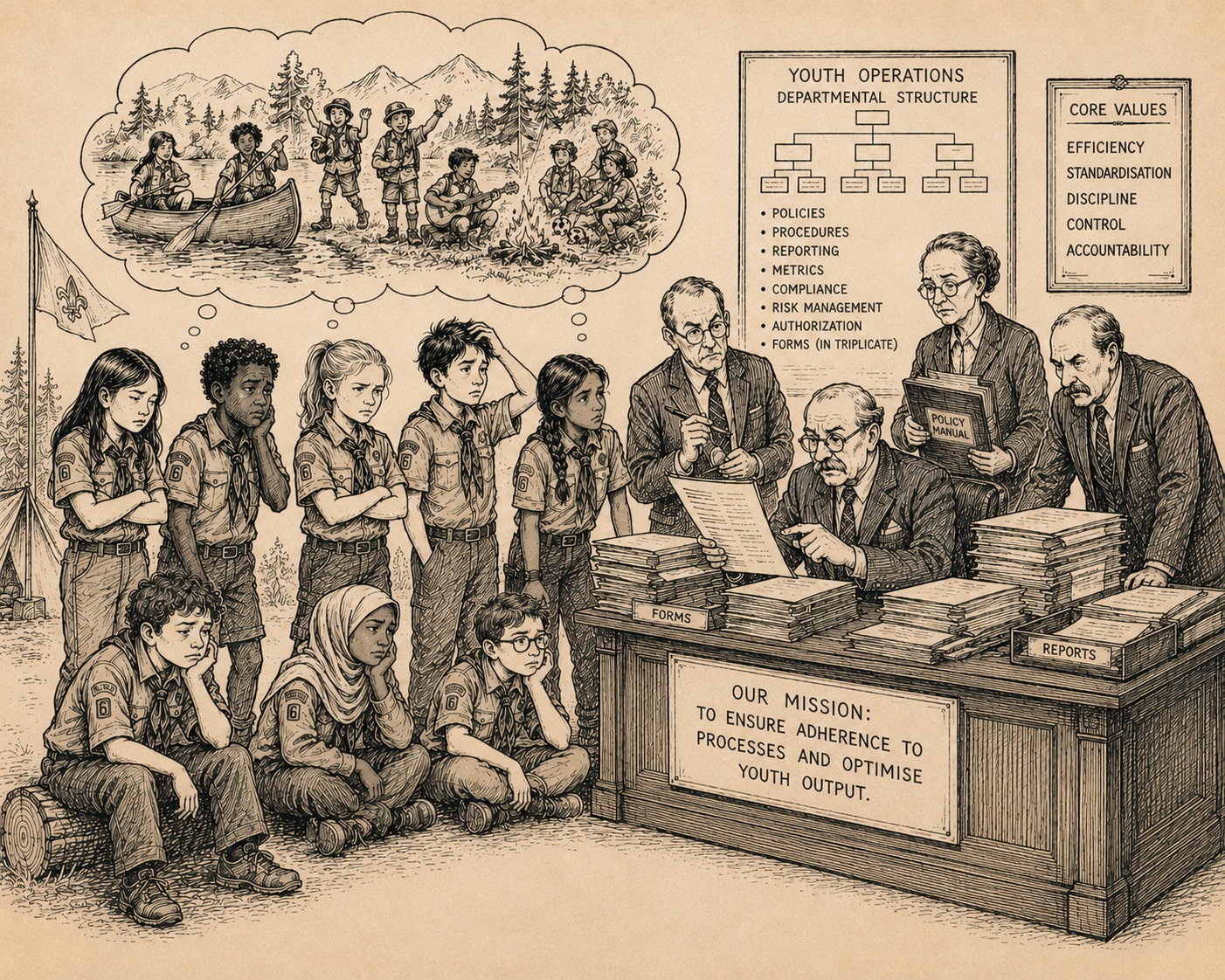
While BSA’s gold loopers1 still use “patrol method” when talking about the Scouts BSA program, they are using the words while abandoning the thing. Over the past century, gold loopers have mostly paved over the patrol method, filling that space with a corporate-bureaucracy simulation.
Before I go on, some level setting:
- BSA means the Boy Scouts of America, now rebranded as Scouting America.
- Scouts BSA is the program that I separately argue is optimized for middle schoolers.
- A troop is the community-level implementation of the Scouts BSA program, divided into patrols (teams) of roughly six to eight youth.
Scouts BSA’s focus has strayed far from youth leading self-governing patrols. Instead, the focus is on youth filling bureaucratic roles in an adult-authored, troop-level structure.
Series note: This is part one of a five-part series on how BSA’s gold loopers stole the patrol method, replacing it with a corporate-bureaucracy simulation. (The next articles will be published in a few days.)
Part 2: How the troop bureaucracy acquired a leadership theory
Part 3: How troop positions of responsibility steal patrol ownership
Part 4: Adults must stop hiding behind youth offices
Part 5: High schoolers are not troop staff
What the patrol owns
A patrol is more than a seating chart or a camping subunit. Again, it a small team of youth pursuing adventures they actually own.
BSA’s material describes a patrol as a small team where youth “learn skills together, share responsibilities and take on leadership roles”.2 World Scouting treats the “Scout Method”3 (its equivalent to “patrol method”) as an “essential and unique system for progressive self-education”4.
The patrol method is the timeless vision of Scouting’s founder, Robert Baden-Powell5:
The Patrol System is the one essential feature in which Scout training differs from that of all other organizations, and where the System is properly applied, it is absolutely bound to bring success. It cannot help itself!
Robert Baden-Powell, Aids to Scoutmastership, 1920 edition
It is also visible in BSA’s international peer organizations. The exact wording varies, but the center of gravity is familiar: patrols do the program, adults support. For example:
- Scouting Ireland says the troop program should be based around “Patrol based adventure and interaction”, that camp should be patrol based, and that Scouts should decide and organize their own program while working in patrols with adult support.6
- Scouts Australia says the patrol method “is integral to Scouting” and that “[v]irtually all Scouting activities occur in Patrols”.7
- The Scout Association in the United Kingdom says patrols “should be able to conduct their weekly programme on their own” with “adult[s] providing advice and guidance where needed”.8
The adult-support point is crucial. The patrol method is not youth isolation. In BSA terminology, the support comes through “adult association”9: adults close enough to guide and restrained enough not to own the result.
Scouts BSA’s own aims and methods point the same way. Leadership development is the only item that appears both as an aim and as a method.10 The patrol method develops leadership because it gives small teams the space for real decisions, real peer influence, and real consequences.
The patrol is the natural unit of action
No ordinary group of youth, handed a blank page and a trail map, would invent a corporate-bureaucracy simulation. They would invent a patrol. A leader would emerge. They would choose a destination, argue about what would make the trip worth doing, decide how bold they want to be, and come home with a story that belongs to them. They will stumble. That is part of the work. The patrol method gives them a real space in which to try.
That instinct sits near the beginning of Scouting. Baden-Powell wrote about the natural youth gang as raw material for Scouting11, and Ernest Thompson Seton likewise built from the tendency of boys to form groups1213.
Seton’s Woodcraft Indians program formalized that instinct into small bands, which were essentially patrols, with their own youth leaders and adult guides. (Some cross-band youth roles also existed, but they supported the patrols in rotating, episodic terms, such as during a campout. They were not a lasting bureaucracy that replaced small-team ownership.)14
This is much of the magic of the patrol method: personal development by harnessing a natural tendency of youth.
The patrol is the unit of action. It is where a Scout with a vision has to motivate actual peers, not simply occupy a titled office inside a bureaucratic structure devised by gold loopers.
The troop exists to support patrols
The patrol method means Scouts acting through small, self-directed teams. It does not mean youth filling offices in a troop-wide administrative chart.
The patrol method places the spotlight on patrol programs, not troop machinery. The troop supports the patrol method by being a container for patrols and a support structure around them. It is not supposed to be the operating unit that consumes patrol autonomy.
That said, the support of patrol autonomy still needs guardrails. A working troop has safety expectations, adult availability, transportation limits, calendar realities, facility reservations, and shared patrol commitments. However, those limits come from practical necessity, not obedience to a youth bureaucracy.
For example, the Patrol Leaders and Scoutmaster might agree that the troop will host a campout at Tyler State Park in October and that all patrols will share a Saturday evening meal. That facility and meal choice will bound the option space for patrol adventures. This bounding is a result of the decision of the patrols, and the remaining option space is expansive, allowing real patrol autonomy.
The simple test is this: Who gets to answer the patrol’s real questions? What adventure do we want to attempt? What would make this ours? What risks are we ready to manage? What help should we ask from adults? Which mistakes are ours to learn from? What traditions and habits do we want to build?
If those questions are answered by a troop bureaucracy before the patrol ever asks them, the patrol method has been stolen. And that is what the next article will help us see, the gradual theft of the patrol method and how it was replaced with a troop-level youth bureaucracy.
A council of patrol leaders is not troop staff
Some will point to Baden-Powell’s own council of Patrol Leaders as evidence of troop-level staffing. That council was not a troop staff meeting. It was Patrol Leaders guarding collective standards and settling inter-patrol questions while each patrol kept its own program.15 Authority flowed up, from the patrols, into this council from the patrols.
In the gold-loopers’ Scouts BSA corporate-bureaucracy simulation, the PLC inverts that authority. The modern PLC is where a Senior Patrol Leader chairs a standing committee whose stated purpose is to “review[…] and carr[y] out” the “troop’s plans”16 (emphasis added), and patrols then share in execution of PLC decisions alongside troop-level youth bureaucrats.
Baden-Powell’s PLC was patrols in congress. BSA’s PLC is operation of a corporate bureaucracy.
The semantic fate of “court of honor” tells the same story. In Baden-Powell’s formulation, the court of honor was a narrower form of the Patrol Leaders’ Council, intended to handle the more thorny issues, such as advancement and discipline. Advancement and discipline are now adult-managed, and that is appropriate.17 However, this name survives today as a ceremony to hand out patches.18 The disappearance of the original court of honor function is a symptom of a larger shift, which requires us to ask, “What meaningful responsibility remains for Patrol Leaders and patrols, especially beyond contributing to planning troop activities and supplying labor to a troop-level youth bureaucracy?”
Gold loopers stole the patrol method from youth
In the Scouts BSA program, we often see teams that cook together, camp together, make duty rosters, clean gear, and solve ordinary camp problems. We mistakenly believe this is evidence of the patrol method.
While those chores are necessary, they are not proof that the patrol method is being used. An adult can point to Scouts planning a menu and still miss the deeper thing: patrol self-government.
The patrol method depends on the patrol having meaningful control over its own life. The patrol should be able to form its identity, choose its adventure, make its arrangements, develop its habits, and live with the consequences.
The question is not whether a team is performing chores together. Essential to the patrol method is that the patrol owns its adventure.
Gold loopers stole the patrol method from BSA’s youth. Their design for the Scouts BSA program displaces the patrol method with a corporate-bureaucracy simulation19:
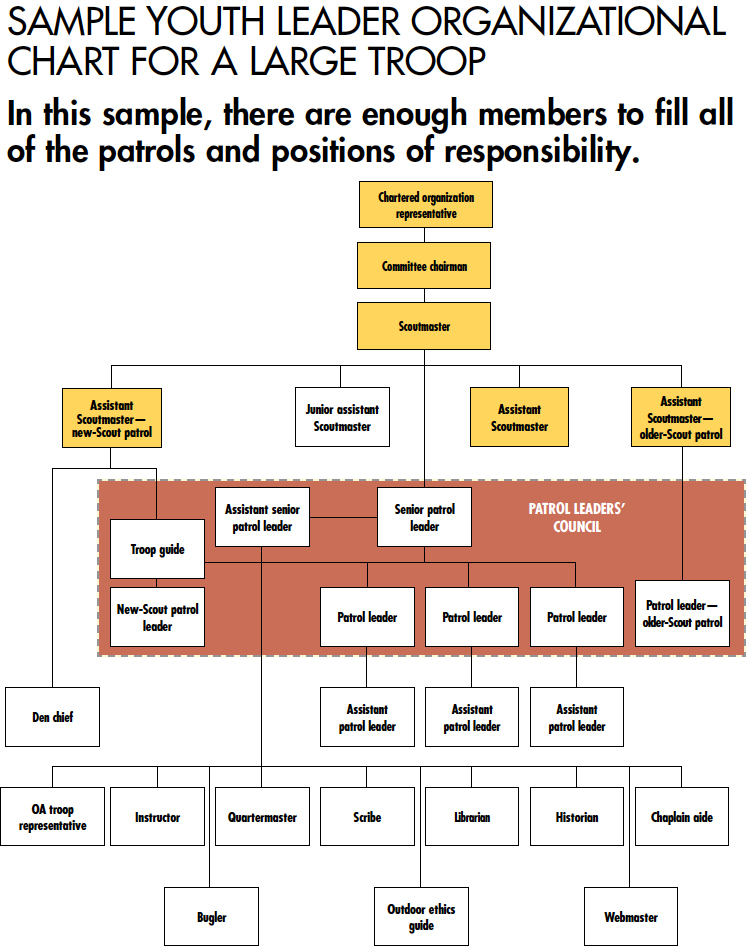
The teams are still there, and they are still called patrols. That is why Scouts BSA can appear to preserve patrol-method vocabulary even though the patrol’s crucial self-government opportunity is hollowed out.
The patrol flag remains. The patrol name remains. The patch remains. The chores remain. But gold loopers captured the patrols, moving the center of decision-making into a troop-level youth bureaucracy. They eviscerated the very thing Baden-Powell said the patrol method exists to do20:
The object of the Patrol System is mainly to give real responsibility to as many of the boys as possible with a view to developing their character. If the Scoutmaster gives his Patrol Leader real power, expects a great deal from him, and leaves him a free hand in carrying out his work, he will have done more for that boy’s character expansion than any amount of school-training could ever do.
Robert Baden-Powell’s reflection on the point of patrols in Aids to Scoutmastership, 1919 edition (emphasis added).
Leadership is influence, not administration
The Patrol Leader is supposed to be the leader of a largely self-governing patrol. That means this youth helps turn the patrol’s own will into action: drawing out a vision, persuading peers, coordinating preparation, settling friction, noticing who needs help, and keeping the patrol moving toward a shared purpose.
The Patrol Leader’s authority is peer-based leadership. This is trust, competence, and respect inside the patrol, not a titled slot inside a troop chain of command.
The Scouts BSA corporate-bureaucracy simulation changes the Patrol Leader’s work. Instead of leading a semi-autonomous patrol, the Patrol Leader becomes a transmission belt inside a troop machine: attend the PLC21, receive the troop plan, relay it to the patrol, supply labor for troop activities, report upward, and keep the patrol aligned with decisions made elsewhere.
Management keeps the institution running. Supervision keeps people in line. Administration keeps the files straight. These are what the corporate-bureaucracy simulation emphasizes.
Leadership is different: it is mutual influence around a shared vision.
That distinction is not some eccentric Scouting obsession. For example, Abraham Zaleznik‘s classic Harvard Business Review essay, “Managers and Leaders: Are They Different?”, contrasts the managerial concern for competence, control, and balancing groups with the imaginative, desire-driven work of leadership.22 Translate that into Scouts BSA, and the problem becomes obvious. The corporate-bureaucracy simulation gives adults the neat surface of management. The patrol method, which gold loopers paved over, gives youth the messy social space where leadership can actually form.
Administration does not become leadership because youth do it
Competence with the English language can help one be a better plumber, yet it would be absurd to claim that high-school English classes constitute training for plumbers. The same goes for administration, management, and supervision: they are not leadership. While training in those competencies can have value to leaders, they do not cause a person to become a leader.
A Scout can chair a meeting, direct traffic, enforce a schedule, assign tasks, or take minutes without practicing leadership. Those actions may be useful. They may even be necessary in a bureaucracy. But usefulness does not make them leadership.
Nor does foisting troop-level administrative duties on youth, especially in the sense of lasting, titled roles, cause leadership development. Those tasks can be useful. A particular older youth might even want some of them as an additional challenge. But just because a youth occupies that titled role does not transform it into leadership.
Also, there is nothing essential to Scouting that requires troop-level administration to sit at the center of any youth’s experience. What this mainly does is redirect youth attention out of the leadership-oriented patrol experience towards troop-level bureaucratic concerns, and it removes from patrols the decision points that make self-directed teams real.
Even worse, this troop-level youth bureaucracy stands in for adult mentoring, filtering it through a youth-run, supervisory chain of command.
None of this enhances BSA’s mission to develop leaders.
When adults snort, “But the youth lead the troop,” they have not answered the charge. They have repeated the problem. Instead of being provided leadership opportunity, the youth were presented with a bureaucratic scheme and told to operate it.
The burden of proof belongs on gold loopers
In BSA culture, those who doubt gold loopers are treated with disdain. This culture puts the burden of proof on supporters of the patrol method, requiring them to explain why they resist the corporate-bureaucracy simulation. That has it backwards, and the burden should run in the other direction.
Unlike the corporate-bureaucracy simulation, the patrol method has the founder’s warrant, remains recognizable in world Scouting, fits the natural way youth form small teams around shared adventures, and supports genuine leadership development. If gold loopers want to replace leadership development with a bureaucratic, troop-office scheme, the burden is on them to explain why their substitute is better.
Gold loopers’ usual answer is that troop offices and positions of responsibility teach leadership. But a bureaucratic office does not become leadership merely because gold loopers say so. Gold loopers have mostly kept the patrol-method vocabulary while training Scouts and adults to operate something else.
Adjacent programs show the shape
The irony is that the programs on either side of Scouts BSA preserve the small-team shape better than Scouts BSA itself.
Cub Scouts adapts the small-team pattern for younger children. Elementary-school children need adults much closer at hand, so the program is adult-led. But structurally, the den remains the small team, the Den Leader works directly with that team, and dens generally run independent programs.23
Venturing adapts the same spirit for high schoolers. Adult Advisors advise rather than command24, and the crew design allow officer duties and team structure to vary with the crew’s needs.25 High schoolers can mentor within their own ranks: planning age-level adventures, apprentice younger high schoolers into real responsibility, and build a peer culture appropriate to their age.
The next article follows the historical buildout of the Scouts BSA corporate-bureaucracy simulation, where gold loopers gradually built a troop-office machine, wired it into advancement, and then gave that machine a leadership-development theory.
Footnotes
- Gold loopers are people associated with BSA’s national organization, which also includes territories, wear yellow shoulder loops on their uniforms. Formally, this color is called “gold”. While shoulder loops date only to the uniform redesign from around 1980, I apply the term retroactively to BSA’s national-level volunteers and professionals of every era. (Council and district adults, not a subject of this series, wear silver loops.) ↩︎
- The Patrol, Troop Leader Resources, Boy Scouts of America. ↩︎
- Constitution of the World Organization of the Scout Movement, World Scout Bureau, August 2024 ed., Chap. I, Art. III, p. 7. The team system is a constitutional element of the Scout Method, agreed by all member organizations, including BSA. ↩︎
- Scout Method, World Scouting. ↩︎
- Robert Baden-Powell, Aids to Scoutmastership, 1944. p. 8. This is the World Brotherhood edition. Pagination is based on the digitized PDF copy with three columns. ↩︎
- How to Run Scouts, Scouting Ireland, pp. 21-22. ↩︎
- The Adventure Begins – Scout Method, Scouts Australia, Feb. 1, 2018. ↩︎
- Leadership, The Scout Association. ↩︎
- Scouts BSA: The Aims and Methods of Scouting, Boy Scouts of America. BSA lists “Association with Adults” as one of the methods of Scouts BSA. ↩︎
- Scouts BSA: The Aims and Methods of Scouting, Boy Scouts of America. BSA identifies leadership development as one of Scouting’s aims and also as one of the methods of Scouts BSA. ↩︎
- Robert Baden-Powell, Aids to Scoutmastership, 1944, p. 8. ↩︎
- David C. Scott, Ernest Thompson Seton: The Beginnings of Controversy, Scouting Milestones, curated by Colin Walker. ↩︎
- Ernest Thompson Seton, The Birch-Bark Roll, 6th Edition, 1906, p. 3. ↩︎
- Ernest Thompson Seton, The Book of Woodcraft, 1921, pp. 179-189. ↩︎
- Robert Baden-Powell, Aids to Scoutmastership, 1944, p. 8. ↩︎
- Patrol Leader’s Council Monthly Planning, Boy Scouts of America. ↩︎
- This evolution is appropriate. The Barriers to Abuse places discipline under the Adult Supervision section. While the Guide to Advancement, 2025, permits limited youth involvement in selected advancement mechanics, it is always at the discretion of adults. For example, section 4.2.1.2 The Scout Is Tested leads with “The Scout’s unit leader authorizes those who may test and pass the Scout on rank requirements”, then lists selected, titled youth roles the unit leader might consider authorizing for this duty. ↩︎
- Troop Courts of Honor, Boy Scouts of America. ↩︎
- Troop Structure, Boy Scouts of America. ↩︎
- Robert Baden-Powell, Aids to Scoutmastership, 1919, p. 47. ↩︎
- Despite the name, the Patrol Leaders’ Council (PLC) does not focus on Patrol Leaders or patrols. The focus is on the troop-level machinery. Patrol Leader’s Council Monthly Planning, the main documentation for how this committee works, leads with “The troop’s plans…” ↩︎
- Abraham Zaleznik, Managers and Leaders: Are They Different?, Harvard Business Review, Jan. 2004. Zaleznik contrasts the managerial concern for competence, control, and balance with the imaginative work of leadership. ↩︎
- How Cub Scouting is Organized, Boy Scouts of America. ↩︎
- Venturing Terminology, Boy Scouts of America. ↩︎
- Crew Officer Orientation: Facilitator’s Guide, Boy Scouts of America, 2025. ↩︎
Leave a Reply