
Troop-level positions of responsibility undermine the patrol method. They steal ownership from patrols by taking over decisions that should belong to small teams, and they teach Scouts that real responsibility sits outside the patrol.
Even the thin positions matter. They pull youth away from patrol programs and into troop-level duties that are often just make-work.
The roster changes where everyone looks for responsibility. Patrols lose autonomy when Scouts treat troop-level titles as the owners of concerns. This reduces the patrol to a labor pool for someone else’s plan, or a side project beneath the troop machine.
Gold loopers legitimize the swap by calling it leadership. That word hides a youth-staffed bureaucracy.
The first article in this series argued that gold loopers replaced patrol ownership with a youth-operated corporate-bureaucracy simulation. The second article traced how gold loopers built this simulation and gave it a leadership-development theory. This article looks inside the machinery: troop offices and advancement incentives that deflate the patrol method.
Series note: This is part three of a five-part series on how BSA’s gold loopers stole the patrol method, replacing it with a corporate-bureaucracy simulation. (The next articles will be published in a few days.)
Part 1: The patrol method is not a youth bureaucracy
Part 2: How the troop bureaucracy acquired a leadership theory
Part 4: Adults must stop hiding behind youth offices
Part 5: High schoolers are not troop staff
Troop offices pre-decide patrol work
Start with the main patrol-method question: “How will this patrol own its adventure?”
Troop positions of responsibility often answer that question before the patrol can ask it. Every formal troop-level office above the patrol is a decision already made, an opportunity thieved from the patrol.
A troop needs troop-level coordination. The first article put that work where it belongs: a congress of patrol leaders whose authority rises from the patrols.
Over the 20th century, gold loopers neutered patrols, moving authority from patrols to a corporate-bureaucracy simulation. This simulation became the troop operating model. The simulation was institutionalized in the 1972 Improved Scouting Program.
The 1981 Official Scoutmaster Handbook illustrated this simulation, describing troop-level bureaucratic positions as “natural”, naming the Senior Patrol Leader as the “big shot” who “directs Patrol Leaders, chairs the Patrol Leaders’ Council, and is in charge of the troop”, then treating other roles, like Quartermaster, Scribe, and more, as obvious troop-level answers whenever a related concern arises.1 Before the patrol could ask how to solve a problem, gold loopers had already bureaucratized the answer.
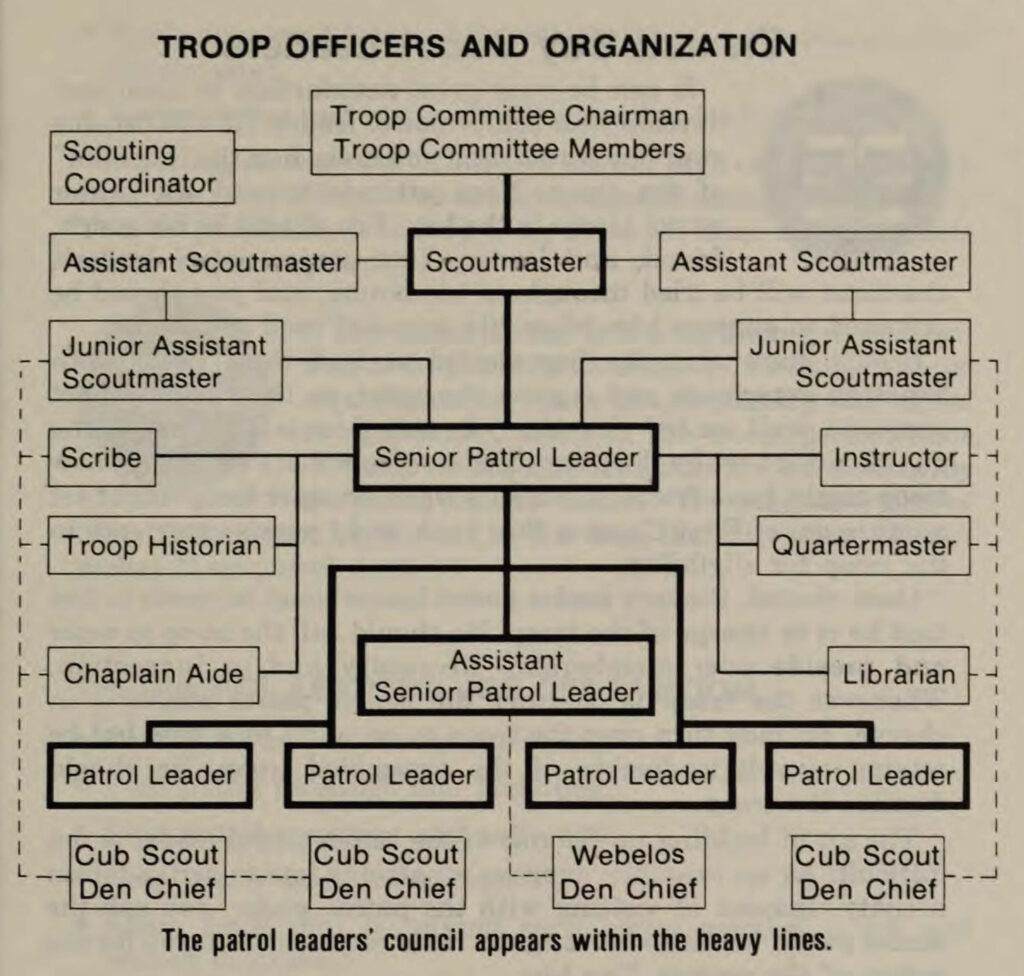
The organization chart takes sides. It tells adults and Scouts that the troop’s real operating logic is bureaucracy, not leadership, with ownership centered in troop offices instead of patrols.
The thefts are different
The corporate-bureaucracy simulation damages patrol ownership by changing who sets the program, where decisions are made, where Scouts look for direction, who participates in patrol life, how patrols learn, who provides adult association, and what receives status.
The Senior Patrol Leader role and Patrol Leaders’ Council apparatus pull program ownership out of patrols. Instructor and Troop Guide shift patrol learning into troop-level youth offices, displacing adult association. Other roles, like Quartermaster, Scribe, and Historian, are softer examples, but they still show patrol concerns yielding to bureaucratic youth titles on a troop roster.
This heavy administrative machinery was not part of Baden-Powell’s design for Scouting. Even early administrative youth roles in BSA, like Scribe, began emerging in the 1910s to help with the paperwork and logistical burdens of growing units. They were practical answers to administrative problems, not proof that patrol ownership had to give way to a youth-staffed office chart.
In other national programs, the framing tends to be healthier. Where analogues to BSA’s bureaucratic youth offices even exist, these are typically informal roles that are subordinate to patrol life, rotated among patrol members, and used to strengthen the patrol. They generally don’t build a troop-level bureaucracy that displaces patrol ownership. For example, Scouts Ireland describes analogous roles as “roles within the Patrol” that “reinforce a Scout’s sense of belonging to a Patrol”.3
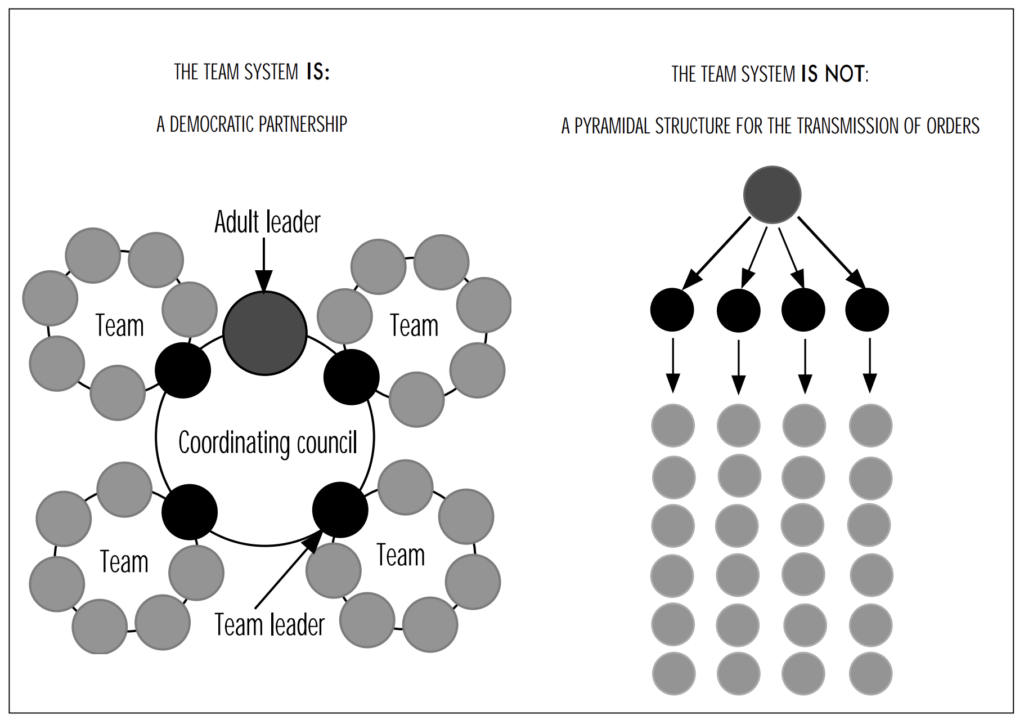
World Scouting frames the same principle structurally rather than anecdotally. Its team system is “not a pyramidal structure for the transmission of orders”.4 Instead, each small team provides its own leadership and “the young people organise their life as a group.”5 National programs follow suit. The Scout Association in the United Kingdom centers its youth structure on Patrol Leaders rather than a roster of troop offices, and treats the Patrol Leaders’ Council not as a governing body but as a way “to make sure that the adult leadership team hears from young people.”6 Scouts Australia, under a “Youth Leading, Adults Supporting” model, locates leadership in the patrol: “the role of the Patrol Leader is to lead their patrol”. Patrols rotate responsibility for troop-level activities, coordinated through an informal council of Patrol Leaders.7
Program determination moves upstairs
Every troop office is a stored decision, a governance choice pre-encoded before the patrol can make it.
The biggest stored decision is program ownership. The Senior Patrol Leader description makes the point plainly: the SPL chairs troop meetings, events, activities, the annual program planning conference, and Patrol Leaders’ Council meetings, while also appointing other troop youth leaders and assigning duties.8 But the stored decision is not just one youth title. It is the apparatus itself: troop program is made upstairs, and Patrol Leaders are trained to feed input into that machinery rather than lead independent patrol programs.
When answers sit in troop-level offices, troop-level action becomes the program, upending the patrol method. BSA affirms the primacy of troop-level programming: “[m]ost patrol activities take place in the context of troop activities” and may not “conflict with the troop calendar”.9
Patrols may still divide chores inside a troop event, but chores are not ownership. A patrol can decide who brings the stove yet have little meaningful say over its program.
The Patrol Leaders’ Council name misleads. It sounds like a congress of patrols. In fact, it is the “troop’s elected and duly appointed governing body”, a standing bureaucratic committee chaired by the SPL.10 A key part of the corporate-bureaucracy simulation, this committee reduces Patrol Leaders to middle management inside a troop machine. The patrol is still visible, but ownership of its destiny has been moved upstairs. The adult-leader guidebook reinforces the supremacy of troop-level planning, with Patrol Leaders not being pulled into annual event planning until the Scoutmaster and SPL have already drafted a plan.11
Removal of officers from patrols
Presumably to allow sufficient focus to operate the Scouts BSA bureaucratic machine, the SPL, Assistant SPL, and Troop Guide are not members of patrols.12 This is not just a distraction from patrol life. The corporate-bureaucracy simulation removes them from the patrol method.
Adult leaders have long debated how the SPL should relate to ordinary patrols because an SPL can overshadow the Patrol Leader of whichever patrol he joins. That gives away the problem. The office is treated as powerful enough that adults must manage its effect on ordinary patrol operations.13
Troop offices steal patrol-based learning and adult association
A patrol that owns its adventure also owns much of its learning. If its members cannot cook, tie a knot, or care for a new member, the problem belongs to the patrol. That isn’t always orderly, yet that is where patrol leadership starts.
In the patrol method, adult association is the backstop. Adults stand in relationship with patrols and mentor them toward greater capability.
The corporate-bureaucracy simulation pushes troop-level Instructor and Troop Guide roles into the space where patrol learning and adult association should happen.
BSA’s Instructor description assigns basic-Scout-skill instruction and merit-badge-counselor coordination to this youth bureaucrat.14 The Troop Guide partly overlaps Instructor, partly provides specialized training for Patrol Leaders.15 Neither of these roles comes close to the mentoring relationship of a caring adult.
Even with good intentions, the younger patrol’s leader becomes a person being managed rather than the person leading. Growth and team formation both suffer.16
Patrols should not be left ignorant. Adults should help them develop the habit of teaching, orienting, and strengthening themselves. The theft happens when the patrol learns to receive instruction from the troop’s youth bureaucracy instead of owning that development with appropriate adult partnership.
The roster makes patrols look upward
A youth troop office pulls bureaucracy into the youth program. It gives one youth a title over a concern that might otherwise belong to patrols, adults, or nobody at all. Scouts then spend less time influencing peers inside a patrol and more time staffing an adult-authored roster of bureaucratic offices. Patrol autonomy disappears by habit. Everyone keeps looking upward.
Quartermaster, Scribe, and Historian show the pattern. The Quartermaster is assigned records on patrol and troop equipment, equipment issuing, and related administrative chores.17 The Scribe is described as the troop’s secretary, attending PLC meetings, recording discussions, coordinating attendance, and maintaining advancement records.18 The Historian gathers photos and facts about troop activities, cares for troop trophies and souvenirs, and keeps information about former troop members.19
These offices steal differently. Gear has a real patrol dimension. Records may be necessary but mostly serve troop administration. Historian is a thin role that often exposes make-work. Together, they show how the troop-office roster changes the center of gravity. A patrol should care for its own gear habits, decide what records help its own members, and choose whether it wishes to memorialize its own adventures. The troop office teaches a different lesson: look outside the patrol for the real owner.
Scouters sometimes ask how to make these bureaucratic offices meaningful when the natural work is thin. The answers often become make-work: newsletters, spreadsheets, social media, attendance logs, binders, kits, closets, photo rosters, and reminders. Some of that work may have a patina of value. But this is bureaucracy. Calling it youth leadership shows how far the office roster has wandered from leadership or the patrol method.20
A theme of the youth-staffed, troop-level bureaucratic roles is how they take on troop-level responsibilities that adults should handle in the background. Adults can track shared equipment, keep a website updated, add to a troop scrapbook, and check attendance. That is just administrative work, not leadership. It should not compete with the Patrol Leader’s authority, remove a patrol decision, displace Scouts from patrol involvement, or tell Scouts that the real action is in a youth-staffed bureaucracy.
Advancement turns offices into currency
Advancement is part of Scouting. World Scouting includes personal progression as part of the Scout Method21, and peer organizations have awards and progression. For example, The Scout Association in the United Kingdom offers badges that Scouts can work toward22, and Scouts Australia describes its Achievement Pathways as a personal progression framework that recognizes personal development23.
Scouts BSA’s badge ladder turns troop offices into rank-advancement currency. The Star rank requires a Scout to serve four months in one or more listed positions of responsibility, or to carry out a Scoutmaster-approved “leadership project”. The Life rank does the same while raising the bar to six months. The Eagle Scout rank then eliminates the leadership-project option.24 The adult-leader guidebook makes the pressure explicit, pushing adult leaders to ensure offices are filled to support advancement.
This guidebook even warns that receiving a badge of office does not itself make a Scout a leader. That warning is right, but the advancement machinery provides different incentives.25
The patch becomes proof of tenure, and the Scoutmaster becomes the adult who must keep enough recognized offices available for the advancement machine.
Motivation to advance can be healthy. But with the immense cultural weight on BSA’s advancement, the credential needs to mean more. The badge should recognize real leadership, real adventure, and real growth, not tenure in an adult-authored, bureaucratic office.
Adventure and the patrol method have no need for a youth-staffed, troop-level Librarian role.26 The advancement system does.
Unit adults become innocent accomplices
Gold loopers call their troop organization chart “samples”, and technically they are. But the troop-structure page tells the Scoutmaster and Senior Patrol Leader to determine what positions the troop needs from that chart. Then it ties those positions to advancement and says all youth should have the opportunity to serve in them.27
Adults receive the chart as ordinary Scouting, then are told advancement depends on it. This is immense pressure to conform.
Unit-level adults are largely innocent, not understanding they were hoodwinked by gold loopers in the theft of patrol ownership. Unit-level leaders faithfully set up the very bureaucracy that displaced the patrol method: the patrol still gets a name, but the troop-position roster stripped the power and stripped adult partnership.
The machine is easier to preserve than patrol space
The patrol method leaves green space for personal growth. Bureaucracy paves over it.
That green space is where leadership development happens. A patrol that owns its own program works through ambition, uncertainty, and risk. It burns pancakes, forgets tent stakes, changes its mind, argues, recovers, and discovers that a patch does not make a leader. Peer trust does, and peers can ignore you if you have not earned it.
Gold loopers created a system with its own institutional interests: huge books, patches, advancement, training syllabi, and committees that defend their machinery. The patrol method, by contrast, asks adults to tolerate the messiness of patrol ownership.
Gold loopers are bureaucrats. While their corporate-bureaucracy simulation is orders of magnitude more complex than the patrol method, it is also more definable. It is easier for bureaucrats to standardize and defend, plus it generates ample make-work to justify even more gold-looper volunteer and professional roles. Once gold loopers built their complex machine, their incentive was to preserve it and blame unit volunteers for failures.
The next article turns from the youth offices to the adults standing behind them. Once adults believe that meaningful guidance must be routed through a troop-level org chart, they abandon one of Scouting’s core methods. By hiding behind this manufactured youth bureaucracy, adults sever direct mentorship of the patrol and abdicate their main duty, the adult-association method of Scouting.
Footnotes
- The Official Scoutmaster Handbook, Seventh Edition, Boy Scouts of America, 1981, pp. 49-54. ↩︎
- Ibid., p. 49. ↩︎
- The Scouters Manual, Scouts Ireland, 2010, p. 51. ↩︎
- Scouting: An Educational System, World Organization of the Scout Movement, 1998, p. 26. ↩︎
- The Scout Method, World Organization of the Scout Movement. ↩︎
- Run a Patrol Leaders’ Council, The Scout Association (UK). ↩︎
- Scouts Australia Official Program Resource, Patrol Leader role description (Aug 2021, v1.2); New Program Overview, Scouts Australia. ↩︎
- Senior Patrol Leader and Patrol Leader, Troop Leader Resources, Boy Scouts of America; Scouts BSA Troop Leader Guidebook, Volume 1, Boy Scouts of America, 2018, pp. 75-76. ↩︎
- Scouts BSA Troop Leader Guidebook, Volume 1, Boy Scouts of America, 2018, p. 20. ↩︎
- Patrol Leader’s (sic) Council Monthly Planning, Troop Leader Resources, Boy Scouts of America. ↩︎
- Scouts BSA Troop Leader Guidebook, Volume 1, Boy Scouts of America, 2018, pp. 33-37, 119-121. ↩︎
- Senior Patrol Leader Handbook, Boy Scouts of America, 2018, pp. 15, 140-141. ↩︎
- Ibid.; also as illustrative examples: With whom does the SPL eat?, Scouter.com, April 9, 2010, and SPL and ASPL do they belong to a Patrol?, Scouter.com, September 26, 2005. ↩︎
- Instructor,Troop Leader Resources, Boy Scouts of America. ↩︎
- Troop Guide, Troop Leader Resources, Boy Scouts of America. ↩︎
- (these are provided as illustrative examples, so this is not an exhaustive list; the depth of the argument is in the comments, sometimes not apparent by the thread titles indicated by the link names) Question About Troop Guide Position, Reddit r/BSA; using troop guides, Scouter.com; Why were Venture patrols done away with?, Scouter.com; Troop Guide in Mixed Age Patrols Without New Scout Patrol, Scouter.com; New Scout Patrol, Scouter.com; Question – Does your troop have a leadership patrol?, Reddit r/BSA. ↩︎
- Quartermaster, Troop Leader Resources, Boy Scouts of America; Scouts BSA Troop Leader Guidebook, Volume 1, Boy Scouts of America, 2018, pp. 73, 128-129. ↩︎
- Scribe, Troop Leader Resources, Boy Scouts of America; Troop Leader Guidebook, Volume 1, 2018, p. 73. ↩︎
- Historian, Troop Leader Resources, Boy Scouts of America; Scouts BSA Troop Leader Guidebook, Volume 1, Boy Scouts of America, 2018, p. 73. ↩︎
- (this is provided as an illustrative example) Making Positions of Responsibility Meaningful, Reddit r/BSA. ↩︎
- World Scout Youth Programme Policy and AIS, World Organization of the Scout Movement. ↩︎
- Scout Awards, The Scout Association. ↩︎
- Achievement Pathways, Scouts Australia Official Program Resource. ↩︎
- 2025 Scouts BSA Requirements, Boy Scouts of America, 2025, pp. 17-22. ↩︎
- Scouts BSA Troop Leader Guidebook, Volume 1, Boy Scouts of America, 2018, pp. 16, 19, 69, 96. ↩︎
- Librarian, Troop Leader Resources, Boy Scouts of America. ↩︎
- Troop Structure, Troop Leader Resources, Boy Scouts of America;Scouts BSA Troop Leader Guidebook, Volume 1, Boy Scouts of America, 2018, pp. 14-15, 133. ↩︎
Leave a Reply