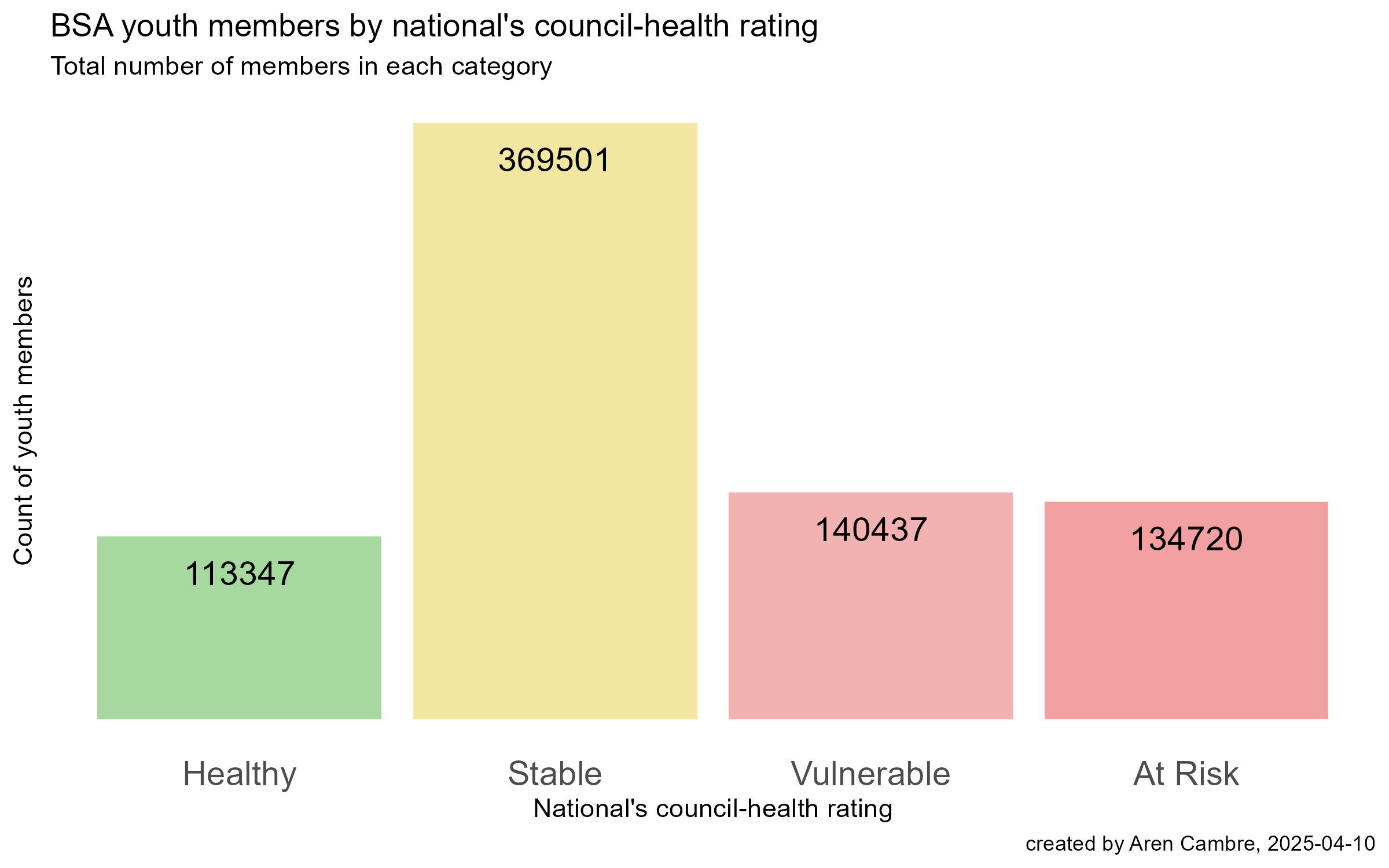
Without a bold vision, BSA is doomed within a decade. With Move Forward: Save Scouting, we can be relevant to society, improve programming, ditch unsound practices, and streamline the experience.

Only 15% of Scouts are in healthy BSA councils

Per BSA’s data, 85% of Scouts are in unhealthy councils.

It’s no surprise. We’ve shrunk 84% below our peak youth count, and we’re still shrinking.

This could change with the positive vision in Move Forward: Save Scouting. However, national prefers failure, so it has different priorities like adopting toxic brands, perpetuating cultural theft, appeasing misogynists, attacking adventure, avoiding authentic leadership development, clinging to a money-losing amusement park, worshiping itself, sustaining a good-old-boy career system, scamming Eagle Scouts, infantilizing high schoolers, and attacking those who share feedback.

How councils are ranked

Using their operating margins (short-term and long-term), endowments (scale and growth), and liquidity (cash on hand), BSA classifies councils as:

  • Healthy
  • Stable
  • Vulnerable
  • At Risk

Maps

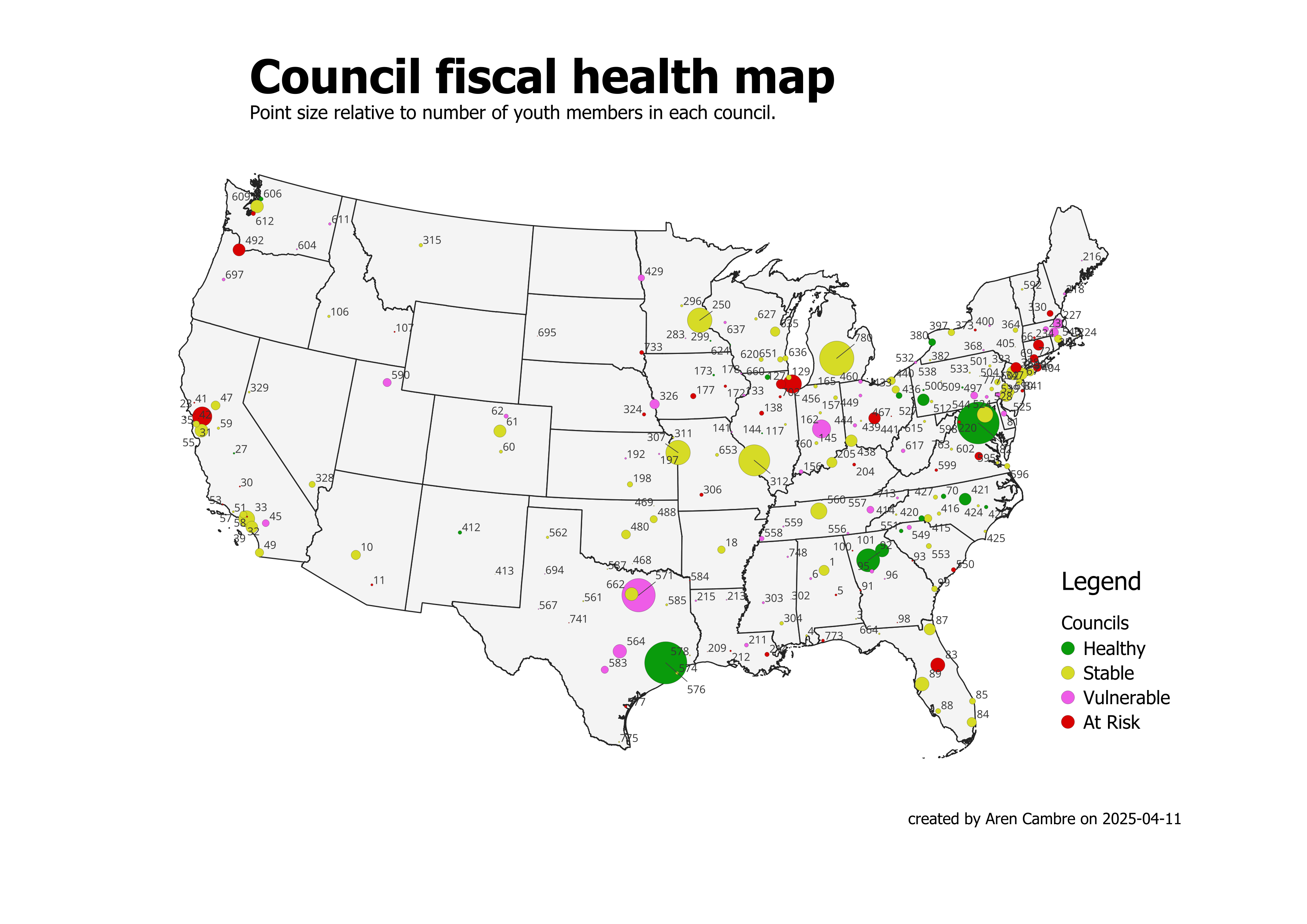
Here’s a static map with points scaled by counts of youth members1 (scroll down for a crosswalk of council numbers to names):
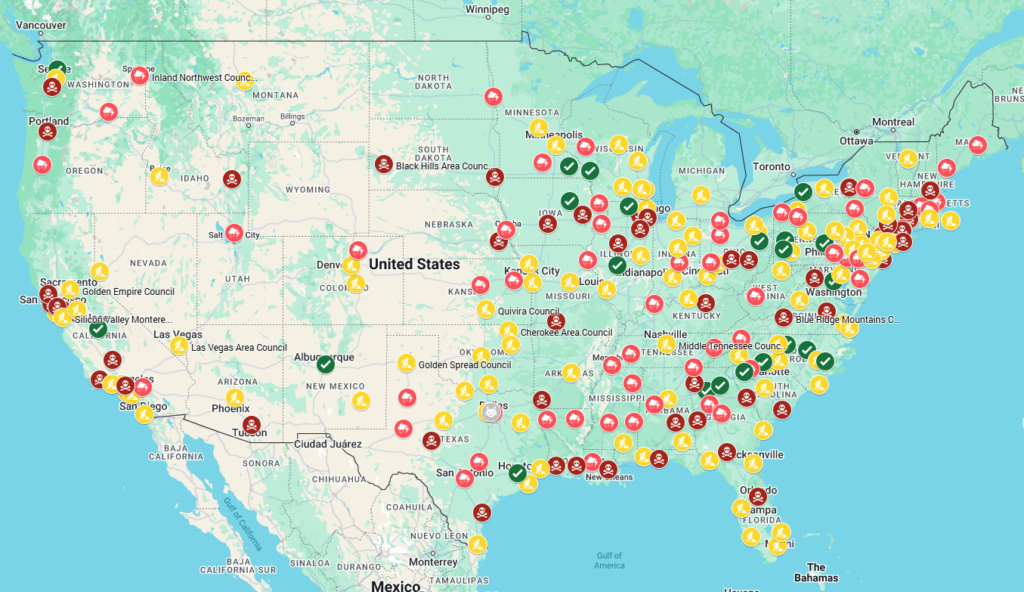
The same data in Google Maps:
We need fewer councils

BSA has 236 councils. This means 236 Scout Executives, bureaucracies, corporations, boards of directors, support infrastructures, and more.

While Girl Scouts USA is not a benchmark, it is a valid comparison. Currently, GSUSA serves its 1.1 million members with 111 councils2, with a mean of just under 10,000 scouts per council.

With 764,651 members across BSA, each of BSA’s 236 councils, on average, serves about 3,200 Scouts.

Compared to GSUSA, BSA has 112% more councils to serve 30% fewer youth. This means lower efficiency and a higher burden of bureaucracy and red tape per Scout. It also means many councils lack the critical mass to have an effective community presence, which hampers fundraising, recognition, and marketing. It’s hard to imagine how this helps deliver Scouting.

Even if we managed to reduce our council count by half, we’d still have 36% fewer Scouts per council than GSUSA.

Underlying data

The underlying data:

  1. Count from April 2025. ↩︎
  2. Girl Scouts: Facts and Figures, Girl Scouts USA. ↩︎

Comments

7 responses to “Only 15% of Scouts are in healthy BSA councils”

  1. Brandon Lewis Avatar
    Brandon Lewis

    This says there are 174 councils, is this correct? I thought there were 240 councils.

    Thanks

    1. Aren Cambre Avatar
      Aren Cambre

      Thank you! The correct number is 236. That is now updated. Sorry for my error.

  2. LH Avatar
    LH

    What’s your source for ranking the councils?

    1. Aren Cambre Avatar
      Aren Cambre

      This is a ranking exercise that national performed. I am just conveying the ranking. This is not my analysis.

  3. Vic Reynauld Avatar
    Vic Reynauld

    I’m not sure I’d consider my old council (Colonial Virginia) to be “stable”.

    In the mid/late 2010’s, CVC got over extended financially and almost needed to file bankruptcy. This caused them to lose all of their real estate including their original office building and Scout Shop AND their scouting reservation, which was foreclosed and auctioned off. It was years before they could open a new office building and scout shop and, to this day, they have to go out-of-council for long term camps.

    CVC in still such a mess that they’re in negotiations to merge with the Heart of Virginia Council by Summer of 2026 and have the two become a brand new mega-Council. A “council” that will extend through a massive portion of the entire state: As far east as the mouth of the Chesapeake Bay in Hampton, as far west as Buckingham County (just south of the City of Charlottesville), as far South as the North Carolina border, and as far Northeast as Westmoreland County (on the Potomac River border with Maryland).

    That seems insane to me. I don’t fathom why they don’t merge with the nearby Tidewater Council and unify the region in to one Hampton Roads council. Scouts in Hampton, Newport News, Suffolk and Franklin have a lot more in common with Norfolk, Chesapeake, and Virginia Beach than they do Richmond, Petersburg, Tappahannock, or the counties of the extreme Northern Neck.

    This merger will almost also certainly mean *yet another* merger of the OA lodges. I was there when the Peninsula Council’s Kecoughtan Lodge and the Old Dominion Council’s Chanco Lodge had to merge following the Council merger that created the Colonial Virginia Council and it wasn’t pretty. Members of both lodges felt slighted. Reading statements made by council and OA officials on the matter, it looks like the 30th Anniversary of the Wahunsenakah Lodge for the CVC will also be it’s final hurrah and they’re likely going to simply be absorbed into the HOVC’s much older Nawakwa Lodge. (Aside: This is another case for why the OA needs to be torn down and redesigned.)

    The irony here is this council reduction is exactly what you think needs to happen (and I agree) but it’s being done in the stupidest way possible, which is also par for the course with the modern day BSA leadership.

    1. Vic Reynauld Avatar
      Vic Reynauld

      Update: I just found out that the merger plans NARROWLY failed late last month (32 for, 30 against, 2 abstaining) so that’s tabled for now, though they’re still in discussions to make it happen “at a later date”.

    2. Aren Cambre Avatar
      Aren Cambre

      A note on OA: It needs to just be retired.

      Everything that OA does that is valuable, all are things that are essentially stolen from the programs. All of OA’s social activities and training programs should be liberated to Venturing.

      Also, OA’s camp service is just a council operation. Why? Because OA lodges are nothing more than a council operation. Councils don’t need the OA brand to do camp service. That can continue without the OA brand.

      The rest of OA is toxic and should be stopped.

      Any problem OA is felt to solve, that is an opportunity to improve the programs. In other words, we must stop seeing OA as a tool to patch over program faults. We must instead fix the program faults.

Leave a Reply to LH Cancel reply

Your email address will not be published. Required fields are marked *

Discover more from Untended Fire

Subscribe now to keep reading and get access to the full archive.

Continue reading